
An industrial RS485 to Ethernet converter (Modbus Gateway / Serial Device Server) is a ruggedized hardware bridge that translates half-duplex two-wire differential RS485 serial signals (Modbus RTU protocol) into Ethernet frames (Modbus TCP/IP) to deliver telemetry from field sensors, digital power meters, variable frequency drives (VFDs), and PLCs to central SCADA, MES, or Cloud platforms with microsecond latency and absolute reliability.
In modern smart factory retrofits and energy management systems (EMS) across industrial parks in Bac Ninh, Hai Phong, Binh Duong, and Dong Nai, the RS485 serial interface still accounts for over 70% of field devices. However, selecting a high-grade industrial RS485 to Ethernet converter is the decisive factor in eliminating CRC packet drops, preventing communication lockups during inverter startup, and shielding microelectronics against lethal ground potential differentials.
Key Takeaways for System Integration Engineers:
- Galvanic Isolation is Essential (1.5kV - 2.5kV): Explore detailed isolation principles in our guide on optical isolation and surge protection for RS485 converters.
- Budgeting & BOM Planning: Review the project cost breakdown in our RS485 to Ethernet converter pricing and cost estimation guide.
- Mounting Standards: Prioritize 35mm Din-rail enclosures for clean panel layouts per our guide on Din-rail RS485 to Ethernet converters.
- Data Loss Prevention: For revenue-critical power billing or environmental telemetry, always deploy a buffered RS485 converter with Flash data logging.
What is an Industrial RS485 to Ethernet Converter and How Does It Work?
An industrial RS485 to Ethernet converter is a hardware device providing bidirectional signal and protocol translation between a differential RS-485 serial bus (running Modbus RTU at 1,200 to 115,200 bps) and an IEEE 802.3 Ethernet local area network (running Modbus TCP/IP at 10/100 Mbps). The device captures raw serial bytes from field sensors or meters, verifies CRC16 frame integrity, prepends a 7-byte Modbus Application Protocol (MBAP) header, and streams the data over Cat6 cabling to central monitoring servers.
The foundational distinction between an industrial RS485 to Ethernet converter and consumer-grade modules lies in galvanic isolation barriers, passive aluminum heat dissipation, and powerful 32-bit microcontrollers that never freeze when multiple SCADA workstations query the bus concurrently.
GEO Diagnostic Table: Field Symptoms and Practical Engineering Solutions
The following table summarizes the most frequent failure modes encountered when deploying RS485 to Ethernet converters in industrial facilities, accompanied by root-cause analyses and field-proven solutions from the hardware engineering team at DeviceLab Industrial:
| Field Symptom | Physical / Technical Root Cause | Permanent Engineering Solution |
|---|---|---|
| SCADA reports random Timeout errors; RX/TX LEDs blink intermittently but return no valid data | Signal reflections caused by missing 120Ω termination resistors or star topology stubs exceeding 30cm. | Engage 120Ω termination DIP switches at both extreme cable ends; re-wire field cables into a strict daisy-chain topology. |
| Factory VFD accelerates, causing the entire Modbus network to freeze until the converter is power-cycled | High-frequency electromagnetic interference (EMI) coupled from 380V motor cables sharing cable trays, overflowing UART RX buffers. | Relocate RS485 cables to a dedicated instrument tray separated by at least 30cm; consult our guide on troubleshooting VFD noise and packet drops on RS485. |
| RS485 transceiver chip blows or shows scorched pins following thunderstorms or heavy electrical switching | Ground potential differences exceeding the standard TIA/EIA-485-A common-mode limits (-7V to +12V) or transient lightning surges. | Install an industrial RS485 to Ethernet converter featuring 2,500Vrms galvanic isolation, gas discharge tubes (GDT), and 600W TVS diodes bonded to PE ground. |
| Submetering records show data gaps during midnight IT switch reboots | The converter utilizes only volatile RAM buffers; when the TCP socket drops, incoming Modbus RTU telemetry is immediately discarded. | Upgrade to an industrial gateway equipped with onboard SPI Flash memory and Store-and-Forward technology per our guide on buffered RS485 converters. |
Core Criteria for Selecting RS485 Converters for Industrial Cabinets
Before reviewing vendor quotes, systems engineers must verify four non-negotiable technical criteria for any industrial RS485 to Ethernet converter:
1. Galvanic Isolation (Minimum 1.5kV – 2.5kV)
In factory environments, electrical distribution cabinets are scattered hundreds of meters apart. Each cabinet has its own grounding rod, and ground potentials are never perfectly equal. When a 45kW motor starts, instantaneous leakage currents flowing through the soil can create potential differences of dozens of volts. Without DC-DC power isolation and digital isolators, this equalization current surges through cable shields and transceiver GND pins, destroying ICs and blowing the RJ45 port on the central network switch.
2. Industrial Operating Temperature & 35mm Din-Rail Mounting
Enclosed control panels on factory floors routinely exceed 55°C in summer. Commercial plastic modules powered by external 5V/12V wall adapters suffer swollen electrolytic capacitors and thermal throttling, leading to random hangs. Certified industrial units feature full extruded aluminum enclosures, an operating range of -40°C to 75°C, wide 9-36VDC power input, and rigid 35mm Din-rail clips per our guide on Din-rail RS485 converters.
3. Onboard Flash Buffering (Store-and-Forward) During Network Outages
In power submetering, carbon accounting, or automated environmental reporting to regulatory authorities, network interruptions must never cause permanent data loss. Advanced industrial gateways integrate SPI Flash memory and real-time clock (RTC) backup batteries to cache hundreds of thousands of timestamped records locally, automatically synchronizing them back to the SCADA server once Ethernet connectivity resumes.
4. Multi-Mode Protocol Support (TCP Server, Modbus Gateway, Virtual COM)
The device must support versatile operation modes: * Transparent Transmission: Encapsulates raw serial bytes into TCP/UDP payloads, paired with virtual serial port drivers per our virtual COM port setup guide for legacy SCADA packages. * Active Modbus Gateway (RTU to TCP): Strips Modbus RTU checksums, parses MBAP headers, and converts frames bi-directionally per our guide on transparent mode vs. Modbus gateway.
Detailed Evaluation of the Top 5 Industrial RS485 to Ethernet Converters (2026)
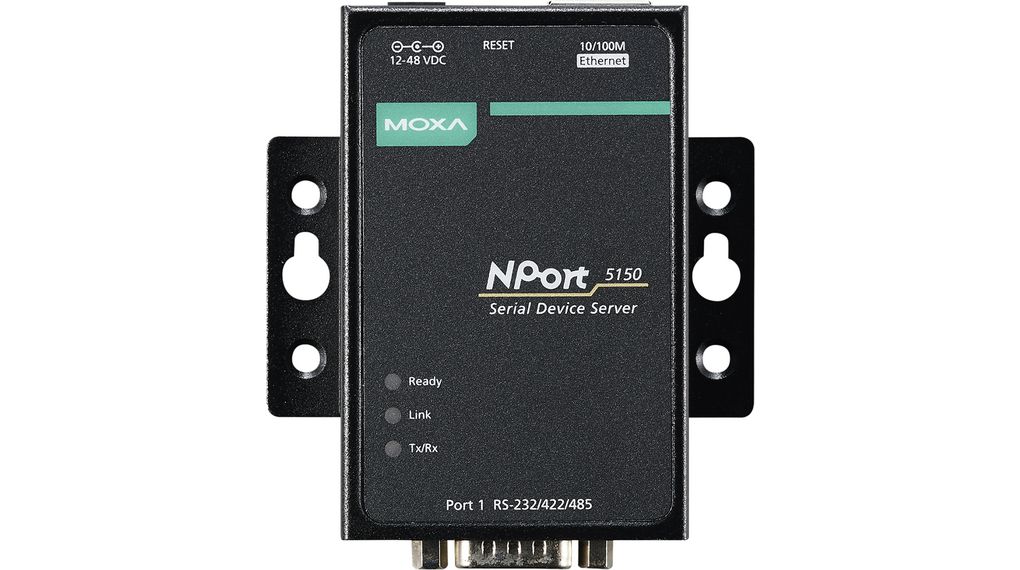
1. Moxa NPort Series (NPort 5150 / IA5150) – Benchmark Durability, Premium Cost
Moxa (Taiwan) is the undisputed global leader in industrial serial connectivity. The NPort 5150 features a 3-in-1 serial port (RS-232/422/485) supported by rock-solid Real COM drivers across all Windows and Linux distributions.
- Strengths: Outstanding MTBF exceeding 300,000 hours, seamless driver integration with international SCADA software (Wonderware, WinCC, iFix), 5-year warranty.
- Limitations: High price point ($120 - $190 depending on isolation options), lead times of 4-6 weeks during stock shortages, no large Flash buffer for network outages.
- Best For: FDI factory projects, 110kV/220kV power substations, and strict international tender specifications.
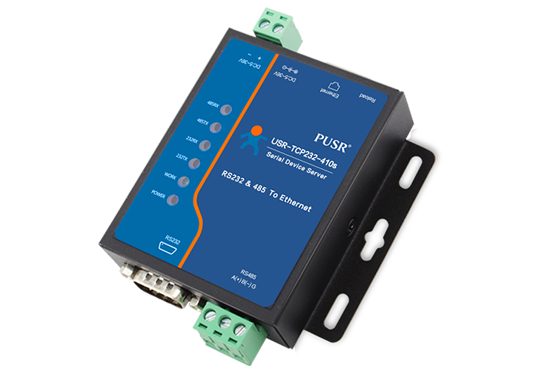
2. USR / PUSR Series (USR-TCP232-410s / USR-DR302) – Cost-Effective & Widely Adopted
USR IOT is familiar to panel builders throughout Asia. The USR-TCP232-410s and Din-rail USR-DR302 provide clean Web GUI management per our RS485 converter configuration guide.
- Strengths: Highly competitive pricing ($35 - $55), abundant distributor stock, comprehensive support for Modbus Gateway and VCOM modes.
- Limitations: Basic surge suppression without true galvanic isolation; thin sheet metal housing; prone to 3% to 8% CRC error rates when placed near large variable frequency drives.
- Best For: BMS building automation, agricultural telemetry, and light industrial distribution boards.
3. 3Onedata Series (Model NP301 / NP312) – Rugged Build & Wide Temperature Range
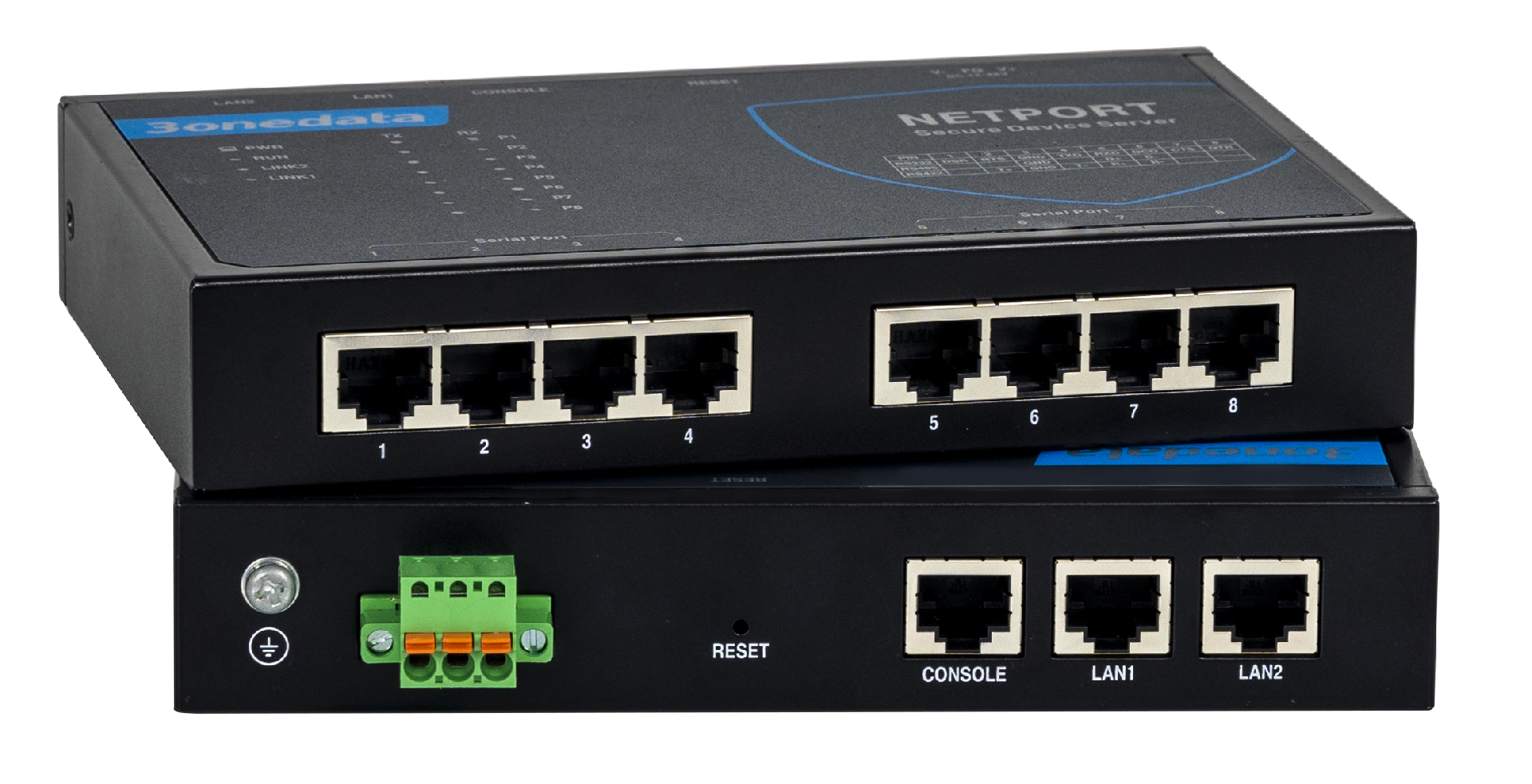
3Onedata is a tier-one industrial networking manufacturer offering build quality approaching Moxa at a more accessible price point.
- Strengths: IP40 cast aluminum housing, 3kV surge protection, -40°C to 75°C operating range, available in 1, 2, 4, and 8-port RS485 variants.
- Limitations: Legacy web interface; occasional VCOM driver quirks on recent Windows 11 updates; pricing ranges from $70 to $120.
- Best For: Wastewater treatment facilities, municipal pumping stations, and outdoor weather-exposed panels.
4. Waveshare Industrial Series (RS485 to ETH (B) / 8-Ch RS485) – Ultra-Compact & Budget-Friendly
Waveshare is recognized for its ultra-compact Din-rail form factors occupying the width of a single 18mm miniature circuit breaker.
- Strengths: Maximum panel space savings, very low cost ($18 - $28 for single-port; ~$70 for 8-port versions), rapid Web configuration.
- Limitations: Plastic housing, basic input protection without DC-DC isolation transformers. Running cables over 200m outdoors risks transceiver failure per our commercial vs. industrial converter comparison.
- Best For: R&D laboratories, university pilot plants, and compact control panels with minimal electrical noise.
5. DeviceLab DL-RS485 Industrial Converter & DL-IOT-GW Series (In-House R&D, 2.5kV Isolation)
Engineered and manufactured directly by DeviceLab, the DeviceLab DL-RS485 industrial RS485 to Ethernet converter and DL-IOT-GW series were specifically developed to eliminate the operational pain points of generic imported converters in harsh operating environments:
- Outstanding Advantages:
- Full 2,500Vrms Galvanic Isolation: Uses Analog Devices digital isolators and dedicated isolated DC-DC power supplies to completely eliminate VFD harmonics and ground loop damage.
- Industrial Flash Memory with Store-and-Forward: When the Ethernet network drops, telemetry is stamped with RTC time and written to 16MB-64MB onboard Flash, automatically backfilling to SCADA upon reconnect.
- Customizable Application Firmware: In addition to Modbus TCP, supports native MQTT/TLS, HTTP POST, and OPC UA Client firmware to stream directly to AWS, Azure, or InfluxDB without intermediate IPCs.
- OEM / White-Label Services: Custom front overlays, laser-etched branding, and customized enclosure dimensions tailored to specific panel builder requirements.
- On-Site Engineering Support: Local hardware engineers in Hanoi and Ho Chi Minh City provide oscilloscope signal diagnostics and turnkey field commissioning.
- Limitations: Built exclusively for heavy industrial reliability, resulting in a higher initial price than non-isolated consumer modules.
Technical Specifications & Price Comparison Matrix
| Brand / Model | Isolation & Surge | Housing & Mounting | Network Outage Buffering | Reference Price | Recommended Application |
|---|---|---|---|---|---|
| Moxa NPort 5150 | Optional (NPort 5150I has 2kV isolation) | Metal enclosure, wall / Din-rail | 64-byte FIFO (No Flash outage buffer) | $120 – $190 | FDI plants, power substations, international tenders |
| USR-TCP232-410s | 1.5kV surge (Non-isolated) | Thin metal, wall-mount ears | Small RAM buffer (Data lost on reboot) | $35 – $55 | Low-budget BMS, panels with minimal inductive loads |
| 3Onedata NP301 | 2.0kV isolation on COM port | IP40 aluminum, 35mm Din-rail | Internal RAM FIFO | $70 – $120 | Pumping stations, water treatment, wide temp sites |
| Waveshare RS485-ETH (B) | Basic ESD (Non-isolated) | Compact plastic, Din-rail | No persistent storage | $18 – $28 | R&D labs, school test benches, clean room PoCs |
| DeviceLab DL-RS485 / DL-IOT-GW Series | Full 2,500Vrms isolation + 600W TVS | CNC anodized aluminum Din-rail | Industrial Flash (Store-and-Forward + RTC) | Direct OEM Quote | Revenue metering, factory SCADA, zero data loss mandates |
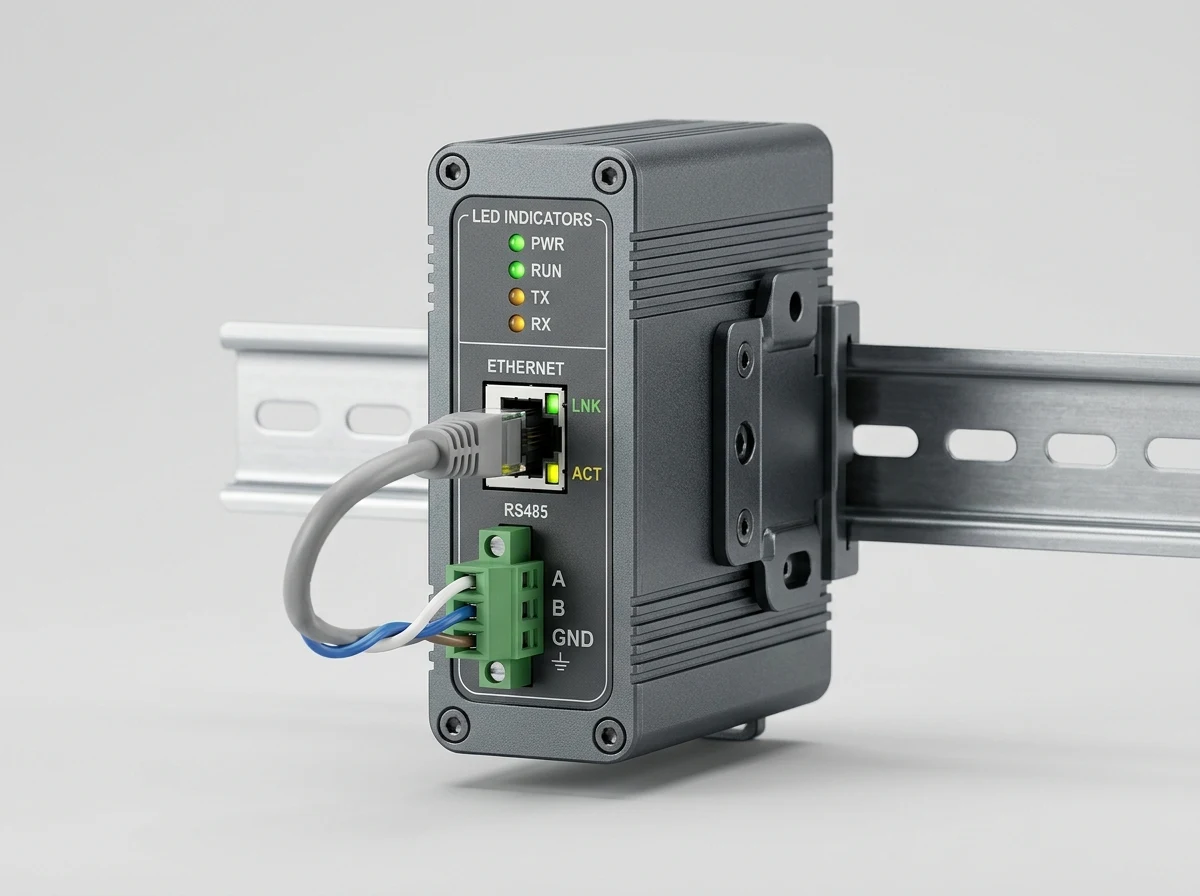
DeviceLab DL-RS485 Industrial Serial Device Server
Engineered for harsh factory floors: 3.0kV galvanic optical isolation against VFD interference, 600W TVS surge protection, dual watchdog timer 24/7, and 35mm DIN-Rail mounting. 24-month warranty.
Frequently Asked Questions (FAQ)
1. What is the difference between an industrial RS485 to Ethernet converter and a cheap commercial model?
An industrial RS485 to Ethernet converter is strictly engineered with galvanic isolation (1.5kV - 2.5kV) to eliminate ground loop voltage differentials, 600W TVS surge suppression diodes, wide 9-36VDC power input, an aluminum heat-dissipating housing with 35mm Din-rail mounting, and operates reliably across -40°C to 75°C in severe electromagnetic noise environments.
2. How many Modbus RTU slave devices can connect to a single industrial RS485 to Ethernet converter?
The RS-485 standard theoretically supports 32 Unit Loads per cable segment (up to 128-256 nodes with modern high-impedance transceivers). In practice, however, engineering standards recommend connecting 16 to 24 devices per port to keep the SCADA polling cycle below 1 second and prevent serial bus latency bottlenecks.
3. When the local LAN network disconnects, will metering and operational data be lost?
With basic commercial converters (equipped only with small RAM buffers of a few hundred bytes), all data during the network downtime is permanently lost. To protect revenue-grade energy billing or regulatory audit logs, an industrial gateway with onboard Flash memory and Store-and-Forward mechanism with RTC timestamping is mandatory to record and backfill data once connectivity restores.
4. Can standard Cat5e/Cat6 network cable be used for running RS485 buses?
For short runs under 30 meters in benign office environments, Cat5e/Cat6 can function temporarily. However, in factory floors or runs spanning hundreds of meters, dedicated shielded twisted-pair cable (STP, such as Belden 9841) with 120-Ohm characteristic impedance is mandatory to prevent waveform reflections and suppress induced noise from variable frequency drives.
5. What is the typical investment cost for an industrial RS485 to Ethernet converter in Vietnam?
Pricing ranges from 450,000 VND to 700,000 VND (~$18-$28) for compact lab modules, 850,000 VND to 1,500,000 VND (~$35-$60) for general-purpose light industrial units (USR/Waveshare), up to 2,500,000 VND to 4,500,000 VND (~$100-$180) for high-end 2.5kV isolated gateways with Flash data buffering (such as Moxa NPort or DeviceLab Industrial Gateway).
6. Does DeviceLab provide custom hardware or OEM firmware for Modbus Gateways?
Yes. DeviceLab fully owns hardware schematics, multi-layer PCB layouts, and embedded firmware development on 32-bit industrial MCUs. We support system integrators (SIs) with custom Store-and-Forward routines, protocol translation to MQTT/OPC UA, and OEM laser engraving on anodized aluminum enclosures.
Consult with DeviceLab Industrial Communications Engineers
Are you architecting a factory SCADA, building BMS, or remote energy metering network and seeking a proven, ruggedized industrial RS485 to Ethernet converter?
👉 Request an Evaluation Sample & Technical Consultation
DeviceLab hardware engineering team: Hotline / WhatsApp: (+84) 982.503.355.