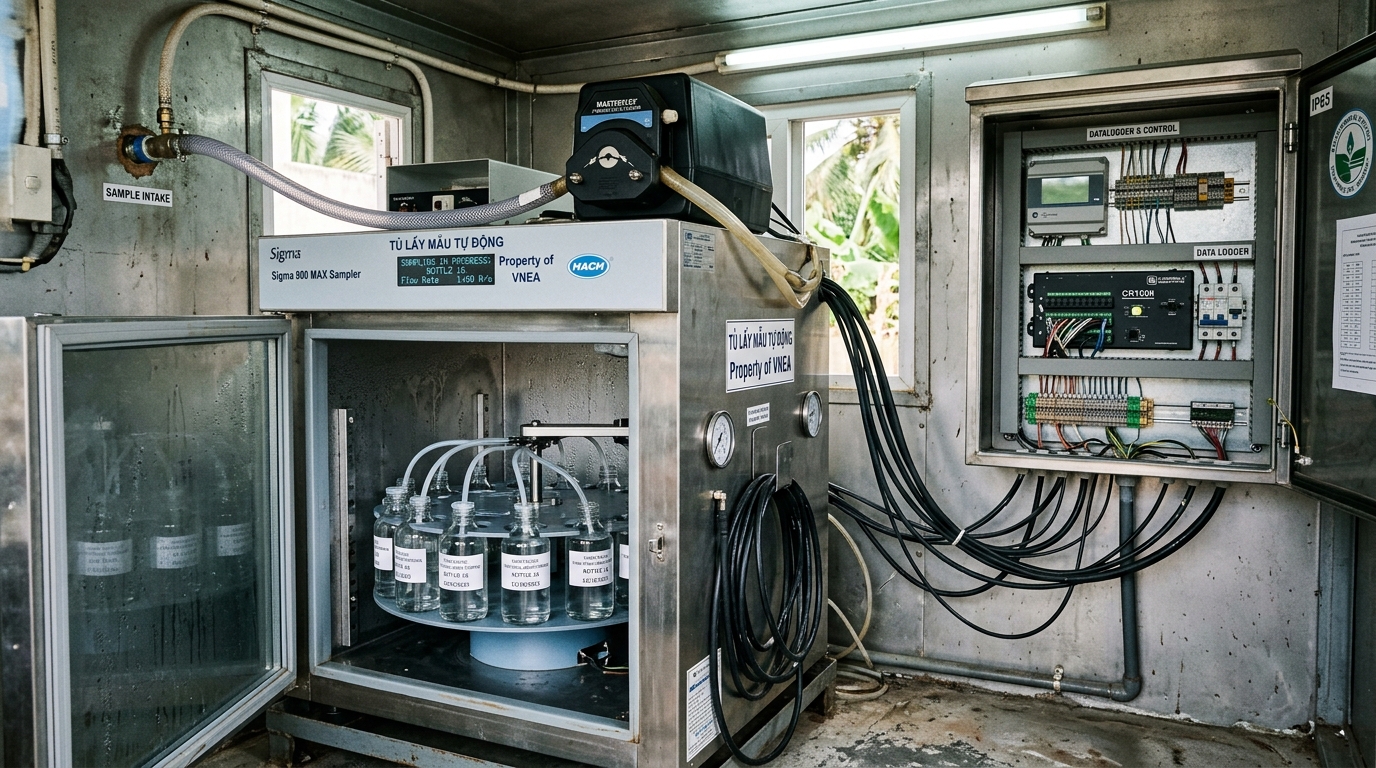
Integrating and controlling automatic refrigerated water samplers via industrial dataloggers is a mandatory technical requirement under Circular 10/2021/TT-BTNMT for all automated wastewater monitoring stations. The automatic water sampler acts as the definitive legal proof repository: when online sensors detect an effluent parameter exceeding environmental discharge standards, or when receiving an on-demand remote sampling command from the Department of Natural Resources and Environment (DONRE), the datalogger must immediately trigger the sampler to draw, bottle, and refrigerate wastewater at $4^circ C pm 2^circ C$ for certified laboratory verification.
This technical guide is part of DeviceLab's comprehensive engineering handbook on environmental monitoring datalogger compliant with Circular 10.
In industrial parks across Binh Duong, Dong Nai, Long An, and Bac Ninh, many environmental station engineers struggle during DONRE acceptance inspections because their automatic samplers fail to trigger reliably. Common issues include incorrect pulse durations that jam peristaltic pump sequences, floating digital inputs that trigger phantom samplings, or lack of remote triggering capabilities from environmental authorities. This technical guide delivers an in-depth breakdown of mandatory triggering scenarios, hardware pinout schematics, and zero-defect integration using the DeviceLab DL-ENV10 Datalogger.
Key Technical Requirements for Automatic Water Samplers (Circular 10/2021/TT-BTNMT):
- Bottle Capacity: Minimum 24 individual bottles (minimum 1,000ml per bottle) or composite container with automated bottle distributor arm.
- Refrigeration Storage Temperature: Actively chilled at $4^circ C pm 2^circ C$ to prevent biological degradation and volatile organic loss.
- Mandatory Triggering Scenarios: (1) Automated threshold exceedance sampling, (2) Scheduled composite sampling, and (3) Remote on-demand command execution from DONRE.
- Control Interface: Relay dry contacts (Pulse / Level Trigger) or digital RS232 / RS485 Modbus RTU commands.
- Central Datalogger Gateway: DeviceLab DL-ENV10 featuring 2 form-C relay outputs, digital event inputs, and real-time sampling logging.
📑 Table of Contents

2 Mandatory Triggering Scenarios for Water Sampler Regulatory Acceptance
During the official acceptance inspection conducted by DONRE officials, technicians must demonstrate two compulsory operational scenarios:
1.1. Scenario 1: Automated Over-Threshold Triggering
When any continuous water quality parameter (such as COD, TSS, Total Nitrogen, Total Phosphorus, or pH) breaches allowable regulatory limits (QCVN 40:2011/BTNMT Column A or B) continuously for a user-defined verification period (typically 3 to 5 minutes to prevent false spikes):
- The DL-ENV10 immediately activates its onboard Digital Relay Output (DO1), closing contacts for a calibrated pulse duration of 2.0 seconds.
- The automatic sampler acknowledges the signal, rotates its distributor arm to the next empty bottle (e.g., Bottle #05), conducts automated high-pressure air purging of the suction line, and pumps 1,000ml of effluent into the bottle.
- The datalogger logs the exact timestamp, bottle index, and triggering parameter value into its non-volatile audit trail.
1.2. Scenario 2: Remote Triggering Command from DONRE Authorities
When environmental enforcement officers detect suspicious regional water pollution or conduct unannounced compliance audits, DONRE software sends a remote sampling command over the cellular network. The DL-ENV10 receives the secure JSON command over HTTPS/MQTT or via a designated trigger flag in the FTP cycle, instantly firing relay DO1 to take an unannounced legal reference sample.
Hardware Wiring Schematics Between DL-ENV10 & Water Samplers
| DL-ENV10 Terminal | Sampler Terminal Pin | Signal Type | Functional Description |
|---|---|---|---|
| DO1_NO / DO1_COM | TRIGGER_IN (+ / -) | Dry Contact Relay (Pulse 2s) | Triggers automated peristaltic sampling sequence |
| DI1+ / DI1- | RUNNING_OUT | Optocoupled Digital Input | Feedback signal: High when sampler is actively pumping |
| DI2+ / DI2- | ERROR_OUT | Optocoupled Digital Input | Alerts datalogger if sampler suffers suction block or bottle overflow |
| RS485_A2 / RS485_B2 | RS485_A / RS485_B | Modbus RTU (Optional) | Digital control: reads internal chamber temperature & bottle status |
Preventative Maintenance & Anti-Clogging Procedures
Wastewater contains suspended solids, fibrous rags, and grease that easily clog sampling tubes. Follow these field maintenance rules:
- Rinse Strainer Weekly: Clean the stainless steel intake strainer submerged in the effluent channel to remove accumulated filamentous algae.
- Replace Peristaltic Pump Tubing: Replace flexible silicone/norprene peristaltic pump tubing every 6 to 9 months to prevent pinhole fatigue leaks.
- Verify Refrigeration Temp: Ensure the internal thermometer reads $4^circ C pm 2^circ C$. If ice forms inside sample bottles, adjust the thermostat to prevent frozen water expanding and cracking glass bottles.