Commercial ESP32 product engineering is the disciplined process of developing robust firmware and industrial-grade custom hardware based on the Espressif ESP32 SoC family—satisfying stringent standards for continuous operational reliability, hardware data security, electromagnetic immunity, and failsafe over-the-air (OTA) lifecycle management in mission-critical B2B environments.
This technical guide is part of DeviceLab's comprehensive engineering handbook on embedded systems architecture and firmware.
The Espressif ESP32 has evolved far beyond a hobbyist prototyping board. With dual 32-bit Xtensa or RISC-V cores running up to 240 MHz, integrated 2.4 GHz Wi-Fi and Bluetooth 5 (BLE), hardware cryptographic acceleration, and ultra-low-power co-processors, the ESP32 represents one of the most cost-effective and capable wireless microcontrollers for modern IoT edge hardware. However, transitioning an ESP32 design from a lab proof-of-concept into a commercial, mass-manufactured product demands rigorous embedded engineering across both software architecture and circuit layout.
This technical guide examines what separates hobbyist Maker setups from industrial-grade ESP32 products, exposes the 5 fatal engineering flaws that cause field failures, compares DIY development boards against DeviceLab's custom industrial hardware, outlines standard multi-tasking firmware architectures using ESP-IDF and FreeRTOS, and details DeviceLab's turnkey ESP32 R&D and ODM capabilities.
What is ESP32 Programming for Commercial Products?
Developing an ESP32 firmware solution for commercial B2B products is fundamentally distinct from hobbyist prototyping. While maker projects prioritize rapid proofs-of-concept using basic hobbyist sketches, commercial development requires an end-to-end engineering methodology that guarantees uninterrupted 24/7 uptime under severe electrical and environmental stress.
Commercial ESP32 firmware is engineered directly on the native ESP-IDF (Espressif IoT Development Framework), leveraging real-time operating system (FreeRTOS) task scheduling, non-blocking asynchronous event loops, rigorous memory leak tracking, silicon-level hardware encryption, and automated failsafe recovery mechanisms.
[ HOBBYIST / MAKER APPROACH (HIGH COMMERCIAL RISK) ]
- Development Platform: Arduino IDE / MicroPython
- Software Libraries: Unverified open-source code with blocking delays and unbounded while loops
- Memory Management: No heap fragmentation tracking; frequent silent runtime crashes
- Hardware Security: Unencrypted flash; firmware binary easily dumped via serial bootloader
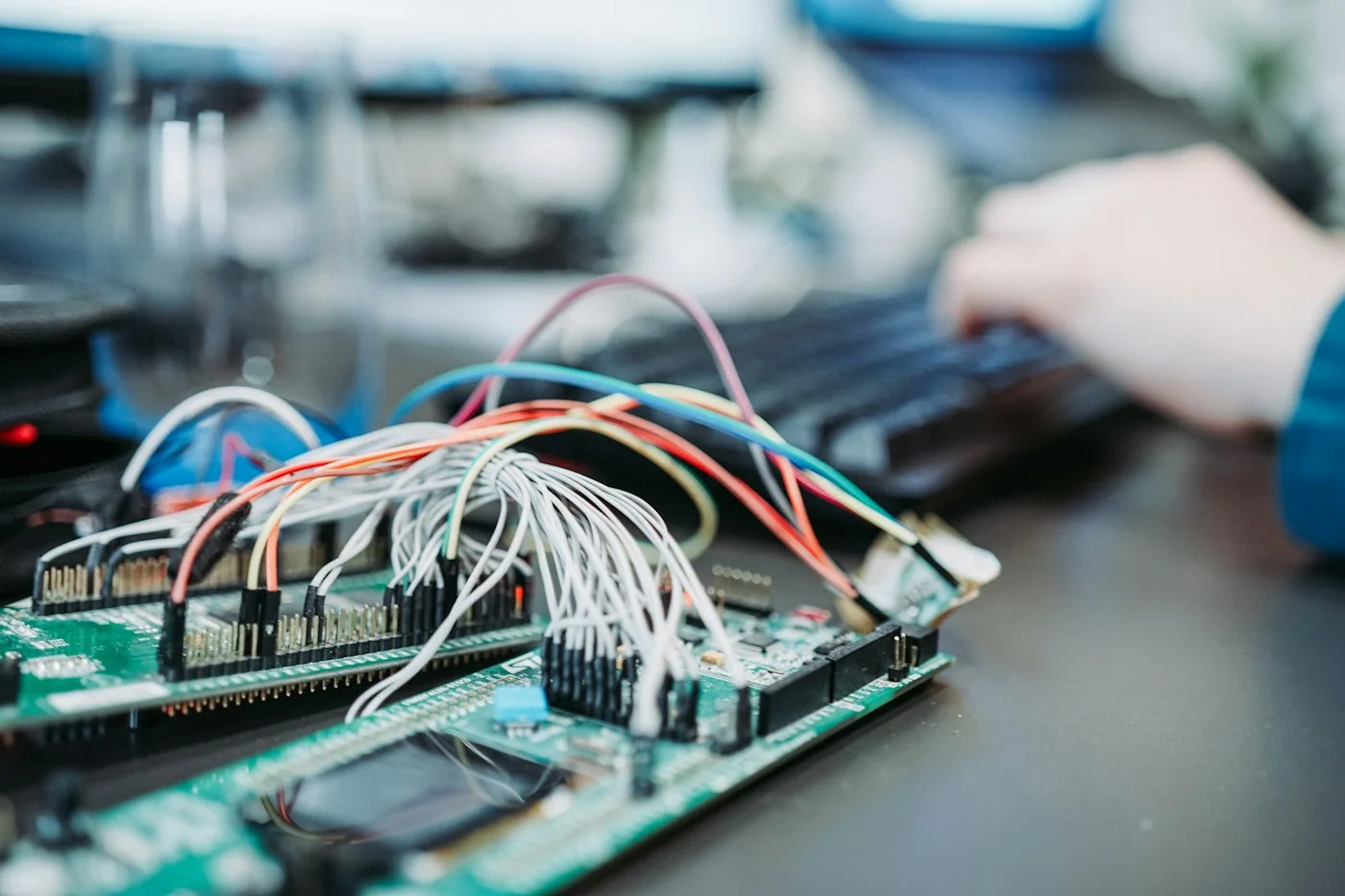
- Circuit Hardware: Generic NodeMCU boards, loose Dupont jumper wires, 5V phone chargers
                      VS.
[ DEVICELAB INDUSTRIAL COMMERCIAL ENGINEERING ]
- Development Platform: Native ESP-IDF v5.x / C/C++ / FreeRTOS multi-tasking architecture
- System Robustness: Zero-blocking state machines, hardware Watchdog Timers (WDT), task watchdog
- Security Provisioning: Secure Boot v2 + AES-256 Flash Encryption locked in eFuse OTP silicon
- OTA Lifecycle: Dual-bank A/B memory partitioning with automated rollback and self-diagnostics
- Industrial Hardware: 4-layer impedance-controlled PCB, 9–36V DC surge protection, 2.5kV optical isolation
5 Fatal Mistakes When Transitioning ESP32 from Lab Prototype to Commercial Market
Over hundreds of embedded design audits, DeviceLab engineers have identified five recurring design flaws that cripple commercial ESP32 deployments when transitioning from benchtop prototypes to field operation:
1. Relying on Arduino IDE Instead of Professional ESP-IDF
While the Arduino ecosystem is ideal for rapid software experimentation, deploying commercial hardware built on Arduino IDE creates grave engineering liabilities. Arduino abstracts hardware registers behind bloated, generic wrapper classes. Many popular community libraries rely on blocking execution (such as blocking delay() calls and unbounded while() polling loops) that starve the CPU, prevent proper real-time thread scheduling, and trigger unpredictable watchdog timeout resets.
In contrast, ESP-IDF provides granular access to hardware timers, DMA controllers, dual-core affinity configuration, power management APIs, and FreeRTOS task primitives, allowing engineers to build deterministic, high-throughput embedded firmware.
2. Insufficient 3.3V Power Supply Design (Brownout Reset Phenomenon)
The ESP32's integrated RF transceiver exhibits intense, rapid power consumption swings. During Wi-Fi calibration, network association, or RF transmission bursts, the chip draws instantaneous current spikes exceeding 500mA for tens of microseconds. If the board's onboard voltage regulator (LDO or DC-DC buck converter) lacks adequate transient response, or if decoupling capacitance is deficient, the supply rail drops below the chip's internal 2.8V threshold.
This triggers the ESP32's internal Brownout Detector, causing cyclic reboots (Brownout Reset loops) that confuse field technicians and degrade user trust.
3. Ignoring Hardware Security: Unprotected Firmware Intellectual Property
By default, the external SPI Flash connected to the ESP32 contains unencrypted compiled machine code. Anyone with a basic USB-to-UART programmer and an open-source tool like esptool.py can connect to the chip's bootloader pins, dump the entire flash binary in less than 60 seconds, reverse-engineer proprietary business algorithms, or extract embedded cloud private keys and API credentials.
Commercial hardware must permanently activate Secure Boot v2 (RSA-3072 signature verification) and Flash Encryption (AES-256-XTS) by burning irreversible hardware electronic fuses (eFuses).
4. Absence of Failsafe Remote Over-The-Air (OTA) Recovery Mechanisms
Releasing connected devices into the field without a resilient firmware update architecture turns routine maintenance into a catastrophic warranty liability. If a single-partition OTA update is interrupted by a sudden power loss or erratic cellular connectivity, the flash partition is left partially written, leaving the microcontroller permanently "bricked" and requiring costly on-site physical replacement.
Industrial firmware requires Dual-Bank A/B OTA partitioning with automated diagnostic validation: the device writes the new firmware to an inactive partition, reboots under diagnostic supervision, validates cloud connectivity, and automatically rolls back to the known-good partition if health checks fail.
5. Unhardened PCB Design Against Industrial Electromagnetic Interference (EMI/ESD)
Hobbyist development boards possess zero industrial noise immunity. In manufacturing plants, elevator machine rooms, or commercial facilities, high-voltage switching transients, relay arcing, motor contactors, and nearby variable frequency drives (VFDs) induce strong electromagnetic noise.
Without TVS diode suppression, high-speed optocouplers, common-mode chokes, and proper multi-layer PCB ground plane shielding, the ESP32's sensitive GPIO lines will experience phantom logic transitions, I2C bus lockups, and permanent silicon latch-up failures.
Comparison Table: DIY ESP32 vs DeviceLab Industrial ESP32 Board

The table below summarizes the technical specifications separating hobbyist development boards from DeviceLab's custom industrial ESP32 hardware platforms:
| Technical Standards | DIY / Hobbyist ESP32 Board | DeviceLab Industrial ESP32 Platform |
|---|---|---|
| Development Environment | Arduino IDE / Amateur C++ scripts | ESP-IDF v5.x / C/C++ / Native FreeRTOS |
| Firmware IP Protection | Unprotected; trivial serial binary readout | Hardware Secure Boot v2 + AES-256 Flash Encryption via eFuse |
| OTA Update Architecture | None, or high-risk single-partition update | Dual-bank A/B partitioning with automated health-check rollback |
| Input Voltage Range | Fixed 5V DC via fragile Micro-USB / USB-C | Wide-range 9–36V DC with reverse-polarity & surge protection |
| I/O Port Protection | Direct unprotected connection to MCU silicon pins | 2.5kV galvanic optical isolation + 15kV ESD TVS diodes |
| Industrial Interfaces | Standard 2.4GHz Wi-Fi / BLE only | Isolated RS485 Modbus RTU, CAN Bus, and 10/100M Ethernet PHY |
| RF Antenna Engineering | Generic PCB copper trace; degraded range & detuning | 50-Ohm impedance matched; certified external IPEX/SMA connector |
| Operating Temperature | Commercial grade: 0°C to +40°C | Industrial grade: -40°C to +85°C continuous operation |
| System Watchdog Protection | Basic software reset loop (often freezes) | Dual-tier hardware Watchdog Timer (WDT) + Task WDT monitoring |
| Manufacturing Standards | Hand-soldered or low-tier generic PCBA | Automated SMT assembly adhering to IPC-A-610 Class 2 standards |
Standard Software Architecture for Commercial ESP32 Products
To achieve years of maintenance-free continuous operation, commercial ESP32 firmware must be structured according to strict architectural abstraction boundaries:
+-------------------------------------------------------------+
| APPLICATION LAYER                                           |
| - Machine State Controllers / Supervisory Logic             |
| - Embedded Local Web Configuration (Captive Portal / HTTP)  |
| - Dynamic Sensor Calibration & Edge Threshold Analysis      |
+-------------------------------------------------------------+
| SERVICES & PROTOCOL MIDDLEWARE LAYER                        |
| - Secure MQTT Client (TLS 1.3 / mTLS X.509 Client Certs)    |
| - Industrial Modbus RTU / Modbus TCP Master Engine          |
| - Dual-Bank A/B OTA Lifecycle Agent & Diagnostics Manager   |
| - LittleFS / NVS Encrypted Local Persistent Storage         |
+-------------------------------------------------------------+
| OS & KERNEL LAYER (ESP-IDF / FreeRTOS)                      |
| - Deterministic Preemptive Task Scheduler                   |
| - Thread-safe Queues, Binary Semaphores & Event Groups      |
| - Dual-Core CPU Affinity Management & Task Watchdogs        |
+-------------------------------------------------------------+
| HARDWARE ABSTRACTION LAYER (HAL & DRIVERS)                  |
| - Hardware DMA Channels (SPI, I2S, UART High-Speed Engines) |
| - High-Resolution PWM / Precision Sigma-Delta ADC Driver    |
| - Power Management Units & Deep-Sleep Wakeup Subsystems     |
+-------------------------------------------------------------+
| PHYSICAL SILICON & INTERFACE HARDWARE                       |
| ESP32-S3 / C3 SoC | Flash | PSRAM | Isolated Transceivers   |
+-------------------------------------------------------------+
Dual-Core CPU Task Optimization Strategy:
In standard dual-core ESP32 chips (such as the classic ESP32 and ESP32-S3), firmware performance depends on assigning dedicated responsibilities to each CPU core:
- Core 0 (PRO_CPU - Protocol & Networking): Dedicated exclusively to managing high-speed network stacks, including the Wi-Fi driver, Bluetooth Low Energy (BLE) controller, LWIP TCP/IP stack, and TLS encryption processing. This ensures network interrupts never block real-time control routines.
- Core 1 (APP_CPU - Application & Real-Time Control): Runs the deterministic application logic, high-precision sensor sampling loops, optical encoder reading, Modbus communication masters, and PID closed-loop control algorithms without being disrupted by wireless network latency.
DeviceLab's Professional ESP32 Turnkey R&D and Hardware Engineering Services
DeviceLab provides end-to-end original equipment and design manufacturing (OEM/ODM) services for businesses seeking to commercialize ESP32-powered industrial products:
- Custom Hardware & Multi-Layer PCB Engineering: Designing robust 4-to-6-layer PCBAs incorporating wide-input DC power supplies (9–36V), industrial galvanic isolation, EMC filtering, and calibrated 50-Ohm RF matching networks.
- Industrial ESP-IDF Firmware Development: Engineering production-grade C/C++ firmware built on ESP-IDF and FreeRTOS, implementing state-machine control, thread-safe memory management, and zero-blocking peripheral drivers.
- Hardware Security & Production Flashing Automation: Configuring Secure Boot v2, hardware Flash Encryption, unique X.509 device certificates, and custom automated test fixtures (ATE) for high-speed factory mass production.
- Enterprise Cloud & OTA Integration: Connecting devices securely via MQTT/TLS to AWS IoT Core, Google Cloud IoT, Microsoft Azure IoT Hub, or private industrial MQTT brokers with end-to-end encrypted dual-bank OTA management.
Frequently Asked Questions (FAQ)
Is the ESP32 chip durable enough for harsh industrial manufacturing environments?
Yes. Espressif manufactures dedicated industrial-grade silicon variants (such as the ESP32-WROOM-32UE or ESP32-S3-WROOM-1U) rated for continuous operation across the full -40°C to +85°C or -40°C to +105°C temperature ranges. When integrated into a professionally engineered PCBA featuring adequate power filtering, transient surge suppression, optical isolation, and conformal coating, ESP32 hardware meets and exceeds industrial reliability standards.
Why should we avoid Arduino IDE for commercial hardware development?
Arduino IDE lacks essential features for commercial firmware engineering: it does not provide native hardware debugging (JTAG/GDB), lacks granular memory profiling, forces reliance on unvetted third-party libraries that use blocking execution, and does not support cryptographic hardware security provisioning (eFuse, Secure Boot v2, Flash Encryption) available in ESP-IDF.
What are the key differences between ESP32, ESP32-S3, and ESP32-C3?
The classic ESP32 features dual Xtensa LX6 cores (up to 240 MHz) with Wi-Fi and BLE 4.2. The ESP32-S3 features upgraded dual Xtensa LX7 cores with dedicated vector instructions for TinyML/Edge AI, USB OTG, and higher GPIO density. The ESP32-C3 is a cost-effective, single-core 32-bit RISC-V processor (up to 160 MHz) designed as an ultra-compact, low-power drop-in replacement for traditional 8-bit/32-bit microcontrollers.
How do Secure Boot and Flash Encryption work on the ESP32?
Secure Boot v2 utilizes an RSA-3072 cryptographic public key hash permanently burned into the ESP32's silicon eFuse blocks. On every boot cycle, the hardware bootloader verifies the digital signature of the secondary bootloader and application binary before executing code. Concurrently, Flash Encryption uses an internal AES-256 key (also locked in eFuses and inaccessible by software) to decrypt SPI Flash data transparently on the fly through the MMU cache, rendering stolen binary dumps unreadable.
What must be considered when designing an on-board Wi-Fi antenna on the PCB?
Designing an onboard PCB inverted-F antenna (IFA) requires maintaining strict keep-out zones devoid of ground planes or copper routing on all PCB layers beneath the antenna. The RF feed line must be calculated as a 50-Ohm coplanar waveguide with ground, accompanied by a Pi-matching circuit (inductors and capacitors) tuned via a Vector Network Analyzer (VNA) to minimize Voltage Standing Wave Ratio (VSWR).
Can the ESP32 maintain concurrent Wi-Fi and Bluetooth connections?
Yes. The ESP32 incorporates an internal RF switch and hardware coexistence arbiter that time-multiplexes the 2.4 GHz radio between Wi-Fi and Bluetooth Low Energy (BLE). However, to prevent audio drops or packet latency under high bandwidth demands, firmware must optimize connection intervals and Wi-Fi DTIM periods through the ESP-IDF coexistence API.
What is the typical R&D investment for a turnkey commercial ESP32 board?
Turnkey engineering costs depend on circuit complexity, industrial I/O density (RS485, CAN, 4-20mA), environmental enclosure ratings, and software feature sets. DeviceLab works on fixed-scope milestone contracts covering schematic design, multi-layer PCB layout, prototype fabrication, ESP-IDF firmware development, and pilot field validation.
How long can an ESP32 operate on battery power?
In Deep-Sleep mode, the ESP32 consumes as little as 10 to 15 microamps (µA) while maintaining internal RTC memory. For intermittent reporting devices (e.g., waking for 3 seconds every hour to transmit sensor telemetry via Wi-Fi), a standard 3.7V 2500mAh lithium battery can power the device for 1.5 to 3 years. For ultra-low-power applications, DeviceLab pairs the ESP32 with external nano-power timers.
Can ESP32 firmware be upgraded in the field without disassembling the enclosure?
Yes. Commercial ESP32 devices utilize dual-bank Over-The-Air (OTA) firmware updating via Wi-Fi or cellular networks. The system downloads the encrypted binary, validates cryptographic hashes, boots into the new image under self-diagnostic observation, and automatically rolls back if cloud verification fails—eliminating physical disassembly or maintenance visits.
When should a design migrate away from the ESP32 to another microcontroller?
While versatile, the ESP32 is not optimal for ultra-precision analog signal measurement (due to non-linear internal ADCs requiring external precision ADCs), ultra-low-latency real-time motor control loops under 10 microseconds, or battery-operated BLE devices that require single-digit microamp operating current (where Nordic nRF52 series SoCs provide superior efficiency).
Conclusion
Transitioning the ESP32 from a prototyping module into a dependable commercial product requires bridging the gap between hobbyist convenience and rigorous industrial engineering. By adopting native ESP-IDF firmware architectures, hardware cryptographic provisioning, failsafe dual-bank OTA updates, and industrially hardened PCB designs, companies can harness the unmatched cost-performance advantages of Espressif silicon while guaranteeing years of zero-maintenance field operation.
DeviceLab provides end-to-end embedded hardware design, industrial firmware engineering, and scalable production services to turn your ESP32 connected hardware concepts into market-defining commercial products. Contact our engineering team today to review your technical specifications and accelerate your development roadmap.