
Custom embedded firmware development is the engineering discipline of authoring low-level machine-control code running directly on microcontrollers (MCUs) or System-on-Chips (SoCs) to interface with physical hardware peripherals, execute real-time control algorithms, handle industrial network communications, and maintain uninterrupted system reliability.
This technical guide is part of DeviceLab's comprehensive engineering handbook on embedded systems architecture and firmware.
Many software development companies and hardware startups attempt to bridge hardware projects using application software developers without specialized embedded systems experience. The result is almost universally troubled: devices that freeze mysteriously after 48 hours of operation, excessive battery drain in sleep modes, unhandled hardware interrupts that crash memory stacks, and complete bricking during remote firmware updates.
This comprehensive technical guide outlines the fundamental architectural layers of commercial firmware, details the 6-stage development lifecycle from hardware bring-up to mass production, evaluates bare-metal versus RTOS approaches, and presents DeviceLab's turnkey embedded firmware engineering capabilities.
What is Custom Firmware Development?
Firmware is the specialized software programmed into non-volatile memory (Flash / ROM) of microcontrollers that directly configures hardware registers, manages clock trees, drives peripheral transceivers, and executes real-time application logic.
Unlike desktop or cloud software that executes inside an operating system with abundant RAM and virtual memory protection, embedded firmware operates directly on bare silicon with severe physical constraints: kilobyte-scale SRAM, strict microsecond interrupt deadlines, hardware watchdog timers, and direct electrical interaction with sensors, power supplies, and communication buses.
Physical Hardware Silicon (MCU, Peripherals, Memory)
            ↓ (Direct Register Reads/Writes, Memory-Mapped I/O)
Hardware Abstraction Layer (HAL) & Low-Level Peripheral Drivers (SPI, I2C, UART)
            ↓ (Task Scheduling, Inter-Process Queues, Mutexes)
Real-Time Operating System (FreeRTOS / Zephyr) or Bare-Metal Super-Loop
            ↓ (Protocol Stacks: Modbus, MQTT, BLE, TLS 1.3)
Communication & Network Protocol Engine
            ↓ (Device Business Logic & Closed-Loop Control)
High-Level Application Logic & Supervisory State Machine
How Does Firmware Differ from Application and Embedded Software?
| Evaluation Criteria | Embedded Firmware (MCU) | Embedded Linux Software (SoC) | Application Software (App / Web) |
|---|---|---|---|
| Target Silicon | Resource-constrained MCUs (ARM Cortex-M, ESP32, STM32, Nordic) | Microprocessors (ARM Cortex-A, MIPS, RISC-V with MMU) | Cloud servers, mobile devices (iOS/Android), PCs |
| Execution Environment | Bare-metal super-loops or lightweight RTOS (FreeRTOS, Zephyr) | Full Linux kernel, user space / kernel space separation | High-level runtimes (Node.js, Python, Java, .NET) inside OS |
| Memory Resources | 32KB to 512KB SRAM; 128KB to 2MB Flash | 64MB to several GB RAM; eMMC or NAND storage | Gigabytes of RAM; gigabytes to terabytes of storage |
| Hardware Interaction | Direct register manipulation; cycle-accurate ISRs | Linux device drivers, sysfs, virtual character devices | Completely abstracted via OS APIs and network sockets |
| Timing Determinism | Hard Real-Time (sub-microsecond deterministic response) | Soft Real-Time (tens of milliseconds unless PREEMPT_RT patched) | Non-deterministic (best effort delivery) |
The Essential Functional Blocks of Production Firmware

Commercial-grade firmware comprises six disciplined engineering subsystems:
Hardware Bring-Up Layer
Initial silicon initialization routines executed upon power-on: configuring phase-locked loop (PLL) clock trees, setting power rail regulators, initializing internal flash latency wait states, and mapping pin multiplexing matrices.
Peripheral Driver Layer
Hardware-abstracted drivers operating physical bus interfaces (SPI, I2C, UART, CAN, ADC, PWM, DMA), handling interrupts and direct memory access transfers without stalling the CPU core.
Communication & Networking Subsystem
Protocol implementation engines: Modbus RTU/TCP, BACnet, CANopen, standard MQTT/TLS 1.3, CoAP, BLE GATT profiles, and cellular AT command state machines.
Application Logic & Supervisory State Machine
The core commercial intelligence: reading calibrated sensor inputs, executing PID closed-loop control algorithms, logging operational states, and driving mechanical actuators.
Reliability & Fault Recovery Subsystem
Hardware Watchdog (WDT) supervisors, Brownout Detection (BOD) resets, non-volatile crash logging, and autonomous memory integrity verification preventing unhandled lockups.
Update & Maintenance Subsystem
Secure dual-bank Bootloader and Firmware Over-The-Air (FOTA) clients enabling cryptographically authenticated field updates without physical disassembly.
When is Custom Firmware Development Required?
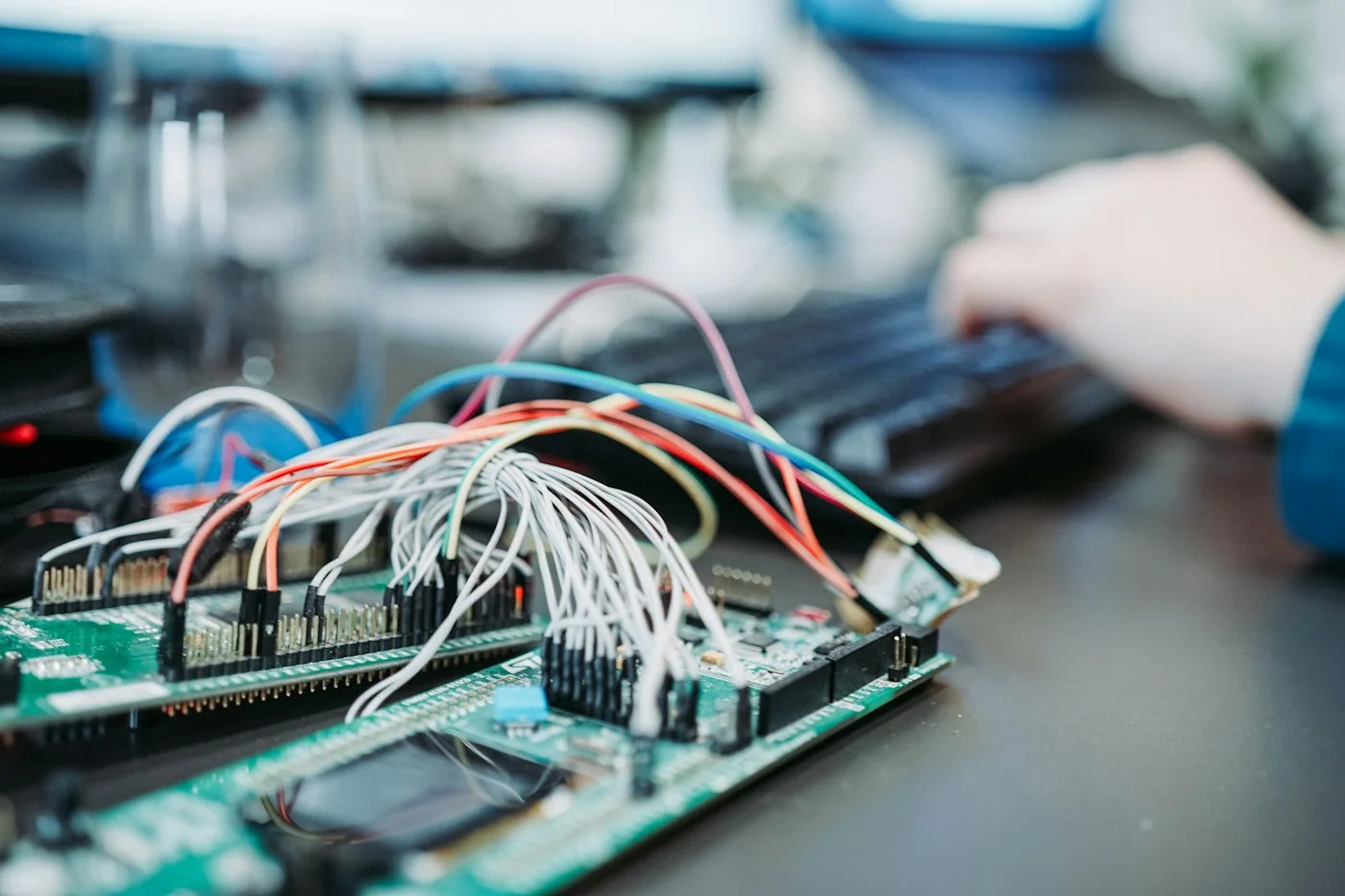
Custom firmware authoring becomes necessary when projects outgrow basic open-source scripts or off-the-shelf catalog devices:
- Transitioning from hobbyist Arduino/MicroPython prototypes to commercial products requiring low power, real-time determinism, and intellectual property protection.
- Developing custom IoT products with bespoke sensor combinations, specialized edge algorithms, or proprietary communication protocols.
- Ultra-low-power battery devices requiring microampere sleep modes, dynamic clock gating, and duty-cycle optimization for 5 to 10-year field longevity.
- Hardware security enforcement: Secure Boot, hardware flash encryption, cryptographic key provisioning, and encrypted FOTA update distribution.
- Hardware-software co-design: writing specialized drivers for newly fabricated custom PCB assemblies during engineering bring-up.
What Information Must Be Prepared Before Firmware Development?

To scope and execute firmware engineering efficiently, the project team must define:
Hardware Specifications
Complete schematic diagrams (Altium/KiCad), component datasheets, pinout allocation matrices, MCU part numbers, and power supply architectures.
Functional Requirements & I/O Matrix
Detailed list of inputs, outputs, sampling frequencies, measurement accuracy tolerances, button interactions, LED indicators, and actuator response times.
Communication & Cloud Protocols
Specification of physical buses (RS485, CAN, Ethernet, BLE, LTE), message payload formats (JSON, CBOR, Protobuf), and server API endpoints.
Operational Environment Constraints
Power budget requirements (mains AC vs. battery lifespan), ambient temperature extremes (-20°C to +70°C), and fail-safe behavior during power loss.
Firmware Update Strategy
Local serial programming (UART/USB) vs. remote cellular/Wi-Fi FOTA updates, rollback policies, and security encryption levels.
API & Backend Handoff
Data payload schemas, cloud broker credentials, telemetry reporting frequencies, and command-and-control message definitions.
How is Production Firmware Engineered?

DeviceLab enforces a disciplined 6-stage firmware engineering progression:
Phase 1: Architecture Design & Peripheral Memory Mapping
            ↓
Phase 2: Hardware Bring-Up & Low-Level Driver Validation
            ↓
Phase 3: Protocol Stack Integration & State Machine Authoring
            ↓
Phase 4: Benchtop In-Circuit Debugging & Logic Analysis
            ↓
Phase 5: Automated Environmental Stress Testing & Power Profiling
            ↓
Phase 6: Secure Bootloader Integration & Production Hex Release
Do You Need an RTOS, Bootloader, and OTA from Day One?

Real-Time Operating Systems (RTOS)
A simple bare-metal super-loop is adequate for devices with 2 to 3 basic tasks. However, when a system combines wireless communication (Wi-Fi/4G), multiple serial buses, file-system logging, and responsive local UI, an RTOS (such as FreeRTOS or Zephyr) is essential to provide preemptive multitasking, inter-process communication queues, and mutex synchronization.
Custom Bootloaders
A custom bootloader is mandatory for commercial products to verify firmware cryptographic integrity upon startup, manage firmware partitions, and execute safe rollbacks if a newly applied update fails to boot.
Firmware Over-The-Air (FOTA)
Designing the memory partition table and dual-bank bootloader from Day One is critical. Retrofitting OTA capabilities after hardware layout and flash sizing are finalized is extremely difficult and often requires board redesign.
How Hardware and Firmware Must Be Co-Developed
Hardware and firmware engineering cannot occur in silos. Successful embedded systems require continuous collaborative iteration loops:
Schematic Capture ──→ Pinout & Peripheral Multiplexing Review (Firmware)
           │
PCB Layout Release ──→ Memory Map & Clock Tree Pre-Configuration (Firmware)
           │
Bare PCB Fabrication ──→ First-Article Hardware Bring-Up & Power Rail Verification
           │
SMT Assembly Complete ──→ Driver Testing, Bus Timing Verification, Logic Analysis
           │
EVT Prototype Testing ──→ Integrated System Testing, 72-Hour Burn-In, Power Profiling
COTS vs. Custom Firmware vs. Full Turnkey Development

| Development Approach | Initial Engineering Cost | Time to Market | Customization Flexibility | Unit Production BOM |
|---|---|---|---|---|
| COTS Firmware & Hardware | Low (purchase standard units) | Immediate (days) | Strictly limited to vendor settings | High unit purchase price ($$$) |
| Custom Firmware on Standard Hardware | Moderate (firmware NRE only) | Fast (2–4 weeks) | High software customization | Moderate unit hardware cost ($$) |
| Turnkey Hardware & Firmware R&D | Higher initial NRE investment | Structured (6–10 weeks) | 100% control over hardware & firmware | Lowest unit production cost ($) |
Firmware Development Roadmap: From Prototype to Mass Production
Phase 1: Proof-of-Concept (PoC) on Dev Kits (Validate Algorithms & Protocols)
            ↓
Phase 2: EVT Prototype Bring-Up (Hardware Validation & Driver Tuning)
            ↓
Phase 3: DVT Environmental Testing (Thermal Chambers, EMC Pre-Compliance, Power Profiling)
            ↓
Phase 4: Production Test Firmware & Automated Pogo-Pin Flashing Fixtures
            ↓
Phase 5: Mass Production Rollout & Turnkey Cryptographic Key Provisioning
PoC Engineering Checklist
Confirming: algorithm calculation accuracy, sensor sampling reliability, communication protocol stability, and backend cloud API handshake parsing.
Key Cost Drivers in Firmware Projects
Development investments are determined by: MCU silicon complexity, protocol stack requirements (e.g., custom industrial protocols vs. standard MQTT), ultra-low-power sleep optimization, and regulatory compliance testing.
When is Firmware Development Alone Insufficient?
When field failures stem from noisy PCB layouts, floating ground planes, inadequate power filtering, or missing ESD protection. Firmware cannot compensate for physical hardware design flaws. In such cases, co-developing both hardware and firmware is required.
Turnkey Embedded Firmware Development Services at DeviceLab
DeviceLab provides end-to-end embedded software engineering for commercial B2B products: * Multi-Silicon Expertise: Production development across ARM Cortex-M (STM32, NXP), ESP32 series, Nordic nRF52/53 BLE, and Microchip silicon. * Industrial Protocol Engines: Custom implementations of Modbus RTU/TCP, BACnet, CANopen, MQTT/TLS 1.3, and cellular NB-IoT/LTE stacks. * 100% IP & Source Code Ownership: Clients receive fully documented C/C++ repositories, build scripts, and production flashing tools upon project completion.
What to Prepare Before Inquiring
Please share your hardware schematics, functional requirement documents, communication specifications, and target microcontroller preferences.
Frequently Asked Questions (FAQ)
Lập trình firmware theo yêu cầu là gì?
The specialized engineering service of authoring custom embedded C/C++ software tailored precisely to a proprietary circuit board, executing dedicated machine control and communication routines.
Firmware khác phần mềm ứng dụng như thế nào?
Firmware operates directly on bare silicon with severe memory constraints (kilobytes) and hard real-time deadlines, manipulating physical hardware registers directly without operating system abstraction.
Thuê lập trình firmware được không nếu chỉ có team software?
Yes. DeviceLab frequently partners with pure software companies, developing the complete low-level embedded firmware and delivering clean, standardized REST/MQTT APIs for their software platforms.
Có thể phát triển firmware khi chưa có PCB hoàn chỉnh không?
Yes. Early development occurs on manufacturer evaluation kits and breadboard mockups, allowing core algorithms and protocol stacks to be validated before custom PCB fabrication.
Firmware có cần RTOS không?
Not for simple devices. For complex multi-tasking IoT systems integrating wireless stacks, local logging, and real-time control, an RTOS like FreeRTOS is essential for reliability.
OTA firmware có bắt buộc không?
While not strictly mandatory for isolated offline hardware, OTA is practically indispensable for connected commercial IoT products to dispatch security patches without field technician visits.
Firmware khác embedded Linux thế nào?
MCU firmware runs on resource-constrained microcontrollers with instant boot times and sub-microsecond determinism. Embedded Linux runs on multi-gigahertz processors with full operating system stacks for high-bandwidth video and complex computation.
Hỗ trợ MCU/SoC và giao thức nào?
DeviceLab supports all major industrial silicon architectures: STM32, ESP32, Nordic Semiconductor, NXP, Microchip, and Renesas, communicating over Modbus, CAN, MQTT, BLE, and cellular protocols.
Handoff protocol/API cần gì?
Clear definition of telemetry message schemas (JSON/Binary), topic naming structures, polling intervals, and authentication credentials.
Chi phí lập trình firmware phụ thuộc gì?
Total engineering hours, protocol complexity, power-optimization requirements, hardware bring-up iteration cycles, and security encryption specifications.
Khi nào cần phát triển cả hardware và firmware?
When engineering a brand-new commercial product requiring optimized physical dimensions, custom I/O channels, low BOM cost, and matched industrial reliability.
Firmware có thể kết nối MQTT, Modbus hoặc RS485 không?
Yes. DeviceLab regularly integrates multi-protocol conversion engines supporting simultaneous RS485 Modbus polling alongside encrypted upstream MQTT/TLS reporting.
Conclusion
Industrial-grade embedded firmware is the invisible foundation that transforms raw silicon circuit boards into reliable, market-dominating commercial products.
Ensure project success by establishing clean modular architecture, hardware abstraction layers, and robust watchdog supervisory mechanisms from day one.
Consult with DeviceLab on Custom Embedded Firmware Development →