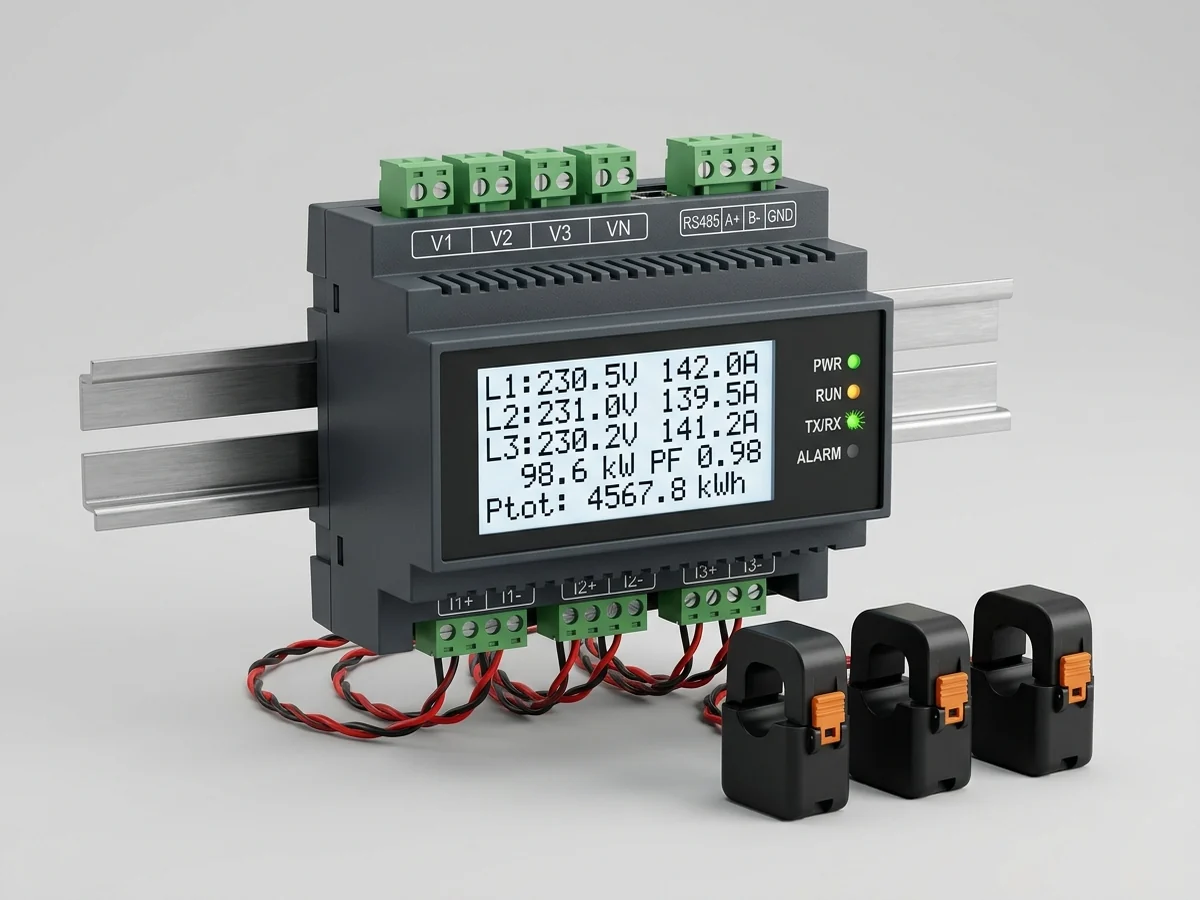
Smart electrical power meters are advanced digital instrumentation devices that measure multi-phase electrical parameters (voltage, current, active/reactive power, power factor, and cumulative energy consumption) and transmit real-time telemetry over digital communication buses (such as Modbus RS485 or Ethernet) to energy management systems, SCADA platforms, and cloud monitoring dashboards.
For industrial plants, commercial buildings, data centers, and multi-tenant facilities in Vietnam, energy costs represent one of the largest operational expenditures. Relying on monthly utility invoices or manual paper meter reading leaves facility directors completely blind to peak demand charges, phase unbalances, harmonic distortions, and equipment energy waste. However, building an effective energy monitoring system requires understanding metering topologies, current transformer (CT) ratios, and structured edge communications.
This comprehensive technical guide details the electrical parameters measured by smart meters, compares direct versus CT-coupled metering, outlines the 5-layer Energy Monitoring architecture, evaluates COTS versus custom telemetry hardware, and explains DeviceLab's turnkey energy monitoring engineering capabilities.
What is a Smart Power Meter?
A smart power meter is a microprocessor-based electronic instrument that continuously samples alternating voltage and current waveforms via high-speed analog-to-digital converters (ADCs), calculates true RMS electrical values, accumulates energy consumption, and provides digital communication ports for remote telemetry extraction.
Unlike legacy electromechanical spinning-disc meters that only display cumulative kilowatt-hours (kWh) on physical dials, smart meters provide instantaneous, bidirectional operational intelligence across all phases, enabling automated tenant billing, peak demand alerts, and predictive electrical maintenance.
| Evaluation Criteria | Local Standalone Power Meter | Integrated Energy Monitoring System |
|---|---|---|
| Primary Objective | Manual on-site display reading | Automated real-time analytics & optimization |
| Data Scope | Instantaneous reading on LCD screen | Continuous time-series logging & trend profiling |
| Communications | Isolated standalone device | Modbus RS485 / Ethernet / 4G cellular telemetry |
| Intermediate Edge Device | None required | Industrial IoT Gateway / Smart Data Logger |
| Software Layer | None | Central SCADA, MES, or Web Energy Dashboard |
| Scalability | Single measurement point | Enterprise-wide multi-substation monitoring |
What Parameters Do Smart Power Meters Measure?
Modern industrial digital power meters capture comprehensive electrical engineering metrics:
1. Voltage (True RMS)
Phase-to-Neutral ($U_{AN}, U_{BN}, U_{CN}$) and Phase-to-Phase ($U_{AB}, U_{BC}, U_{CA}$) voltages, capturing voltage sags, swells, and phase unbalances.
2. Current (True RMS)
Phase currents ($I_A, I_B, I_C$) and calculated neutral current ($I_N$), identifying circuit overloads and leakage currents.
3. Power Metrics
- Active Power ($P$ in kW): The actual real power converted into mechanical work or heat.
- Reactive Power ($Q$ in kVAR): Magnetizing power required by inductive loads (motors, transformers).
- Apparent Power ($S$ in kVA): The total vector power drawn from the electrical grid ($S = sqrt{P^2 + Q^2}$).
Cross-Disciplinary Reference: Explore factory-wide IIoT machine connectivity and automated OEE calculation in our handbook: What is Industrial IoT (IIoT)? Architecture & Roadmap.
4. Energy Consumption Accumulation
- Total Active Energy ($kWh$) and Reactive Energy ($kVARh$).
- Time-of-Use (TOU) Energy: Tracking consumption across Peak, Standard, and Off-Peak tariff hours.
- Bidirectional Energy: Measuring imported vs. exported solar power.
Cross-Disciplinary Reference: Explore factory-wide IIoT machine connectivity and automated OEE calculation in our handbook: What is Industrial IoT (IIoT)? Architecture & Roadmap.
5. Power Quality Indicators
- Power Factor ($cos arphi$): Identifying poor power factor ($<0.90$) that triggers severe utility penalty surcharges.
- Grid Frequency ($f$ in Hz): Monitoring power supply stability ($50 ext{Hz} pm 0.2 ext{Hz}$).
- Total Harmonic Distortion (THD): Quantifying voltage and current waveform distortion up to the 31st or 63rd harmonic induced by non-linear VFD loads.
Cross-Disciplinary Reference: Explore factory-wide IIoT machine connectivity and automated OEE calculation in our handbook: What is Industrial IoT (IIoT)? Architecture & Roadmap.
How Do Smart Meters Connect to Management Systems?
Smart meters transmit data across standard industrial communication networks:
RS485 / Modbus RTU
The dominant physical standard in electrical distribution panels. Multi-drop daisy-chain cabling connects up to 32 meters per bus over distances up to 1,200 meters using twisted-pair wiring.
Ethernet / Modbus TCP
High-end power quality analyzers incorporate native RJ45 Ethernet ports, streaming data directly across plant LAN networks.
IoT Edge Gateways & Data Loggers
An industrial IoT gateway sits between meter serial buses and corporate networks, polling Modbus registers, timestamping data with an RTC, and pushing packets to cloud dashboards via MQTT or REST APIs.
Differentiating RS485 from Modbus
RS485 is the physical electrical wire standard; Modbus is the software communication language running on those wires.
Three-Phase Power Metering Topologies
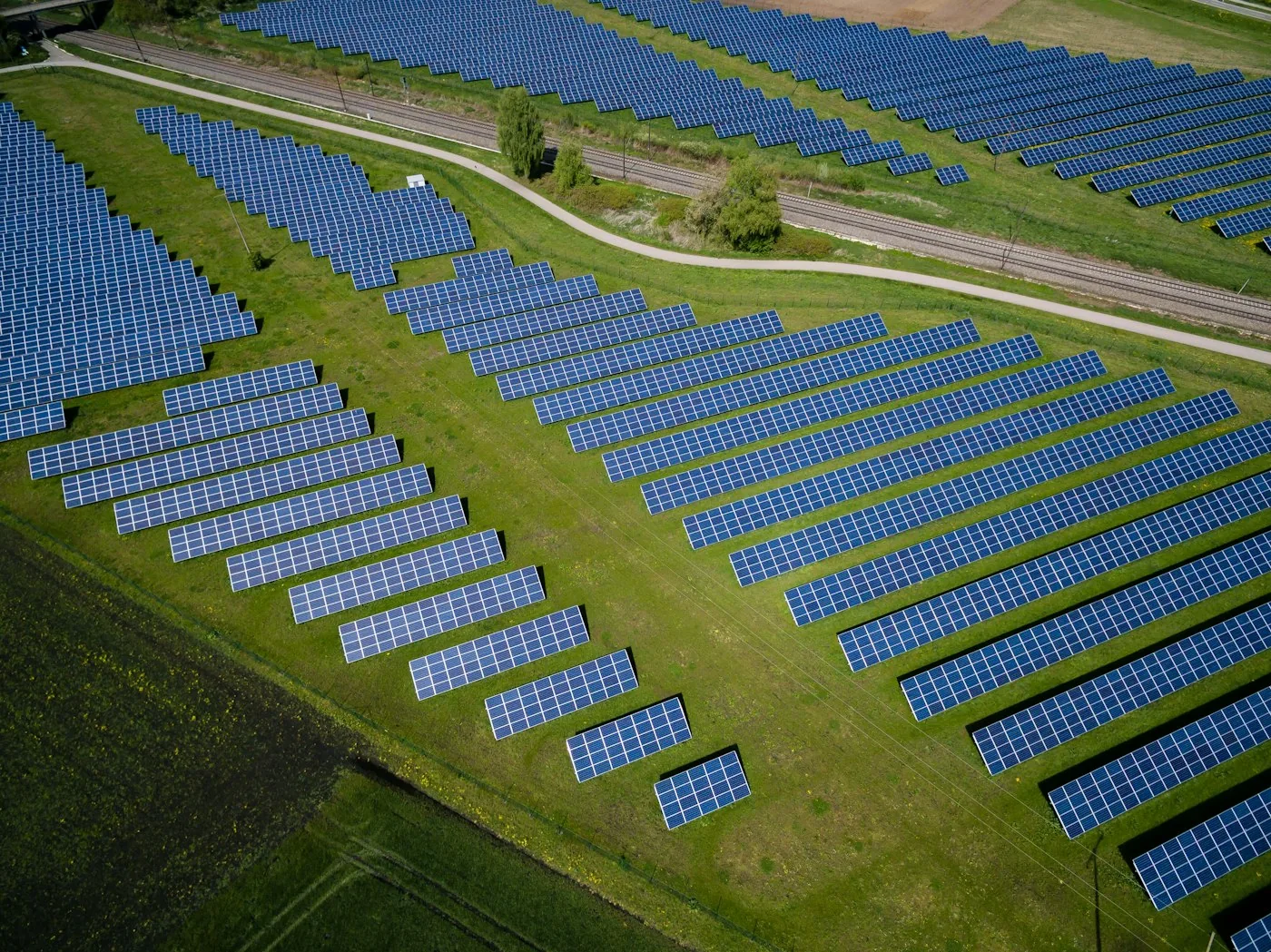
Selecting the correct meter topology depends on electrical service ratings:
1. Phase Topologies
- 1-Phase 2-Wire (1P2W): Residential units, single-phase auxiliary branch circuits.
- 3-Phase 3-Wire (3P3W): Delta-connected industrial power systems without a neutral conductor.
- 3-Phase 4-Wire (3P4W): The standard commercial and industrial distribution format with three phases and a neutral conductor.
Cross-Disciplinary Reference: Explore factory-wide IIoT machine connectivity and automated OEE calculation in our handbook: What is Industrial IoT (IIoT)? Architecture & Roadmap.
2. Direct vs. Indirect CT Measurement
- Direct Metering: Main power conductors pass directly through meter terminals. Limited to low-current loads (typically $le 60 ext{A}$ or $le 100 ext{A}$).
- Indirect CT Metering: For main distribution busbars carrying hundreds or thousands of amperes ($100 ext{A}$ to $5,000 ext{A}$), Current Transformers (CTs) step down line currents to a safe $5 ext{A}$ or $1 ext{A}$ secondary signal measured by the meter. Split-core CTs allow installation without disconnecting power busbars.
Cross-Disciplinary Reference: Explore factory-wide IIoT machine connectivity and automated OEE calculation in our handbook: What is Industrial IoT (IIoT)? Architecture & Roadmap.
The 5-Layer Energy Monitoring Architecture

A reliable enterprise energy management system operates across five coordinated layers:
- Layer 1 — Measurement: Digital power meters and current transformers capturing physical electrical parameters.
- Layer 2 — Field Communication: Shielded twisted-pair RS485 daisy-chain buses linking meters within switchboards.
- Layer 3 — Edge Gateway: Industrial gateways executing cyclic polling, protocol conversion, data filtering, and local Flash buffering.
- Layer 4 — Data & Analytics: Time-series databases (InfluxDB, TimescaleDB) storing historical electrical trends.
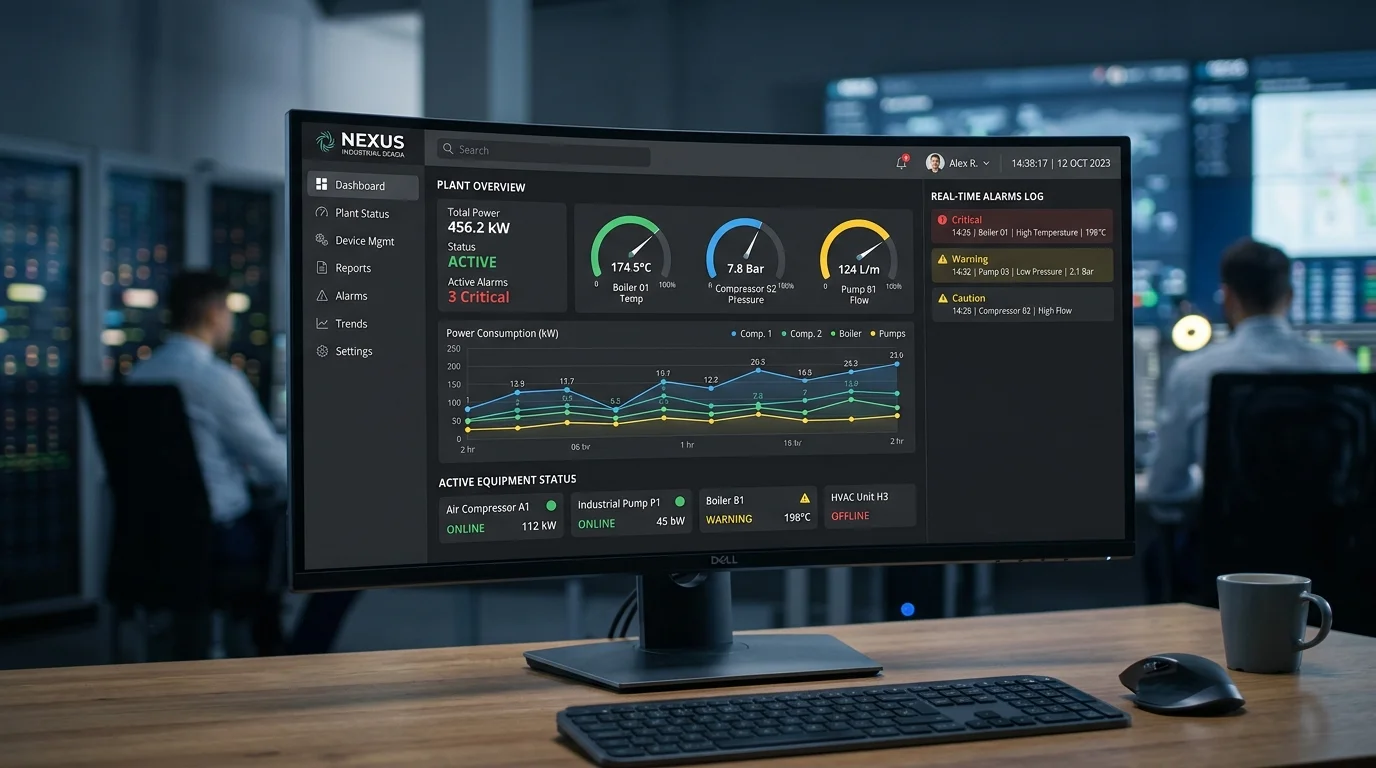
- Layer 5 — Application Layer: Web-based energy dashboards rendering real-time power profiles, automated tariff billing, and anomaly alerts.
How Many Metering Points Does a Factory Require?
Metering density follows a 4-tier hierarchy balancing visibility against capital cost:
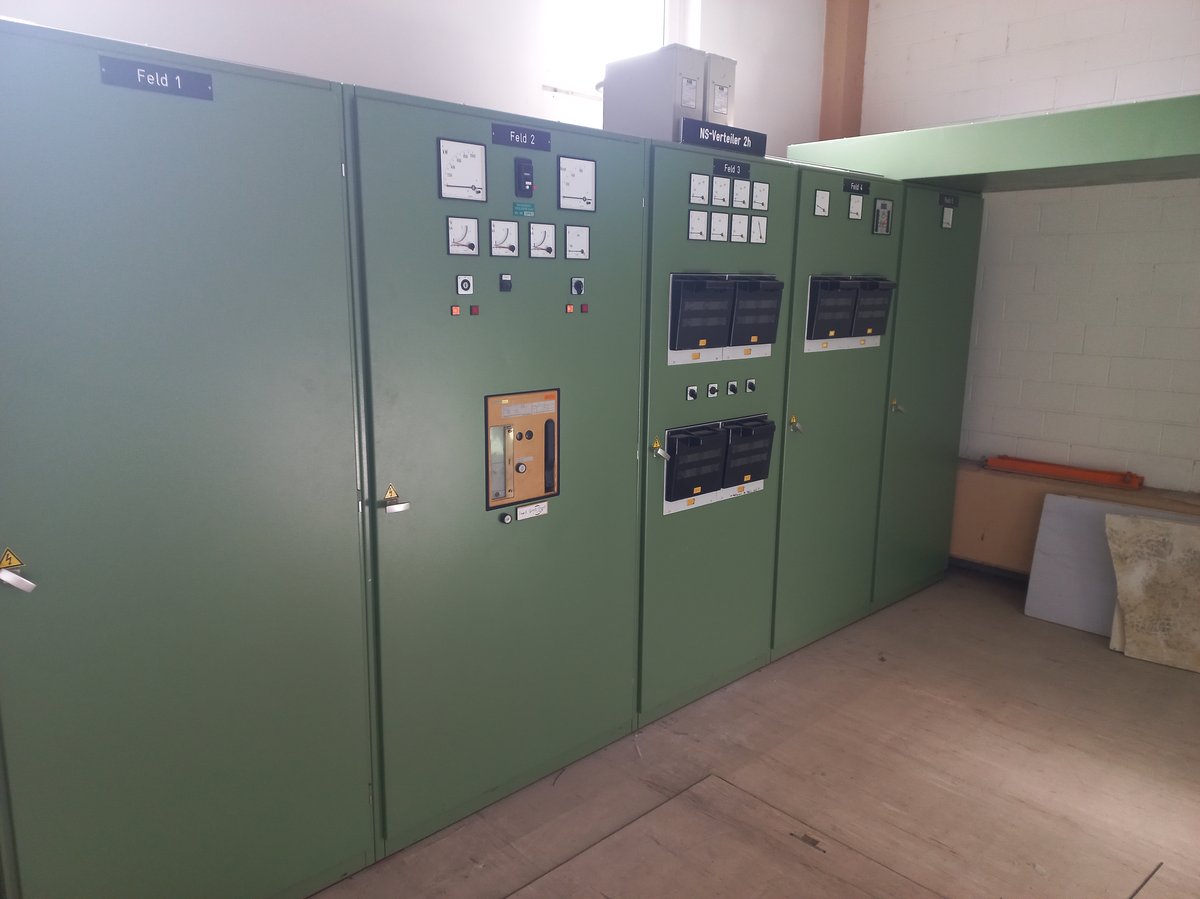
- Level 1 — Main Incomer Substation: 1 meter at the medium-to-low voltage transformer incomer to verify overall utility billing and track factory peak demand.
- Level 2 — Workshop / Department Distribution: 3 to 10 meters monitoring distinct production workshops, administrative buildings, and chiller plants.
- Level 3 — Production Line / Major Machine: Meters on specific bottleneck machines (e.g., injection molders, stamping presses, arc furnaces) to calculate energy cost per manufactured product unit.
- Level 4 — Critical Utilities: Dedicated sub-meters on high-consumption auxiliary utilities: air compressors, central boilers, and wastewater treatment pumps.
Cross-Disciplinary Reference: Explore factory-wide IIoT machine connectivity and automated OEE calculation in our handbook: What is Industrial IoT (IIoT)? Architecture & Roadmap.
Pre-Deployment Electrical Survey Checklist

Audit these parameters prior to procuring hardware:
- Load Parameters: Main breaker amperage rating, busbar dimensions for CT selection, and phase wiring configuration.
- Measurement Objectives: Basic kWh billing vs. advanced power quality logging (harmonics, voltage sags).
- Communication Routing: Cable conduit paths between switchboards and nearest network switches.
- Upstream IT Infrastructure: On-premise SCADA servers vs. cloud hosting preferences.
- Switchboard Operating Environment: Ambient temperature, dust accumulation, and physical space inside panel doors.
When is a COTS Meter + Gateway Solution Sufficient?

COTS hardware is appropriate when:
- Deploying standard commercial sub-metering for commercial office tenants or shopping malls.
- Meters share identical brands and standard Modbus RTU register layouts.
- Network connectivity is stable and does not require complex edge computing.
Cross-Disciplinary Reference: Explore factory-wide IIoT machine connectivity and automated OEE calculation in our handbook: What is Industrial IoT (IIoT)? Architecture & Roadmap.
When is Custom Hardware or Tailored Engineering Required?
Custom engineering is vital when projects encounter complex industrial realities:
- Heterogeneous Multi-Vendor Meters: Facilities operating a mixture of Schneider, ABB, Selec, and Chint meters with incompatible register maps requiring intelligent edge mapping.
- Offline Store-and-Forward Edge Buffering: Remote substations where cellular connections drop frequently, requiring edge gateways with non-volatile Flash to guarantee zero data loss.
- Hostile Cabinet Environments: High-heat electrical rooms ($>60^circ ext{C}$) and severe electromagnetic noise from multi-megawatt drives requiring isolated hardware transceivers.
- Deep SCADA/MES & OEM Integration: Custom hardware form factors, private-label branding, or specialized API protocols.
Factory Energy Monitoring Architecture
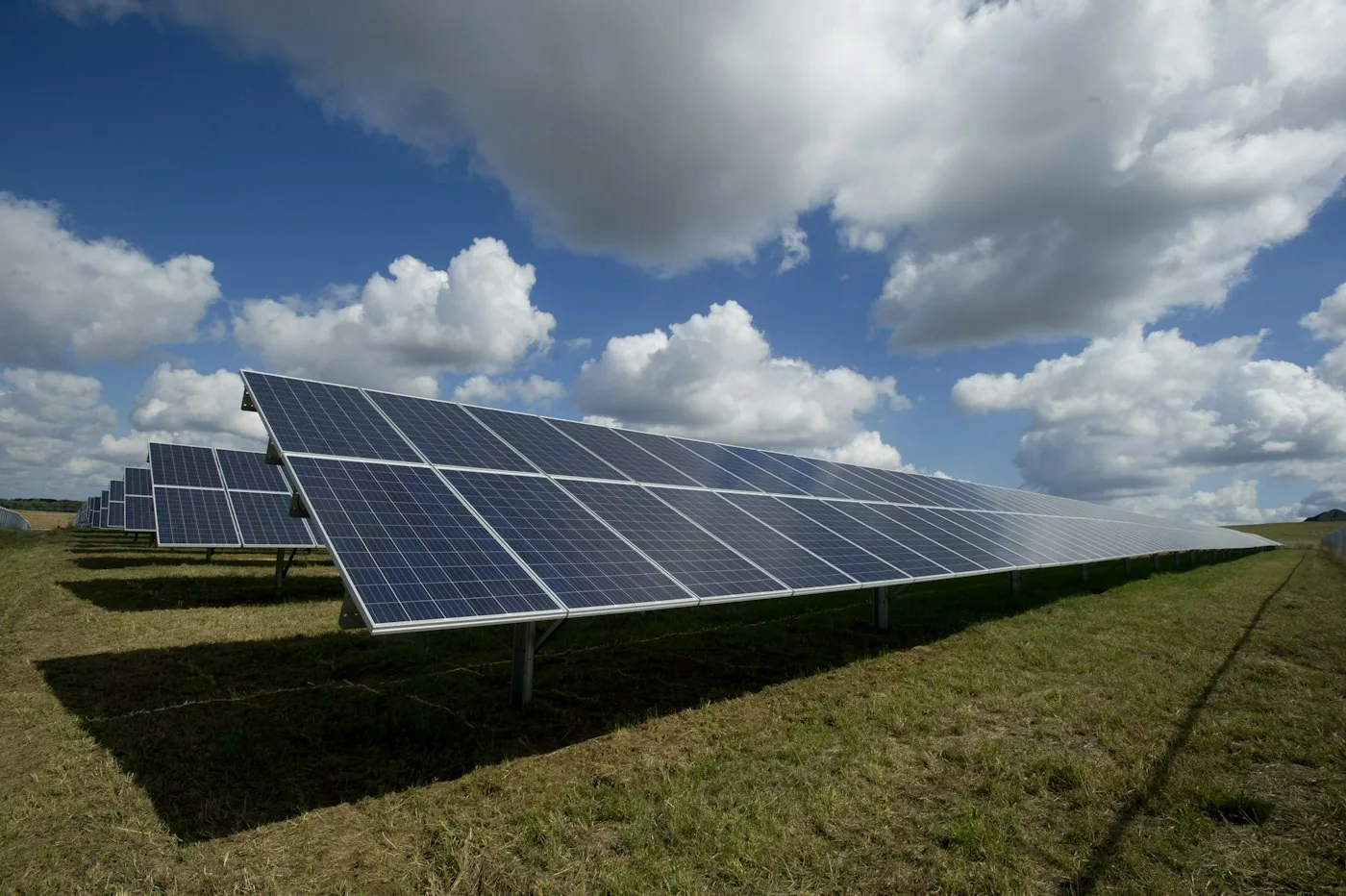
Integrating transformer substations, main switchgear, and distributed sub-panels into a unified real-time telemetry network.
Energy Monitoring Deployment Roadmap

A structured 4-step deployment roadmap: 1. Site audit and electrical single-line diagram review. 2. PoC pilot: instrumenting the main incoming feed and 1 critical production line for 2 to 4 weeks. 3. Full panel rollout: installing meters, split-core CTs, and edge gateways across all switchboards. 4. Dashboard commissioning, automated tariff calculation, and alert configuration.
Key Proof-of-Concept (PoC) Objectives
Confirming: CT ratio accuracy, RS485 communication stability during active motor switching, and alignment between automated readings and official utility bills.
What Factors Determine System Investment?
Total project costs depend on: total metering point count, direct vs. split-core CT ratings, cable routing distances, gateway communication interfaces (Ethernet vs. 4G LTE), and software customization requirements.
How Electrical Telemetry Delivers Operational ROI
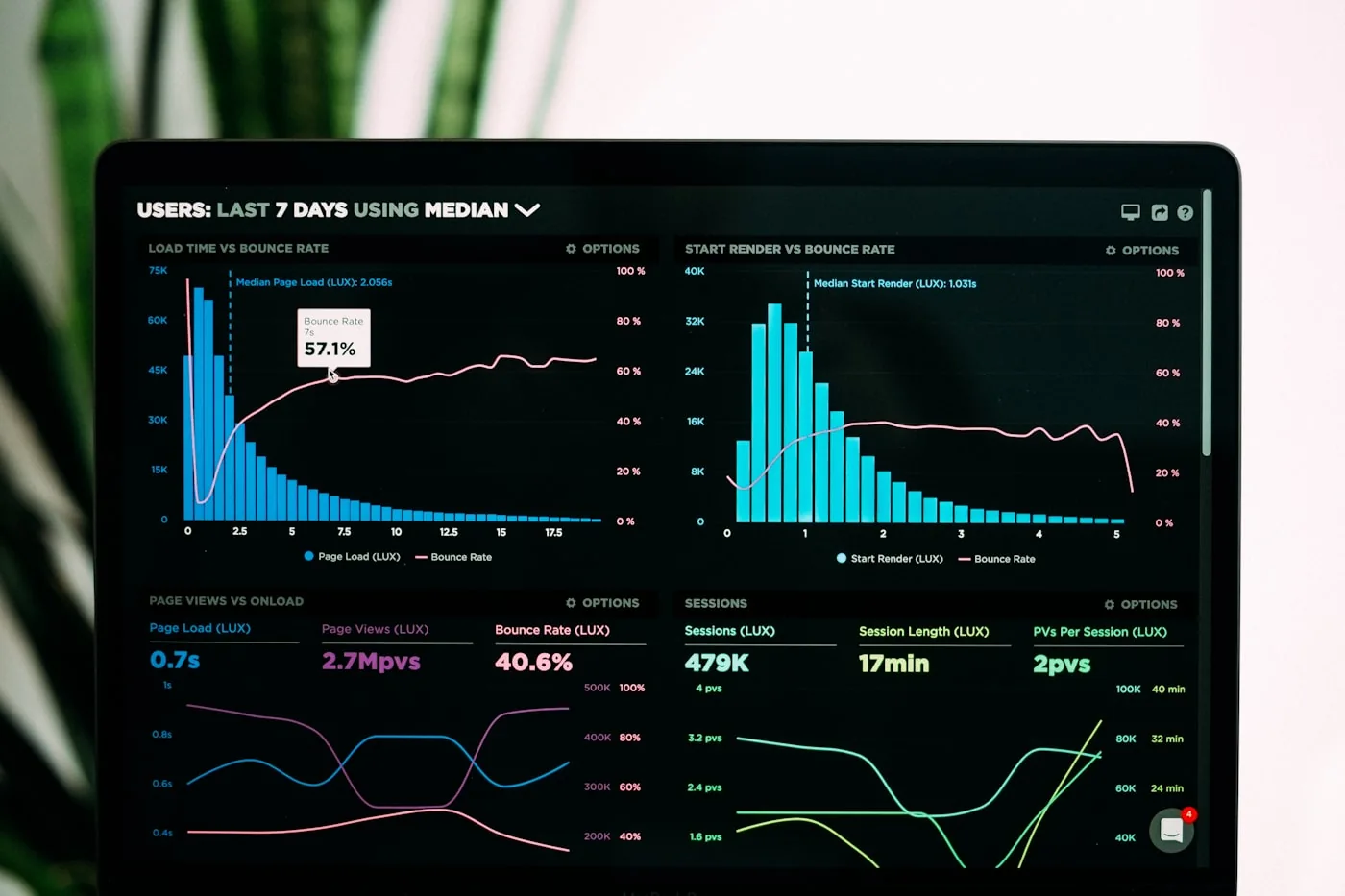
Energy data delivers immediate economic returns: * Peak Demand Shaving: Receiving automated warnings before factory demand breaches contracted thresholds, avoiding severe utility penalty charges. * Power Factor Optimization: Identifying capacitor bank degradation to maintain $cos arphi > 0.95$. * Product Energy Costing: Calculating exact electricity costs per manufactured unit to optimize production scheduling during low-tariff hours.
Custom Energy Monitoring Solutions by DeviceLab
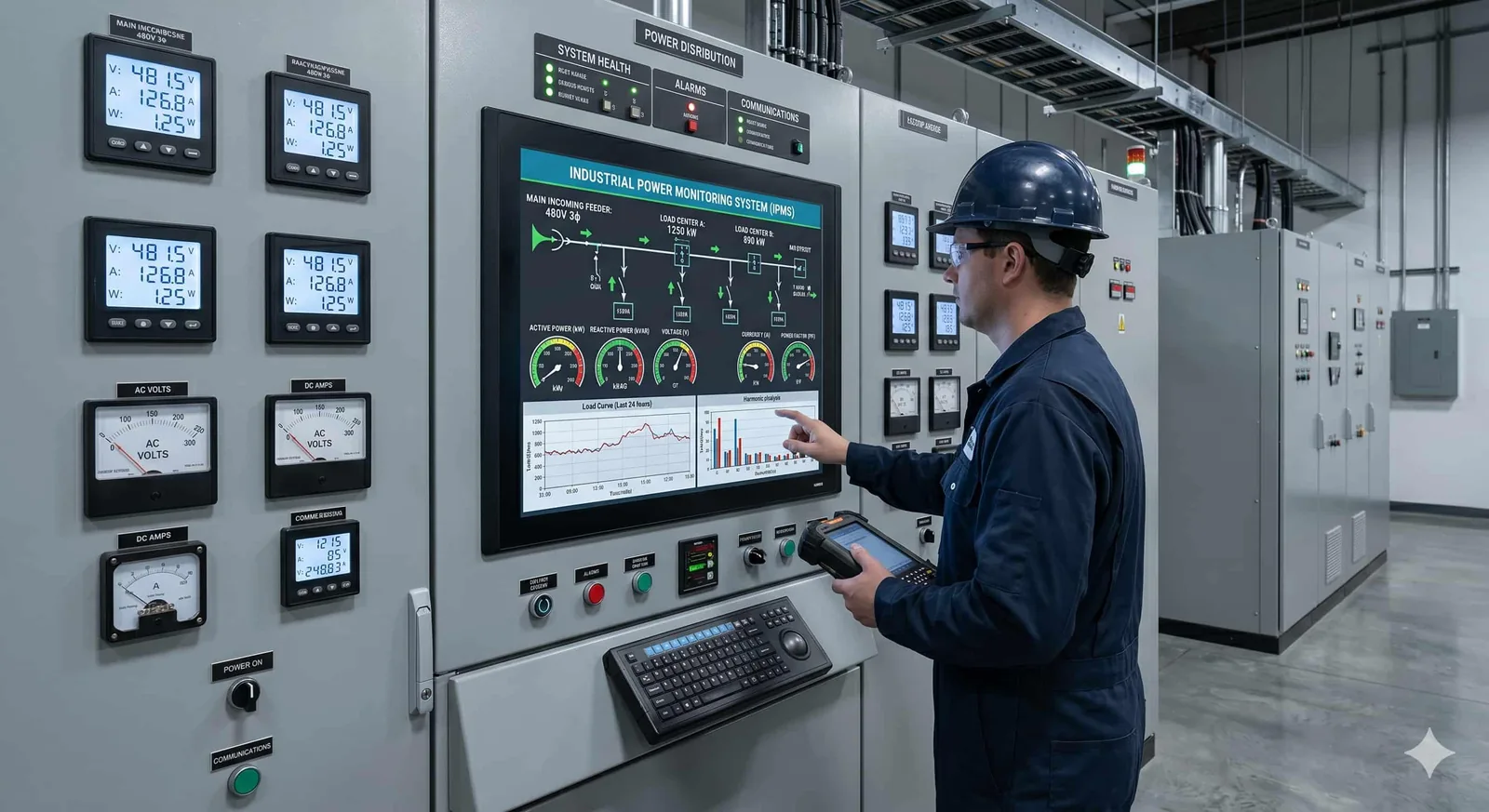
DeviceLab provides end-to-end design and implementation of industrial energy telemetry systems: * Industrial IoT Data Loggers: DIN-rail gateways featuring 2.5kVrms isolated RS485 ports, wide 9–36VDC power inputs, and offline Flash data buffering. * Multi-Protocol Support: Native conversion between Modbus RTU, Modbus TCP, MQTT, and OPC UA. * Turnkey Hardware & Dashboard Integration: Delivering complete solutions from field CT installation to executive web dashboard commissioning.
Learn more about our services: DeviceLab Engineering Capabilities →
What to Prepare Before Inquiring
To receive a tailored technical assessment, prepare: 1. Electrical single-line diagrams (SLD) of your facility. 2. Main incomer breaker ratings and transformer capacities. 3. List of primary workshops and high-consumption equipment. 4. Preferred data hosting model (on-premise server vs. cloud dashboard).
Frequently Asked Questions (FAQ)
Công tơ điện thông minh là gì?
A digital instrument that measures multi-phase electrical parameters (voltage, current, power, energy, power factor) and transmits real-time telemetry over digital communication buses (RS485/Ethernet) to energy management software.
Công tơ điện thông minh khác công tơ điện thông thường thế nào?
Traditional meters only display cumulative kWh on a mechanical dial. Smart meters calculate true RMS voltage, current, peak demand, harmonics, and transmit data digitally in real time.
Công tơ điện thông minh có kết nối RS485 không?
Yes. Industrial digital power meters standardly incorporate RS485 serial ports communicating over the Modbus RTU protocol.
Modbus trong công tơ điện dùng để làm gì?
Modbus is the open communication protocol used by gateways and SCADA systems to query and extract voltage, current, and energy register values from the meter.
Có thể đọc dữ liệu công tơ điện từ xa không?
Yes. By interfacing meters with an industrial IoT gateway connected via Ethernet or 4G LTE, data is monitored remotely via web browsers or mobile apps.
Công tơ điện 3 pha có thể đưa dữ liệu lên dashboard không?
Yes. Gateways convert serial meter telemetry into MQTT or HTTP JSON payloads, updating web dashboards and time-series databases in real time.
Có thể dùng nhiều công tơ trên cùng một hệ thống không?
Yes. Up to 32 meters can be daisy-chained along a single RS485 bus, and multi-port gateways can aggregate hundreds of meters across multiple switchboards.
Cần bao nhiêu điểm đo để giám sát điện năng nhà máy?
A typical factory starts with 1 main incomer meter, expanding to 5–15 sub-meters across major production lines and auxiliary utility equipment.
Có thể dùng công tơ COTS để xây dựng hệ thống Energy Monitoring không?
Yes, standard COTS meters paired with an intelligent IoT gateway form a robust, cost-effective energy management architecture.
Khi nào cần gateway riêng?
When monitoring heterogeneous meter brands, requiring offline Flash data buffering during network drops, or operating in severe high-noise environments.
Có thể tích hợp dữ liệu công tơ vào SCADA/MES không?
Yes. Gateways expose normalized OPC UA or Modbus TCP data trees directly accessible by SCADA and MES software.
Có thể phát triển hệ thống giám sát điện năng theo yêu cầu không?
Yes. DeviceLab delivers bespoke energy telemetry hardware, custom data loggers, and tailored software analytics for enterprise clients.
Conclusion
A smart energy monitoring system transforms electricity from an uncontrollable overhead expense into an optimized, predictable operational resource.
Start with a clear single-line survey and proof-of-concept pilot to benchmark energy savings and achieve rapid ROI.
Contact DeviceLab for an Energy Monitoring System Consultation →
Engineering Guides & Satellite Articles Directory in Factory Energy Monitoring & EMS
Complete technical documentation, wiring schematics, and field implementation guides in this cluster:
- Greenhouse Gas Inventory & Automated Energy Metering under Decision 42
- Factory Energy Monitoring System (EMS) Installation Cost 2026: Itemized Pricing & ROI Analysis
- What is EMS Software? Criteria for Choosing an Energy Management System for Modern Factories
- Energy Metering & Panel Temperature Monitoring for Air Compressors
Cross-Disciplinary Reference: Explore factory-wide IIoT machine connectivity and automated OEE calculation in our handbook: What is Industrial IoT (IIoT)? Architecture & Roadmap.