Automated monitoring of reservoir water levels, spillway discharge, turbine discharge, and downstream minimum environmental flow is a mandatory legal obligation under Decree 53/2024/ND-CP and Circular 17/2021/TT-BTNMT for all small, medium, and large hydroelectric power projects operating in Vietnam. Telemetry systems must function reliably 24/7 in remote mountain canyons with extreme humidity, severe lightning exposure, and total absence of grid power, transmitting structured hydrological data and real-time surveillance images directly to the Department of Natural Resources and Environment (DONRE) and the Department of Industry and Trade (DOIT).
This technical guide is part of DeviceLab's comprehensive engineering handbook on automated groundwater and surface water monitoring.
For hydroelectric plant operators in Son La, Lai Chau, Ha Giang, Gia Lai, and Lam Dong, installing a compliant telemetry station often poses formidable technical hurdles: how to accurately compute spillway overflow and environmental bypass flow in the absence of commercial flow meters, how to power high-definition CCTV cameras off-grid year-round, and how to maintain continuous satellite/4G telemetry during torrential monsoon floods. This technical guide explores hydraulic discharge equations, 80GHz radar level selection, off-grid solar engineering, and edge-computing integration using the DeviceLab DL-ENV10 Datalogger.
Mandatory Hydropower Monitoring Parameters Under Decree 53/2024/ND-CP:
- Upstream Reservoir Level ($Z_{upstream}$): Measured continuously with millimeter precision ($pm 2mm$) using non-contact 80GHz radar transmitters.
- Downstream Tailrace Level ($Z_{downstream}$): Monitored to establish effective gross head and verify tailrace tailwater discharge.
- Minimum Environmental Flow ($Q_{min}$): The legal ecological flow required to maintain downstream river ecosystems, discharged through spillway conduits, bottom sluices, or dedicated environmental turbine units.
- Spillway Overflow Discharge ($Q_{spillway}$): Calculated in real time based on upstream head over spillway crest and gate opening aperture.
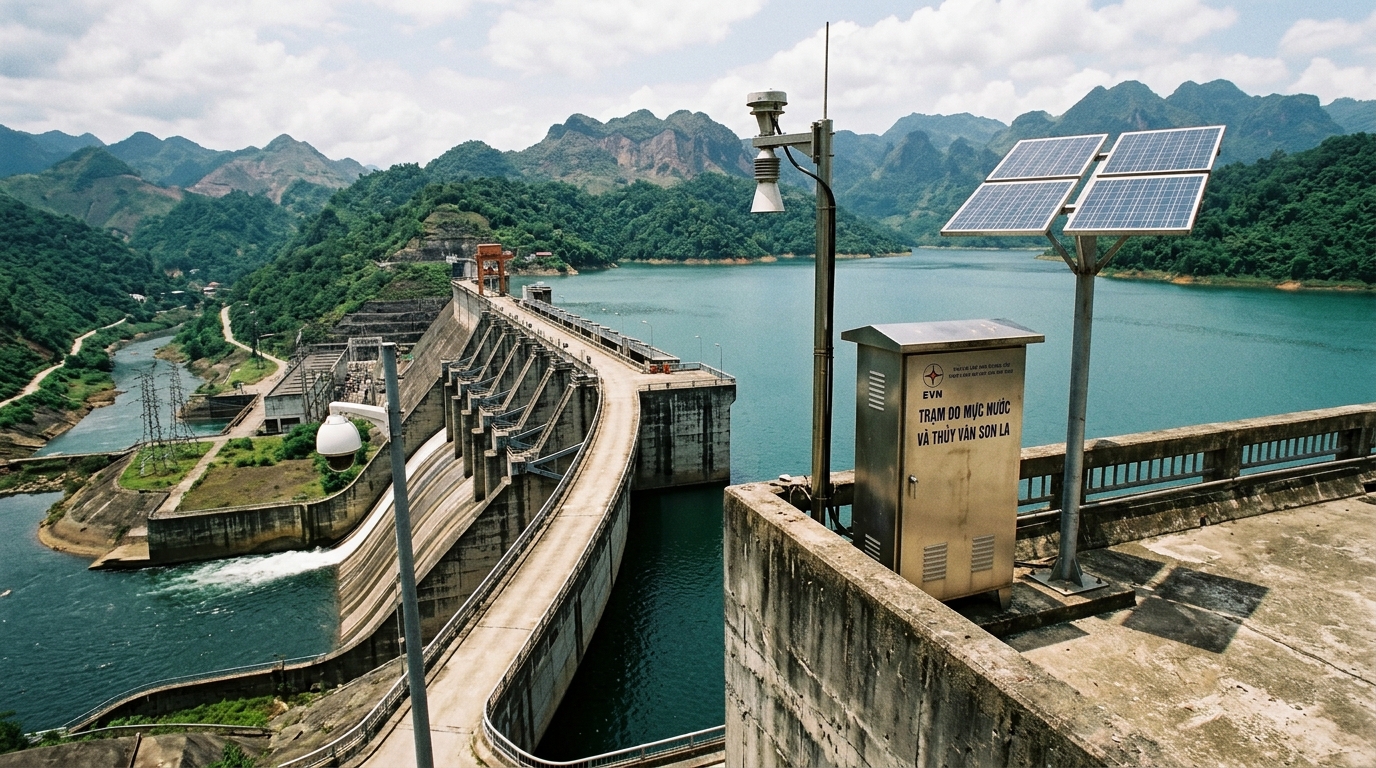
- Visual CCTV Surveillance: Pan-tilt-zoom or fixed outdoor IP cameras streaming real-time video snapshots of spillway discharge gates and the minimum flow outlet.
📑 Table of Contents
- 1. Mathematical Discharge Calculation for Spillways & Minimum Environmental Flows
- 2. Sensor Selection: Non-Contact 80GHz FMCW Radar Level Transmitters
- 3. High-Definition CCTV Camera System for Downstream Discharge Verification
- 4. Off-Grid Solar + LiFePO4 Energy Architecture for Rugged Mountain Operation
- Frequently Asked Questions (FAQ)

Mathematical Discharge Calculation for Spillways & Minimum Environmental Flows
Because physical open-channel flow meters cannot survive high-velocity dam spillway floodwaters, regulatory standards permit hydropower operators to compute discharge mathematically from precision water level sensors positioned upstream of calibrated hydraulic structures.
1.1. Hydraulic Equation for Free Broad-Crested Weirs & Spillways
When reservoir water spills naturally over an uncontrolled Ogee or broad-crested weir crest, discharge ($Q_{free}$) is governed by the standard weir equation:
Where: m is the discharge coefficient (calibrated from dam physical model tests, typically $0.42–0.49$), B is the effective crest width in meters, g is gravitational acceleration ($9.81 m/s²$), and H is the hydrostatic head over the crest ($H = Z_{upstream} - Z_{crest}$).
1.2. Controlled Discharge Through Radial / Sluice Gates
For dams with controlled radial gates, discharge ($Q_{gated}$) is determined based on gate opening height ($e$) and differential hydraulic head ($H_0$):
Where $mu$ is the submerged contraction coefficient, $b$ is gate width, $e$ is gate opening height (read via Modbus optical absolute encoders on the gate hoist), and $H_0$ is total upstream head.
1.3. Real-Time Edge Computing on DL-ENV10 Firmware
Historically, plant operators had to invest tens of thousands of dollars into industrial PLCs and SCADA software to run these discharge formulas. The DeviceLab DL-ENV10 Datalogger eliminates this entire expense. Engineers simply enter the weir dimensions and discharge coefficients directly into the DL-ENV10 Web Dashboard. The embedded ARM microprocessor evaluates these polynomial formulas once every 10 seconds, computing instantaneous flow ($m³/h$ or $m³/s$), cumulative discharge ($m³$), and minimum environmental compliance in real time.
Sensor Selection: Non-Contact 80GHz FMCW Radar Level Transmitters
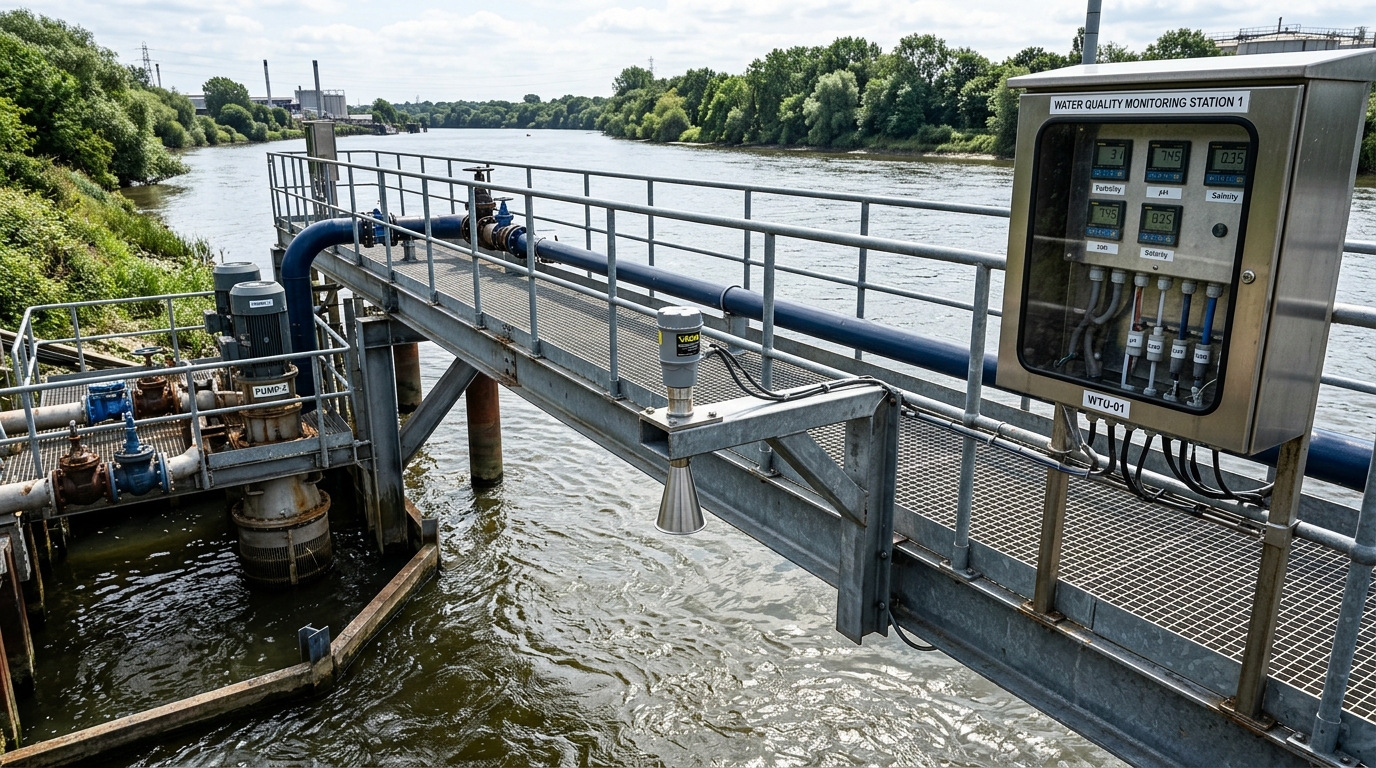
Submersible pressure sensors and ultrasonic sensors perform poorly in hydropower reservoirs due to silt accumulation, floating debris, heavy wind waves, and turbulent foam. For dams and rivers, the industry standard is 80GHz Frequency Modulated Continuous Wave (FMCW) Radar Level Transmitters:
- Narrow 3° to 8° Beam Angle: Concentrates microwave energy within a tight beam, completely eliminating false echo reflections from dam abutment walls, intake trash racks, and bridge piers.
- Millimeter Measurement Accuracy ($pm 2mm$): Essential because a $1cm$ water level error over a massive dam spillway translates into dozens of cubic meters per second of calculated discharge error.
- 100% Non-Contact Installation: The sensor is mounted securely on a bridge girder or cantilever bracket above the highest probable flood line, completely protected from submerged debris, mud, and water turbulence.
High-Definition CCTV Camera System for Downstream Discharge Verification
Circular 17 and provincial DONRE guidelines require visual confirmation alongside numeric data. Hydropower stations must install outdoor IP security cameras providing continuous live streaming or automated snapshot transmission:
- Installation Locations: Camera 1 captures the dam upstream crest and radial spillway gates; Camera 2 captures the minimum environmental flow outlet discharging into the natural downstream riverbed.
- Industrial Specifications: IP67 weatherproof rating, minimum 2.0–4.0 Megapixel resolution, Smart IR night vision (50m–100m range), and support for standard ONVIF / RTSP streaming protocols.
- Bandwidth Optimization: During normal operations, the system uploads scheduled JPEG snapshots once every 15 to 30 minutes over 4G to save cellular bandwidth, automatically switching to continuous RTSP video streaming during flood gate operations.
Off-Grid Solar + LiFePO4 Energy Architecture for Rugged Mountain Operation
Because dam crests and downstream discharge chutes are often located kilometers away from the central powerhouse electrical switchgear, running AC grid cables is cost-prohibitive. DeviceLab engineers deploy dedicated off-grid solar telemetry packages:
- Photovoltaic Solar Array: 150W to 300W Monocrystalline solar panels mounted on anti-typhoon galvanized steel brackets tilted at $15^circ–20^circ$.
- Industrial MPPT Solar Charge Controller: Maximum Power Point Tracking (MPPT) with over 98% conversion efficiency, maximizing harvest during overcast, rainy monsoon weeks.
- Lithium Iron Phosphate (LiFePO4) Battery Pack: 12.8V 50Ah to 100Ah battery bank rated for over 3,500 charge cycles, providing 5 to 7 days of autonomous continuous operation in zero-sunlight conditions.
- Ultra-Low Power Datalogger: The DL-ENV10 consumes less than $1.2W$ in continuous active transmission mode, guaranteeing non-stop uptime.