Surface water intake pumping stations (raw water intake stations on rivers, lakes, and reservoirs) are the critical primary infrastructure supplying raw water to municipal clean water treatment plants, industrial zones, and major agricultural irrigation networks. Under the Law on Water Resources 2023, Decree 53/2024/ND-CP, and Circular 17/2021/TT-BTNMT, all surface water exploitation works with extraction capacities of 100 m³/day-night or greater must install automated, continuous telemetry systems monitoring extraction flow rates, intake water levels, and basic raw water quality indicators directly transmitting to the provincial Department of Natural Resources and Environment (DONRE).
This technical guide is part of DeviceLab's comprehensive engineering handbook on automated groundwater and surface water monitoring.
Unlike borehole well monitoring, river intake pumping stations face harsh hydrological dynamics: extreme seasonal water level fluctuations (flood vs dry season deltas exceeding 8 meters), floating logs and plastic debris, heavy siltation, and critical raw water quality threats like seasonal saline water intrusion. This engineering manual delivers a comprehensive blueprint for designing intake telemetry stations, selecting appropriate level and quality sensors, and deploying the DeviceLab DL-ENV10 Datalogger.
Mandatory Surface Water Extraction Parameters Under Decree 53/2024/ND-CP:
- River / Reservoir Intake Level: Monitored in meters ($m$) relative to national datum (Hon Dau datum), tracking riverbed level trends.
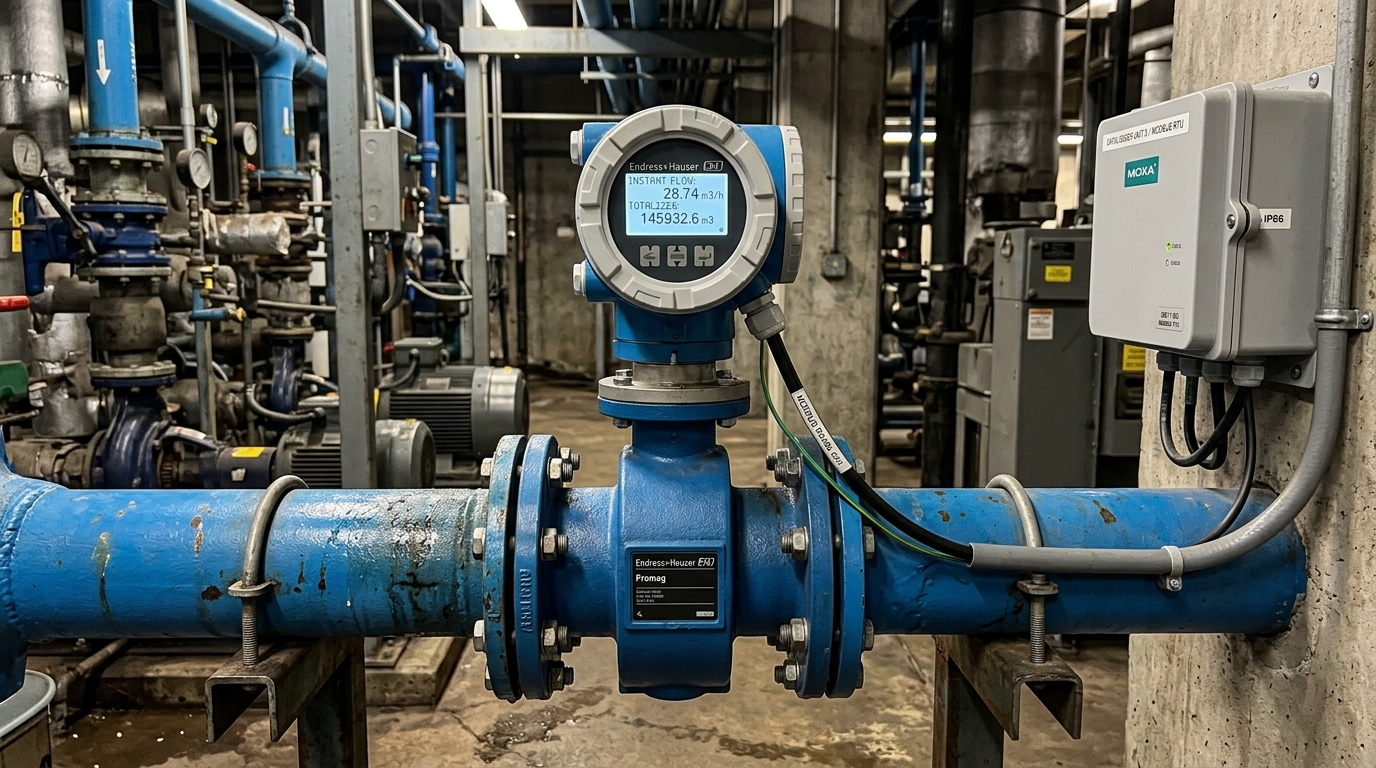
- Raw Water Extraction Flow Rate: Instantaneous discharge ($m³/h$) and cumulative extracted volume ($m³$) measured on main discharge headers.
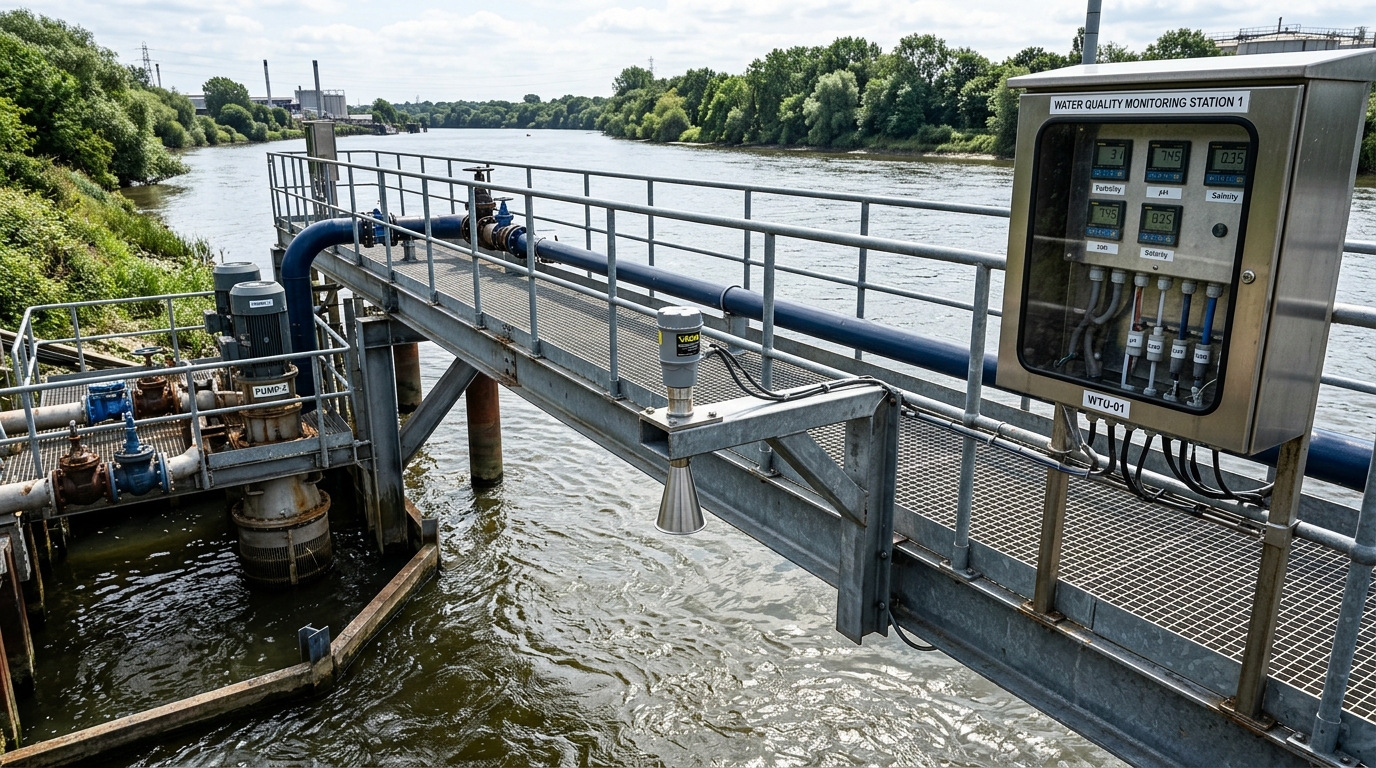
- Basic Raw Water Quality (Optional / Mandatory for large plants): pH, Electrical Conductivity (EC / Salinity in $g/L$ or $mS/cm$), Turbidity (NTU), and Temperature ($^circ C$).
- Transmission Standard: Automated transmission to DONRE every 1 hour via encrypted text files over FTP/SFTP protocol.
- Central Control Device: DeviceLab DL-ENV10 IoT Datalogger with multi-bus RS485 Modbus, analog inputs, and local automated interlock alarms.
📑 Table of Contents

Engineering Challenges of River Intake Stations
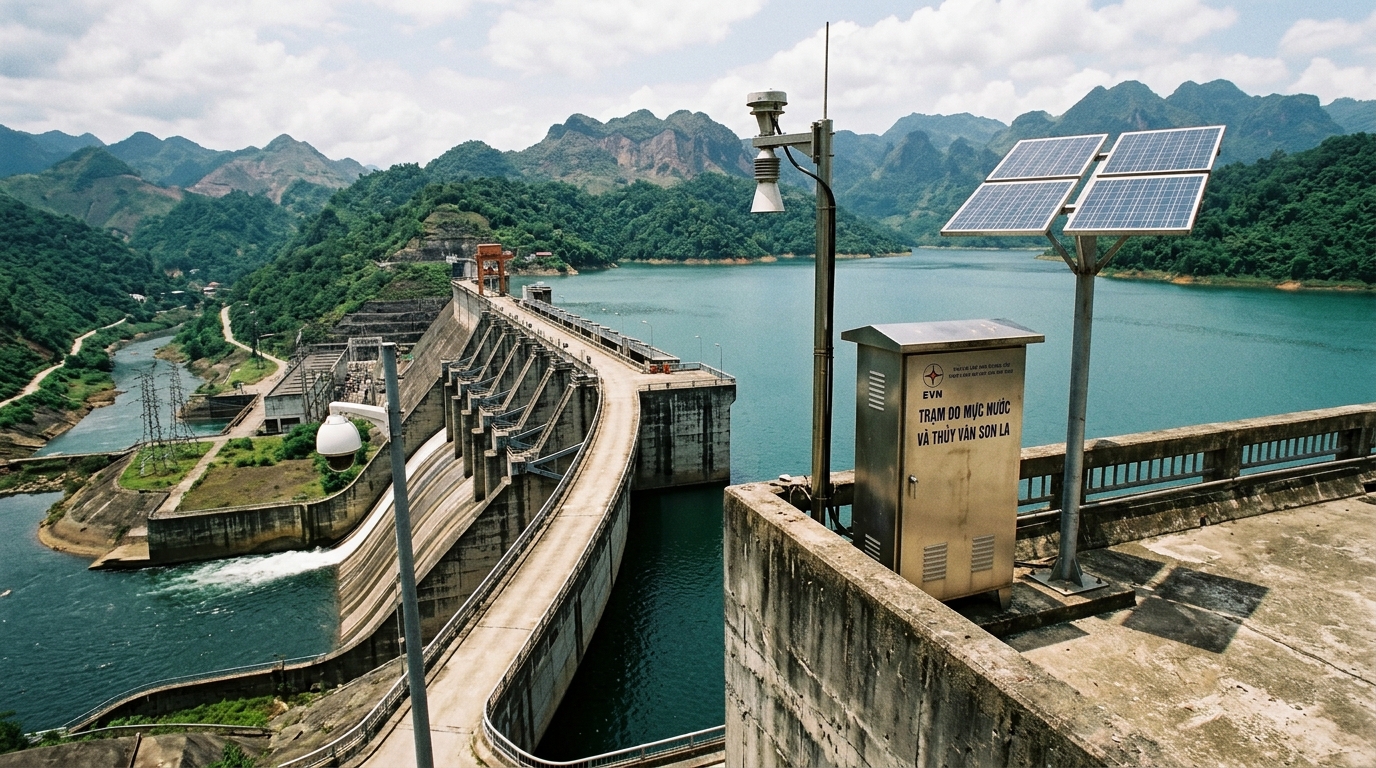
River intake stations present harsh environmental dynamics. The water level can surge rapidly during seasonal upstream storms and drop drastically during drought periods. Silt accumulation can bury submerged sensors, while river floating trash can snap sensor cables.
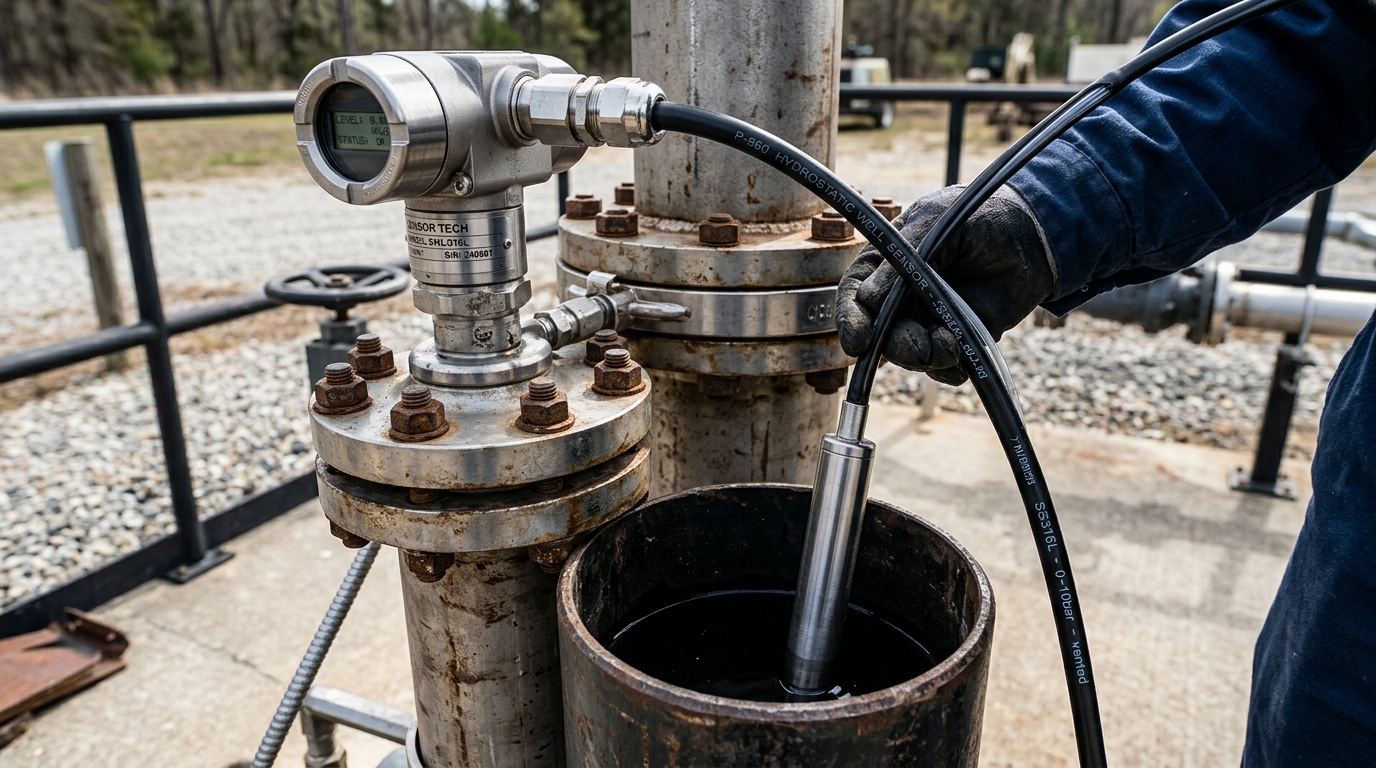
1.1. Comparing Surface Water Level Technologies: 80GHz Radar vs Ultrasonic vs Hydrostatic
| Evaluation Factor | Non-Contact 80GHz FMCW Radar | Ultrasonic Level Sensor | Submersible Hydrostatic Pressure |
|---|---|---|---|
| Contact with River Water | 100% Non-contact (Mounted above river) | Non-contact | Submerged directly into riverbed |
| Silt & Floating Trash Risk | Zero risk (Suspended 2m–15m above surface) | Zero direct risk | Very high (Buried by mud, snagged by debris) |
| Weather Immunity (Wind/Rain/Fog) | Totally immune (Microwave propagation) | Severely disrupted by ambient wind gradients | Good (Immune to surface air shifts) |
| Measurement Span | Up to 30m – 70m | Limited to 5m – 15m | Up to 50m |
| Industry Verdict | Top recommendation for river intake stations | Not recommended for exposed rivers | Acceptable only inside protected stilling wells |
Integrating Raw Water Quality Sensor Clusters into DL-ENV10
For clean water plants, monitoring incoming raw water quality is essential to adjust chemical dosing (alum, coagulants, chlorine) and protect consumers from sudden upstream contamination incidents.
2.1. Multi-Drop RS485 Architecture Consolidating All Sensors into 1 Gateway
Modern raw water intake stations integrate digital RS485 Modbus probes:
- Optical Dissolved Oxygen (DO) & Turbidity Sensors: Utilize optical backscatter and fluorescence technology with self-cleaning wiper arms to prevent biofilm fouling.
- Digital Glassless pH & Redox Sensors: Measure raw acidity and river buffering capacity.
- 4-Electrode Conductivity & Salinity Transmitters: Measure ion concentration across a wide range ($10 mu S/cm$ to $50,000 mu S/cm$).
All probes are connected on a shared, optically isolated RS485 Modbus trunk line directly to the DeviceLab DL-ENV10. This eliminates expensive multiple dedicated signal transmitters and integrates all parameters into a single telemetry package.
Automated Salinity Intrusion Warning to Protect Water Supply Operations
In coastal river basins (such as the Mekong Delta provinces: Tien Giang, Ben Tre, Tra Vinh, and Saigon-Dong Nai River networks), seasonal saltwater wedge intrusion travels dozens of kilometers inland during high tides and dry season low flows. When river salinity exceeds $0.25 g/L$ to $0.50 g/L$ ($400–800 mu S/cm$), water intake pumps must immediately halt to prevent salinization of urban clean water networks.
The DL-ENV10 datalogger handles this autonomously at the edge:
- Continuous scanning of raw water conductivity / salinity every 10 seconds.
- When salinity crosses user-configured caution thresholds, the DL-ENV10 instantly activates onboard digital relay outputs (DO), triggering local strobe sirens and sending automated SMS / Telegram alerts to plant operators.
- The datalogger can directly trip the intake pump control circuit, interlocking extraction pumps automatically before brackish water fills the plant's raw water holding reservoirs.
Automated Regulatory Transmission to DONRE Compliant with Circular 17
Every 1 hour (or 15 minutes as configured), the DL-ENV10 aggregates all river water levels, instantaneous pumping discharge, cumulative extraction volume, and water quality readings. The firmware encodes data into standardized UTF-8 text files compliant with Circular 17/2021/TT-BTNMT formatting guidelines, establishing a secure connection to the provincial Department of Natural Resources and Environment (DONRE) via FTP or SFTP.