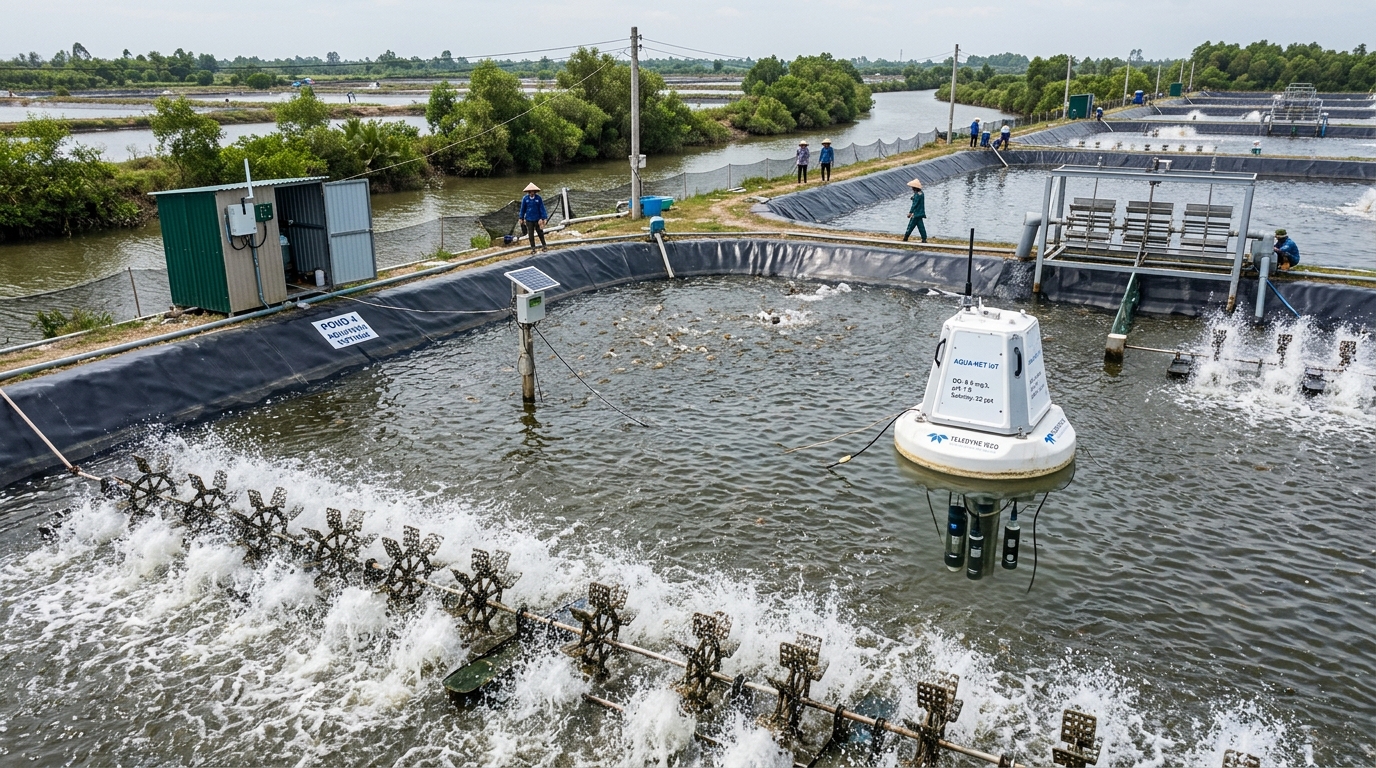
Automated water quality monitoring and intelligent aeration paddlewheel control are vital core technologies for modern intensive and super-intensive shrimp farming (Litopenaeus vannamei and Penaeus monodon) across the Mekong Delta (Soc Trang, Bac Lieu, Ca Mau, Ben Tre). Maintaining continuous real-time control over Dissolved Oxygen (DO), pH, Salinity, Temperature, and Oxidation-Reduction Potential (ORP) is the difference between bumper harvest profits and catastrophic stock die-offs.
This technical guide is part of DeviceLab's comprehensive engineering handbook on automated groundwater and surface water monitoring.
In high-density aquaculture ponds, over 80% of mass mortality incidents occur abruptly between 02:00 AM and 04:00 AM, when algal respiration consumes residual dissolved oxygen, causing DO levels to plummet below $2.5 mg/L$. Farmers relying on manual hand-held test kits or delayed testing cannot react in time. This engineering guide explores aquaculture water quality dynamics, industrial RS485 optical sensor chains, automated paddlewheel aerator control loops, and cloud telemetry using the DeviceLab DL-ENV10 platform.
Critical Aquaculture Water Quality Thresholds:
- Dissolved Oxygen (DO): Optimal: $5.0–8.0 mg/L$. Critical warning threshold: $< 4.0 mg/L$. Lethal asphyxiation threshold: $< 2.5 mg/L$.
- Acidity (pH): Optimal: $7.5–8.3$. Permissible daily diurnal fluctuation: $Delta pH < 0.5$. Acid shock: $< 7.0$; toxic ammonia spike: $> 8.8$.
- Salinity: Optimal for whiteleg shrimp: $10–25 ppt$ ($g/L$). Must be monitored to control osmoregulation stress.
- Oxidation-Reduction Potential (ORP): Optimal bottom sediment health: $> +150 mV$. Anaerobic sludge decay: $< 0 mV$ (indicating toxic $H_2S$ generation).
- Central Control Device: DeviceLab DL-ENV10 featuring automated aerator relay outputs, mobile SMS sirens, and cloud app sync.
📑 Table of Contents

Mitigating the Midnight Dissolved Oxygen Drop (02:00 – 04:00 AM)
In high-density aquaculture ponds, phytoplankton photosynthesis generates abundant oxygen during daylight hours. However, after sunset, photosynthetic production ceases, and dense microalgae, aerobic bacteria, and biomass switch entirely to respiration, consuming massive volumes of oxygen. By 02:00 AM, dissolved oxygen drops precipitously.
If aerators fail or are shut down to save electricity costs, shrimp suffer acute hypoxia, congregating at the pond surface gasping for air, followed by mass mortality. Automated online monitoring with instant closed-loop aerator tripping is the only reliable safeguard against midnight stock loss.
Industrial Optical RS485 Sensor Chain Integration into DL-ENV10
| Aquaculture Sensor | Technology | Measuring Range | Biofouling Protection |
|---|---|---|---|
| Optical Dissolved Oxygen (DO) | Fluorescence Phase Shift | 0.00 – 20.00 mg/L (±0.1 mg/L) | Requires zero electrolyte; automated motorized wiper |
| Digital pH & Temp Probe | Polymer Gel Solid Reference | 0.00 – 14.00 pH (±0.05 pH) | Clog-resistant annular PTFE junction |
| 4-Electrode Salinity / EC | Electromagnetic 4-pole AC | 0.1 – 50.0 ppt / 0–100 mS/cm | Immune to electrode polarization |
| Sediment ORP Probe | Platinum Electrode Ring | -2000 mV to +2000 mV | Tracks bottom sludge anaerobiosis |
Automated Closed-Loop Aerator Control & Mobile Warning Matrix
The DeviceLab DL-ENV10 Datalogger forms an autonomous edge control loop:
- Smart DO Threshold Triggering: When pond DO falls below $4.0 mg/L$, relay DO1 automatically engages the magnetic contactor of paddlewheel aerators and venture injectors. When DO recovers to $6.0 mg/L$, aerators power down, saving 25–40% in monthly electricity bills.
- Immediate Audio-Visual Sirens: If DO drops critically below $3.0 mg/L$, onboard relays trigger high-decibel outdoor sirens and strobe beacons at the farm guardhouse.
- Multi-Channel Mobile Alerting: The internal 4G modem instantly broadcasts automated voice calls, SMS messages, and Telegram notifications directly to farm managers' smartphones.