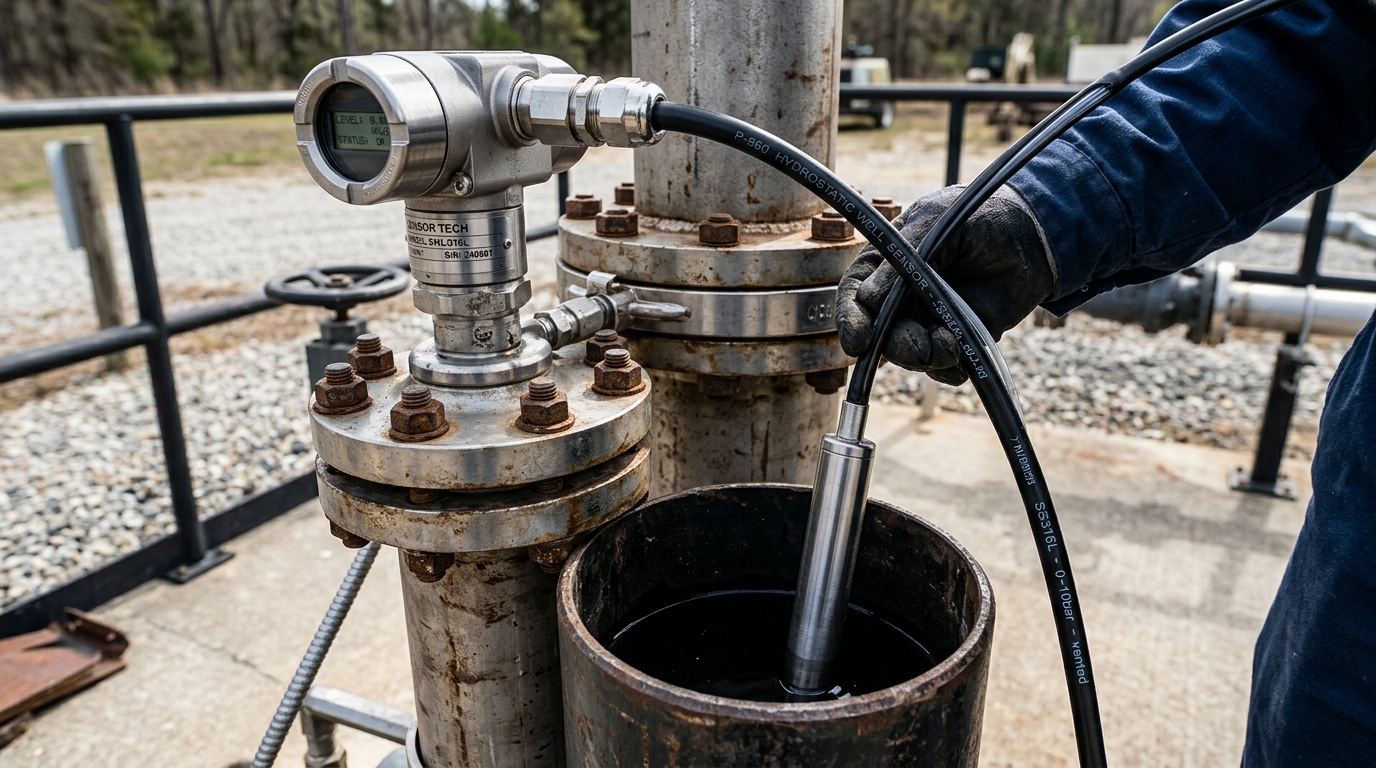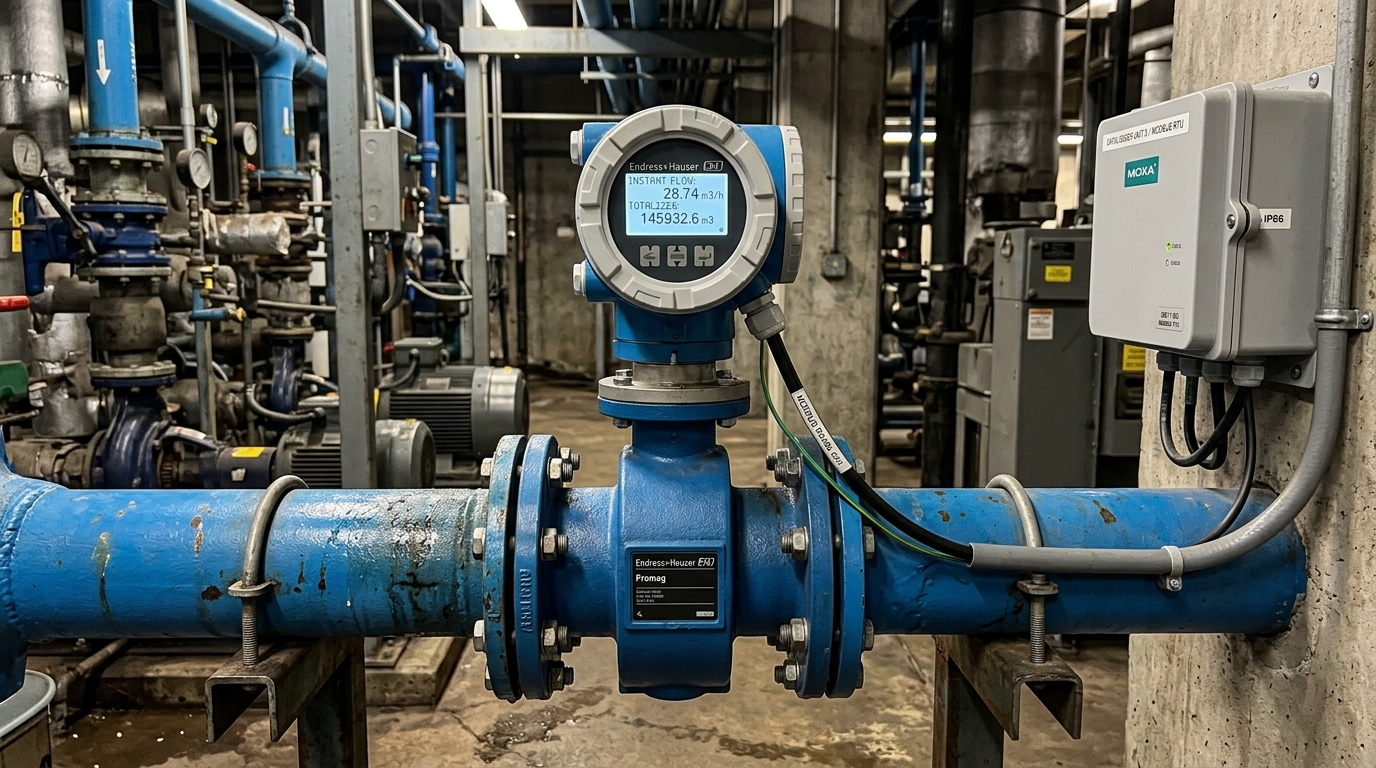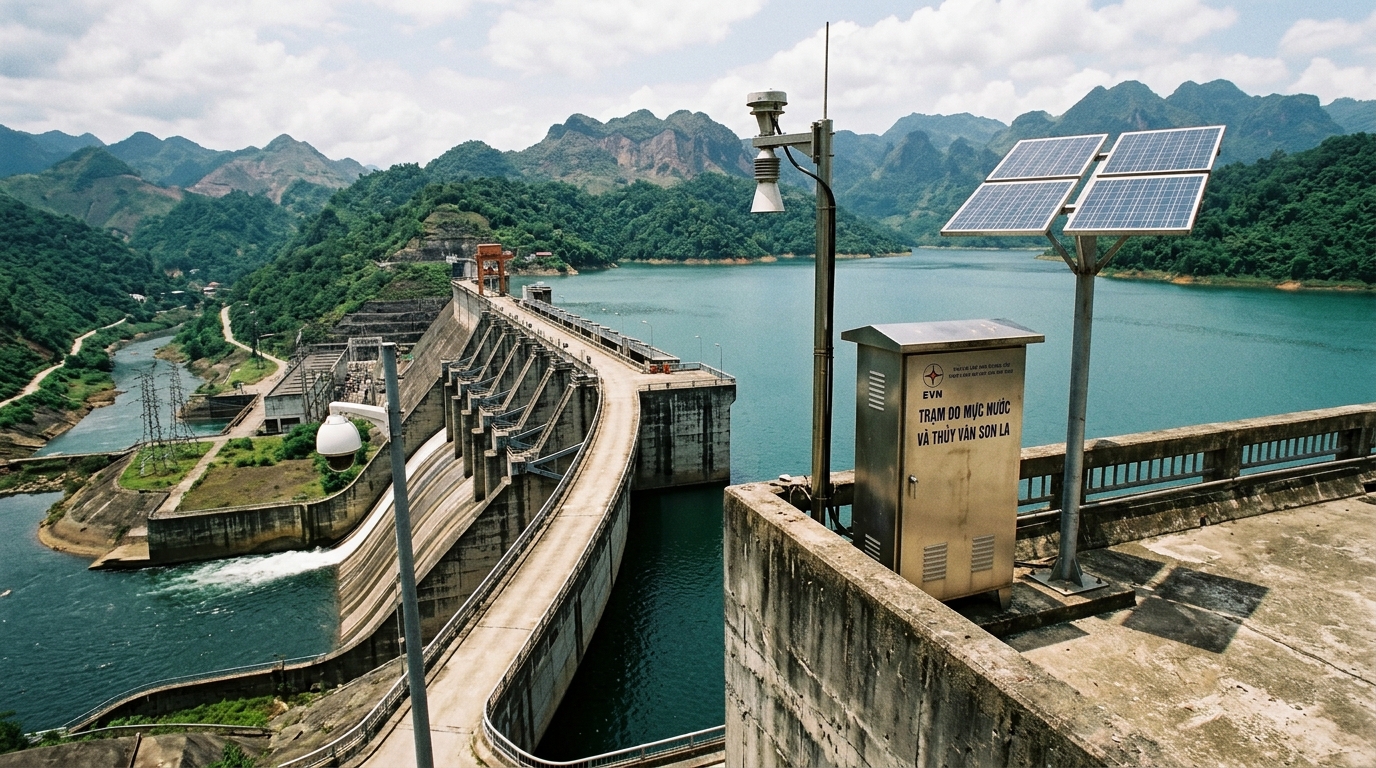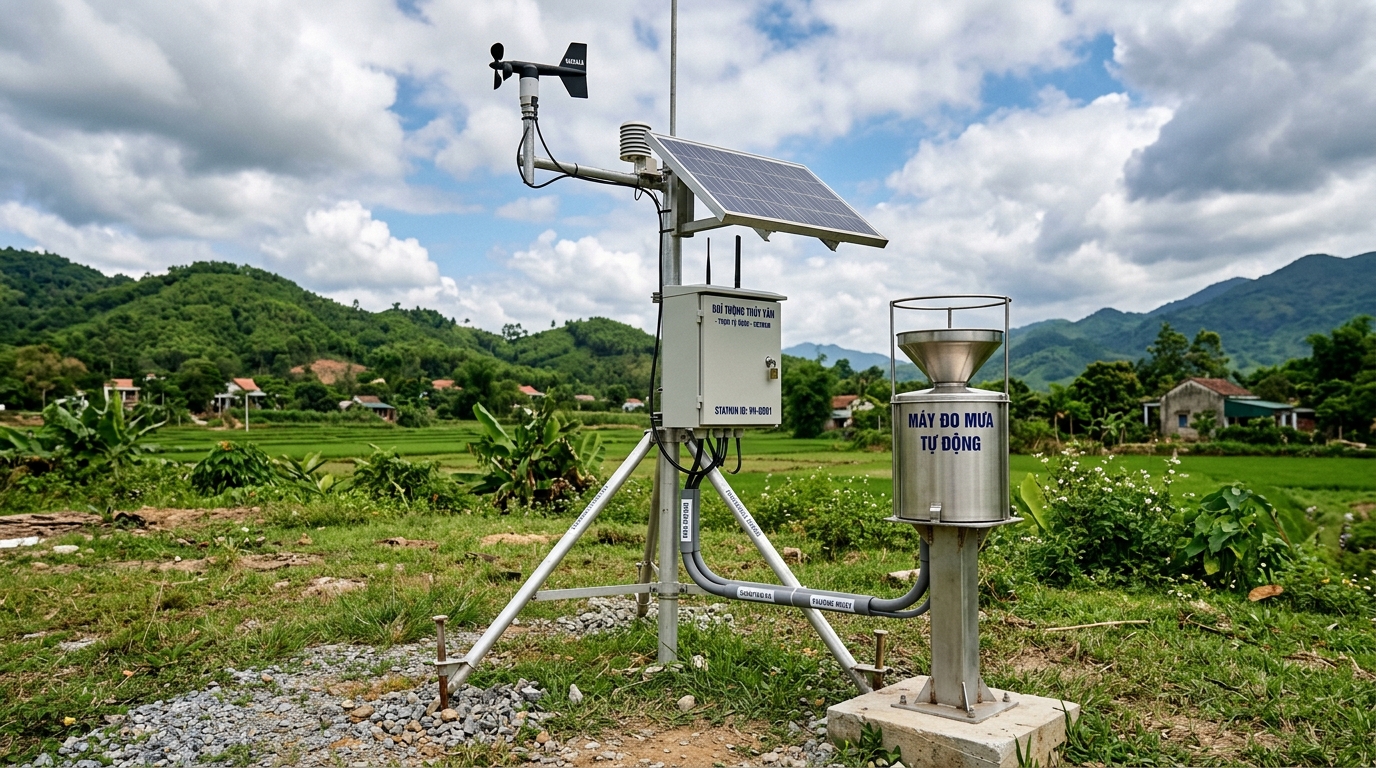
Automated weather stations (AWS) and rainfall telemetry stations are indispensable hydrometeorological infrastructure mandated under Decree 53/2024/ND-CP for reservoir flood control, hydropower dam safety, agricultural irrigation, and natural disaster early warning systems across Vietnam. In remote mountain basins subject to extreme tropical typhoons, dataloggers must maintain microsecond-accurate pulse counting from tipping bucket rain gauges without dropping a single pulse, while interfacing with multi-parameter meteorological sensor clusters and running entirely on off-grid solar power.
This technical guide is part of DeviceLab's comprehensive engineering handbook on automated groundwater and surface water monitoring.
Field hydrologists frequently encounter chronic telemetry failures: pulse contact bouncing that double-counts rainfall during violent cloudbursts, dataloggers sleeping so deeply that they miss sudden rain bucket tips, or lightning surges induced on tall meteorological towers that destroy RS485 wind sensors. This technical manual details tipping bucket pulse acquisition physics, hardware de-bouncing circuits, and multi-sensor integration using the DeviceLab DL-ENV10 Datalogger.
Standard Meteorological Station Specifications (Decree 53/2024/ND-CP):
- Precipitation / Rainfall: Tipping bucket rain gauge ($0.1mm, 0.2mm, or 0.5mm$ per tip) measuring instantaneous rain intensity ($mm/h$) and cumulative rainfall ($mm$).
- Wind Parameters: Ultrasonic or mechanical 3-cup anemometer measuring wind speed ($0–60 m/s$, $pm 0.3m/s$) and wind direction ($0–360^circ$).
- Atmospheric Suite: Air temperature ($^circ C$), Relative humidity ($%RH$), and Barometric pressure ($hPa$).
- Solar Radiation: Silicon or thermopile pyranometer measuring global horizontal irradiance ($0–2,000 W/m²$).
- Central Telemetry Unit: DeviceLab DL-ENV10 featuring high-speed hardware interrupt counters, RS485 Modbus, and ultra-low power solar operation ($< 1.0W$).
📑 Table of Contents

Zero-Loss Pulse Counting Principles for Tipping Bucket Rain Gauges
A tipping bucket rain gauge collects rainfall through an aerodynamic funnel into a calibrated dual-chamber rocker bucket. When $0.2mm$ of rain accumulates, the bucket tilts, momentarily sweeping a small permanent magnet across a hermetically sealed glass reed switch, generating a momentary closure pulse.
1.1. Mechanical Reed Switch Contact Bouncing
When mechanical reed contacts slap together, they physically chatter (bounce) for 2 to 5 milliseconds before settling. Standard microcontrollers without de-bouncing register this single bucket tip as 4 to 8 separate rain events, multiplying reported rainfall totals exponentially!
1.2. Hardware RC Low-Pass Filter & Microcontroller Edge Interrupts
The DeviceLab DL-ENV10 resolves this through dedicated hardware filtering:
- An onboard analog RC filter ($R = 10kOmega, C = 100nF, au = 1.0ms$) clamps high-frequency bounce spikes.
- A Schmitt-trigger digital buffer provides hysteresis, producing a single clean falling edge.
- The pulse triggers a high-priority hardware interrupt that instantly awakens the MCU from low-power sleep, increments the cumulative 32-bit rain counter in non-volatile flash, and immediately returns the MCU to sleep, consuming less than $50mu A$ quiescent current.
Integrating Wind, Solar Radiation & Water Level Sensors via RS485 Modbus
| Meteorological Sensor | Interface / Protocol | DL-ENV10 Channel | Measurement Range & Accuracy |
|---|---|---|---|
| Tipping Bucket Rain Gauge | Pulse Contact (Reed Switch) | PULSE1 / DI1 | 0.2mm or 0.5mm per tip (Accuracy ±2%) |
| Ultrasonic Wind Sensor (2D) | RS485 Modbus RTU | RS485 Port 1 | Speed 0–60 m/s (±0.3m/s), Direction 0–360° (±3°) |
| Air Temp / Humidity / Pressure | RS485 Modbus RTU | RS485 Port 1 (Daisy-chain) | -40°C to +80°C, 0–100% RH, 300–1100 hPa |
| Solar Radiation Pyranometer | 0–2.5V Analog or RS485 | AI1 / RS485 Port 2 | 0 to 2,000 W/m² (ISO 9060 Class C) |