Installing automated IP camera surveillance systems transmitting live video feeds directly to the Department of Natural Resources and Environment (DONRE) is a mandatory technical regulation under Circular 10/2021/TT-BTNMT for automated wastewater, surface water, and industrial flue gas emission monitoring stations. Security cameras serve as the visual evidence layer, preventing unscrupulous enterprises from bypassing monitoring channels, tampering with sensor probes, or diluting effluent discharge streams with tap water.
This technical guide is part of DeviceLab's comprehensive engineering handbook on environmental monitoring datalogger compliant with Circular 10.
Across industrial parks in Bac Giang, Hai Duong, Binh Duong, and Long An, many enterprises face repeated delays during official DONRE acceptance audits because camera installations fail to meet technical guidelines: incorrect camera viewing angles, blurred night-vision footage, missing static IP addresses, or failing to maintain uninterrupted RTSP streaming over cellular 4G networks. This technical manual details required camera installation positions, industrial camera specifications, RTSP streaming configuration, and 4G VPN gateway integration using the DeviceLab DL-ENV10 platform.
Mandatory CCTV Standards Under Circular 10/2021/TT-BTNMT:
- Camera Resolution: Minimum Full HD 1080p ($1920 imes 1080$) with infrared (IR) night vision reaching $ge 30$ meters.
- Weather & Environmental Protection: Minimum IP66/IP67 ingress rating, IK10 vandal resistance, and wide operating temperature range ($-20^circ C$ to $+60^circ C$).
- Streaming Protocol: Real Time Streaming Protocol (RTSP) operating on standard Port 554, supporting ONVIF Profile S/G/T and periodic HTTP Snapshot capture.
- Data Retention & Network: Local NVR recording for at least 30 days, coupled with continuous static IP or dynamic DNS VPN tunnel transmitting live video to DONRE.
📑 Table of Contents

Camera Placement & Viewing Angles Required for DONRE Acceptance
To pass official acceptance inspections, cameras must be deployed in exact designated locations with unobstructed fields of view:
1.1. Camera #01: Indoor Monitoring Station Shelter Overview
Mounted inside the shelter at an elevated corner angle. The camera field of view must clearly capture:
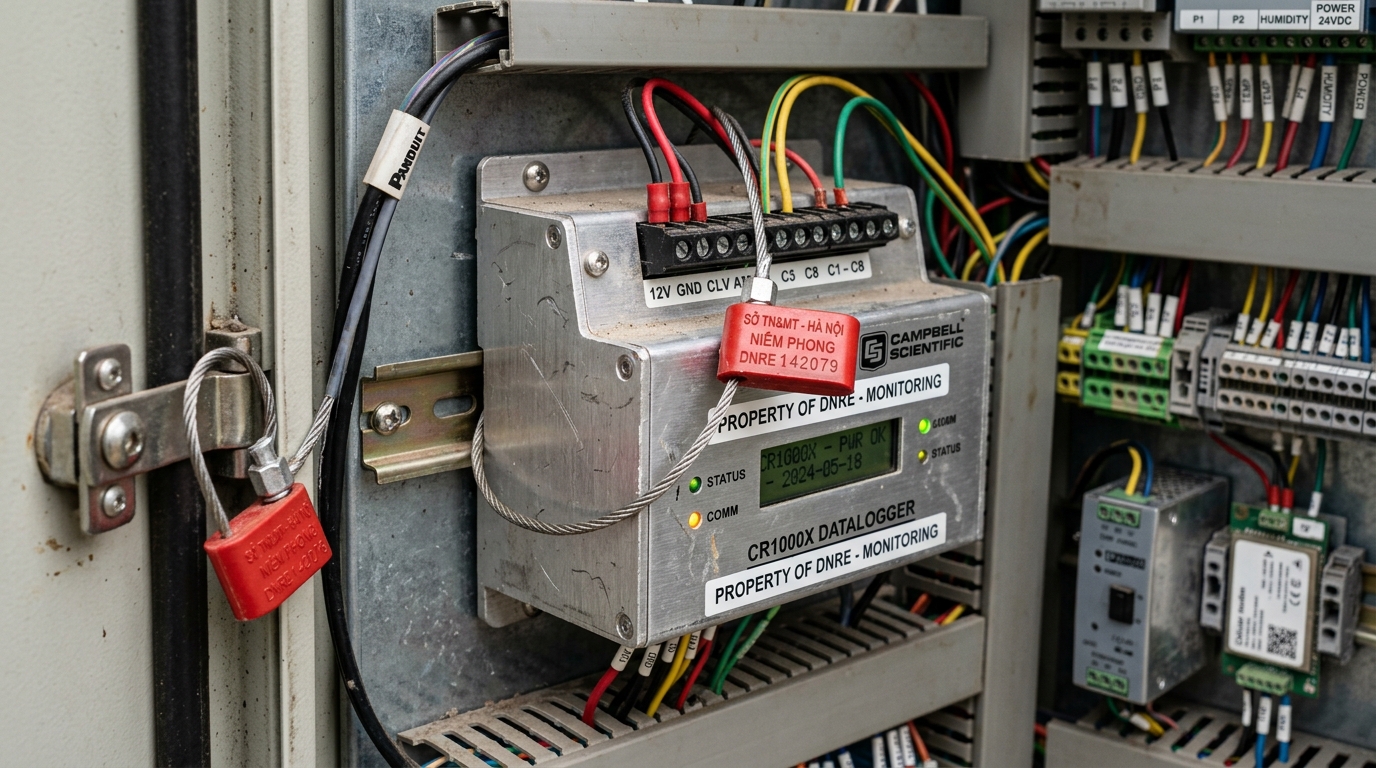
- The front panel of the main Datalogger cabinet and measurement analyzers.
- The automatic 24-bottle refrigerated water sampler door.
- The main entrance door of the shelter, visually logging all personnel entering or exiting the station.
1.2. Camera #02: Final Wastewater Discharge Flume & Outfall
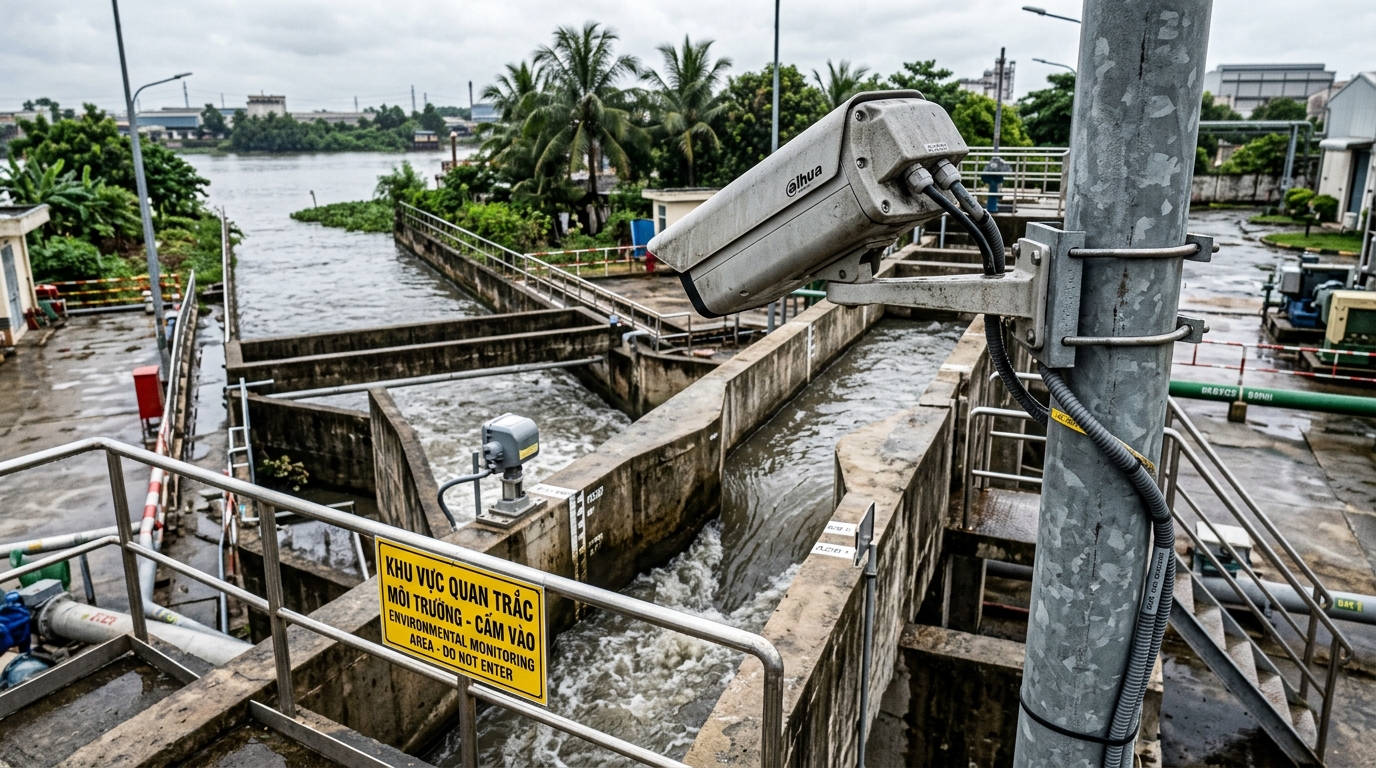
An outdoor weatherproof bullet or PTZ camera mounted directly above the final discharge weir (Parshall flume or V-notch weir). The frame must clearly capture:
- The open water flow surface, allowing visual verification of wastewater color, foam, or floating oil slicks.
- The physical immersion location of sensor measuring probes (pH, TSS, DO) and the sampler intake suction hose.
- The discharge outlet discharging into the receiving environment (canal, river, or public drainage pipe).
1.3. Cameras for Hydropower & Water Resource Extraction Works
For dams and hydropower stations under Decree 53, cameras must focus directly on the downstream minimum environmental flow discharge culvert and the spillway radial crest gates.
RTSP Stream Configuration & 4G Video Transmission Architecture
DONRE monitoring servers ingest video via the Real Time Streaming Protocol (RTSP):
2.1. Industrial RTSP URL Syntax Format
Engineering Tip: Always provide the Sub-Stream (CIF / 720p at 10–15 fps) to DONRE rather than the 4K Main-Stream. This reduces cellular bandwidth consumption by 80% while ensuring ultra-smooth streaming over cellular 4G connections.
2.2. Bypassing 4G CGNAT via Industrial VPN Routers
Mobile network operators (Viettel, Mobifone, Vinaphone) assign private dynamic IP addresses behind Carrier-Grade NAT (CGNAT), preventing incoming RTSP connections from reaching the camera. To overcome this, DeviceLab provides two proven solutions:
- Dedicated Industrial 4G Router with Static IP SIM: Using specialized M2M SIM cards provisioned with public static IPs.
- Site-to-Site WireGuard / OpenVPN Tunnel: The local gateway initiates an outbound encrypted tunnel to the provincial monitoring server, completely bypassing CGNAT blocks.