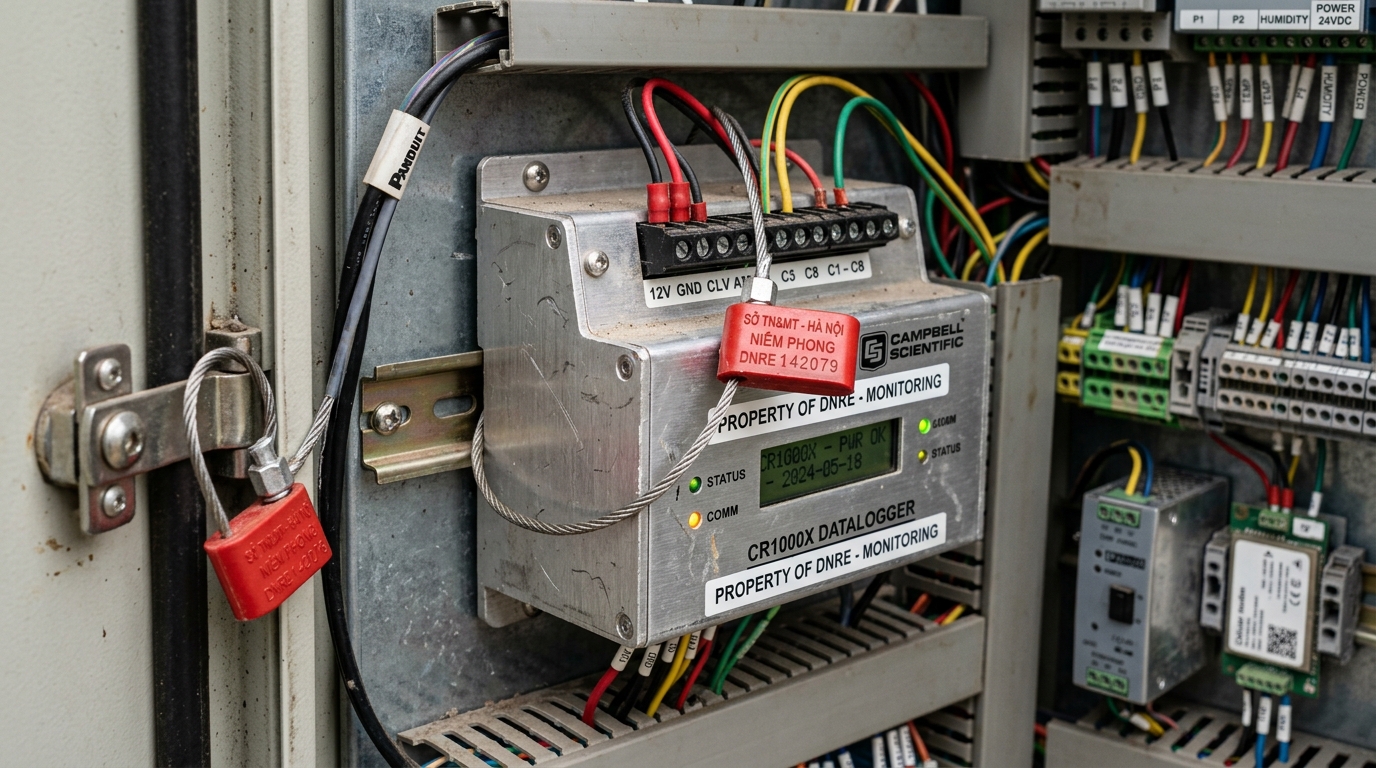
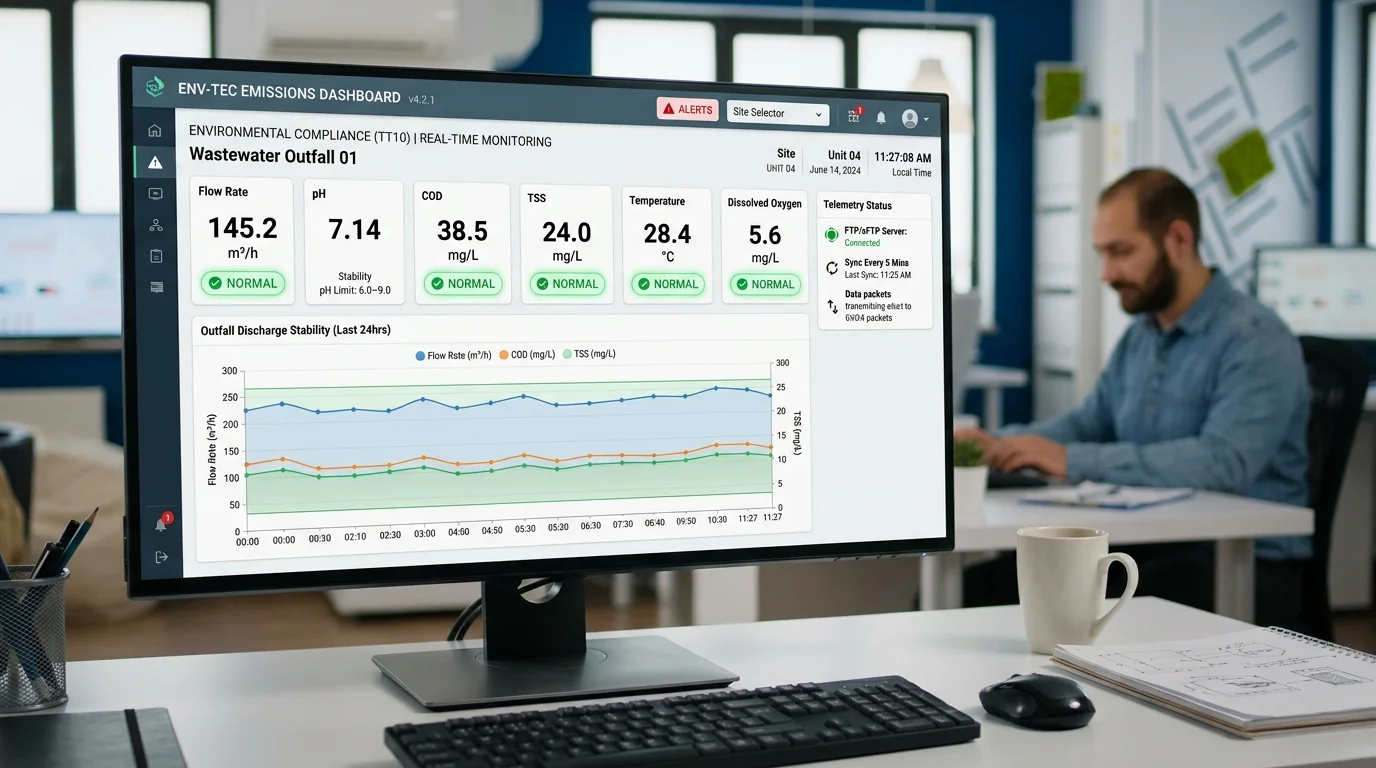
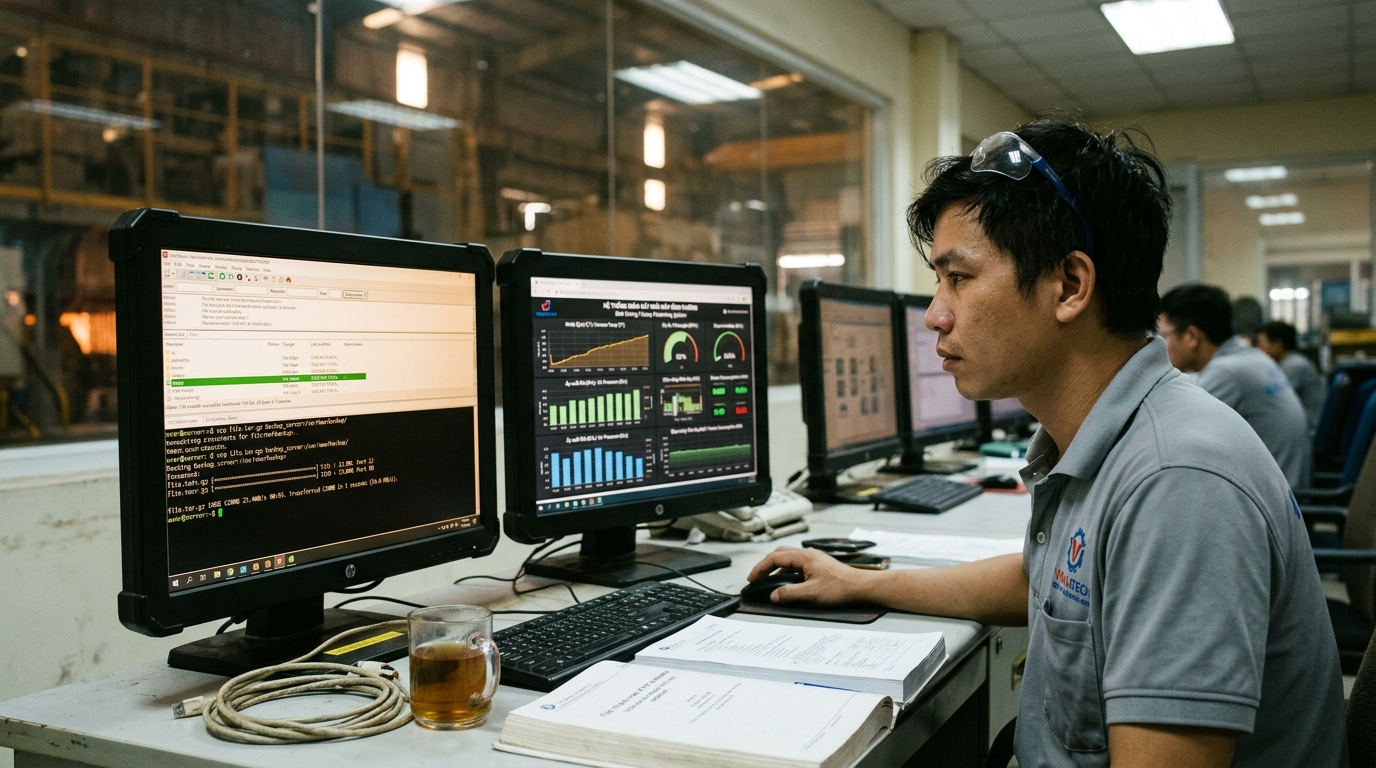
Telemetry dropouts between continuous automated environmental monitoring stations and provincial Department of Natural Resources and Environment (DONRE) servers represent an urgent operational emergency for automation engineers and environmental EPC contractors. This failure typically manifests on the DONRE monitoring portal as an "Offline" station status, fragmented time-series records, or missing 5-minute .txt file transmissions. This article delivers a comprehensive 5-step diagnostic methodology using field instrumentation alongside proven remediation protocols to eliminate root causes on-site.
This technical guide is part of DeviceLab's comprehensive engineering handbook on environmental monitoring datalogger compliant with Circular 10.
📌 Emergency Field Troubleshooting Summary (Key Takeaways):
- Primary Cause (45%): 4G Cellular / SIM Card Outages: Depleted high-speed data balances, modem supply voltage drops, or 4G antennas placed inside steel enclosures causing severe signal attenuation (RSSI < -95dBm).
- Secondary Cause (25%): Blown RS485 Transceivers due to Ground Loops: Unshielded or incorrectly dual-grounded sensor cables running from outdoor sumps causing ground potential shifts exceeding IC absolute maximum ratings.
- Tertiary Cause (15%): Unplanned Windows IPC Reboots: Background Windows Update installations or corrupted SSD sectors resulting from sudden power brownouts.
- Quaternary Cause (10%): Real-Time Clock (RTC) Drift: Depleted coin-cell RTC batteries causing timestamps to reset to the year 2000, triggering automatic file rejection by DONRE servers.
- Quinary Cause (5%): sFTP Directory Permission Errors on DONRE Host: Server-side IP reallocations, rotated passwords, or exhausted disk quotas in the destination directory.
Systematic 5-Step Fault Isolation Protocol for Monitoring Stations
Upon receiving a data loss notice from DONRE or the factory owner, commissioning engineers must avoid haphazardly power-cycling the equipment. Blindly rebooting erases volatile debug logs and obscures the underlying root cause. Follow this disciplined sequential workflow:
| 5-STEP FIELD DIAGNOSTIC WORKFLOW FOR TELEMETRY LOSS |
+-----------------------------------------------------------------------------------+
| STEP 1: Audit Front-Panel Status LEDs (Power, Run, Net 4G, RS485 TX/RX) |
| | |
| STEP 2: Verify 4G RSSI Signal Quality & Data Account via AT+CSQ Command |
| | |
| STEP 3: Measure RS485 Differential Voltage (V_A - V_B) Using a Digital Multimeter |
| | |
| STEP 4: Check Real-Time Clock (RTC) Timestamp Offset Against Reference NTP Time |
| | |
| STEP 5: Extract sFTP Transmission Debug Logs & Audit Server Response Codes |
+-----------------------------------------------------------------------------------+
Step 1: Inspect Status Indicator LEDs on the Datalogger
- NET / 4G LED Rapid Blinking: The cellular modem is searching for carrier registration or cannot read the inserted SIM card.
- NET LED Solid ON with No Data Flow: Cellular connectivity is established, but the device cannot ping the remote DONRE sFTP endpoint (due to incorrect domain/IP settings or carrier firewall port 22 blocking).
- RS485 LED Flashes TX (Transmit) with Zero RX (Receive): Field sensors fail to respond to Modbus query packets (damaged cabling, mismatched baud rate, or unpowered 24V transmitter loop).
Step 2: Measure RS485 Differential Voltage Using a Digital Multimeter (VOM)
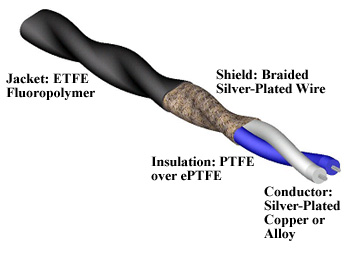
Physical communication layer degradation is the most prevalent field fault. Measure DC voltage across terminal pins A and B:
- In idle state, the standard differential voltage
V_A - V_Bmust range between +0.2V and +0.6V (maintained by bias pull-up/pull-down resistors). - If
V_A - V_B = 0V: The transmission line is open-circuit or the RS485 transceiver IC has suffered an electrical overstress breakdown. - If DC voltage between Pin A/B and Cabinet Ground exceeds ±7V: A severe ground potential difference is present between the sampling sump and the panel, requiring immediate installation of an optical isolator.

sFTP Transmission Error Code Lookup Table for DONRE Ingestion Systems
When reviewing device transmission logs, engineers frequently encounter standard SSH/sFTP protocol error codes. Use this table for rapid diagnosis and resolution:
| Error Code / Log String | Root Cause Mechanism | Immediate Field Remediation Action |
|---|---|---|
| SSH_AUTH_FAIL (Code 530) | Invalid Username or Password issued by provincial DONRE. | Cross-check official credential paperwork. Check case sensitivity and ensure no trailing whitespace exists in strings. |
| SFTP_NO_SUCH_FILE (Code 2) | Destination directory (Remote Directory) does not exist on the DONRE server. | DONRE assigns directories based on station codes (e.g., /DATA_REC/KCN_01/). Contact the provincial IT administrator to verify absolute path hierarchy. |
| SFTP_PERMISSION_DENIED (Code 3) | User account lacks write permissions in the allocated target folder. | Request the server administrator to execute chmod 755 or 775 on the assigned station ingestion directory. |
| CONNECTION_TIMEOUT / REFUSED | DONRE server is down or the local 4G modem has lost internet gateway routing. | Ping public DNS 8.8.8.8. If internet routing succeeds, initiate a manual sFTP connection over port 22 from an engineering laptop to verify server status. |
Long-Term Resolution: Replacing Fragile IPCs with Embedded FreeRTOS Dataloggers
After years of maintaining environmental stations across major industrial clusters in Bac Ninh, Hai Phong, and Binh Duong, DeviceLab's engineering teams reached an unmistakable conclusion: Windows-based industrial box PCs are fundamentally unsuitable for standalone continuous environmental monitoring enclosures.
To permanently eliminate downtime penalties, leading contractors standardize on dedicated embedded hardware running FreeRTOS, such as DeviceLab's DL-ENV10, engineered with 4 robust protective mechanisms:
- Independent Hardware Supervisory Watchdog IC: Completely decoupled from the primary MCU. If electromagnetic interference causes program execution to freeze for more than 15 seconds, the watchdog triggers a hard reset, restoring execution within 2 seconds.
- LittleFS Embedded File System on Industrial NOR Flash: Operates on Copy-on-Write (CoW) architecture. New records are committed to clean sectors before directory indices are updated, preventing file system corruption even during sudden total power blackouts.
- Multi-Stage Digital Filtering on Sensor Front-Ends: Suppresses high-frequency electrical noise generated by pump variable frequency drives, preventing artificial pH or COD spikes that cause false automated sampler actuations.
- Intelligent Throttled Backfill Engine: When network connectivity restores, the system calculates buffered backlogs and transmits files at a controlled pace of 2-3 files per second, avoiding bandwidth saturation and preventing DONRE firewall blocks.

Eliminate Telemetry Downtime with DL-ENV10
Powered by an ARM Cortex-M4 running FreeRTOS, consuming only 3.5W with an integrated 6-8 hour lithium UPS and 180-day local Flash buffering. Guarantees 24/7/365 uninterrupted compliance, eliminating regulatory fine exposures.
Engineering Helpline: (+84) 982.503.355