
Designing custom electronic controller boards for Automated Vending Machines, Smart Parcel Lockers, EV Battery Swapping Cabinets, Unmanned Self-Service Laundromats, and QR Payment Kiosks is a specialized embedded hardware engineering discipline that combines real-time cashless payment telemetry (dynamic VietQR, NFC/RFID, MDB/Pulse interfaces over 4G LTE and MQTT TLS) with fail-safe electromechanical actuation (12V/24V solenoid lock arrays, spiral dispense motors with stall-current protection, and 38kHz modulated infrared drop sensors). Through turnkey embedded R&D and volume PCBA manufacturing in Vietnam, DeviceLab empowers self-service kiosk and locker operators to own 100% of their proprietary controller hardware, eliminate reliance on closed-protocol imported boards, and reduce hardware expansion costs by 40% to 50%.
OEM Hardware R&D & Mass Production for Smart Locker, Vending & Kiosk Networks: This technical engineering guide belongs to our Turnkey Commercial IoT & Electronic Device Development pillar, supported by our in-house Custom Embedded PCB Design Service and Volume SMT/THT PCBA Manufacturing in Vietnam.
⚡ Technical Quick Fact Sheet: Smart Locker, Vending Machine & 4G QR Kiosk Controller Boards
- Modular Smart Locker Control Architecture: Daisy-chained
RS485 Modbus RTU / Custom Hex Slave Boardsdriving12 / 16 / 24 channels of 12V–24VDC Solenoid Locksper board, complete with opto-isolated door latch feedback inputs, infraredParcel Occupancy Sensors, and compartment LED strip drivers—scalable up to256 compartments per master bus. - Solenoid Coil Burnout & Power-Rail Brownout Protection: Hardware monostable pulse-width cutoff timer
Hardware Pulse Limiter (300ms–600ms)preventing coil incineration during OS freezes +Staggered Sequential Firing Queue (350ms step delay)eliminating power-supply current spikes during bulk door unlocking. - Vending Machine & Cashless VietQR Service Activation: Opto-isolated
MDB (Multi-Drop Bus 34VDC 9-bit UART at 9600bps)interface, programmableCoin-Acceptor Pulse Emulationoutputs,8×8 / 10×6spiral motor matrix driver with Shunt over-current stall protection, and38kHz Modulated IR Light Curtain Drop Sensors. - Transaction Security & Connectivity: Industrial
4G LTE Cat-1 / Wi-Fi / Ethernetuplink withHMAC-SHA256 + Unique Transaction Noncecryptographic command verification preventing pulse spoofing and replay attacks.
📌 Why Smart Locker, Vending & Kiosk Operators Design Custom OEM Boards with DeviceLab:
- Eliminate Vendor Lock-In to Foreign Cloud Servers and Recurring Per-Machine Fees: Off-the-shelf QR payment boxes and locker boards sourced from Taobao/Alibaba frequently force telemetry through overseas third-party servers, charge annual platform fees, or withhold low-level protocol documentation—creating severe cybersecurity and operational continuity risks as your network scales.
- Integrate Directly with Your Own Backend & Mobile App in 48 Hours: DeviceLab delivers clean, thoroughly documented
RS485 Hex Protocol Specifications(for connecting to your Android/Linux touch screen) andMQTT TLS JSON APIs(for direct cloud-to-board control over 4G). - Engineered for Vietnam's Tropical Humidity & Unstable Grid Power: All boards feature automated
Conformal Coatingagainst moisture condensation, TVS lightning surge suppression, and hardware cellular modem power-cycling watchdogs for 24/7 unattended operation in apartment lobbies, parking garages, hospitals, and universities.

Field Reliability Risks When Operating Unattended Self-Service Kiosk & Locker Networks 24/7
Unlike factory machinery supervised around the clock by on-site maintenance technicians, Smart Parcel Lockers, Laundry Drop-Off Lockers, Supermarket/Theme-Park Storage Cabinets, EV Battery Swapping Stations, Automated Vending Machines, Water Refill Stations, and Unmanned Laundromats are deployed across hundreds of public, semi-outdoor locations (apartment building lobbies, office towers, student dormitories, and hospital corridors). A single oversight in embedded hardware protection on the controller board can trigger costly field emergencies and severe brand damage:
- Solenoid Lock Coil Burnout & Smoke Generation During Software Freezes: Compact electromagnetic cabinet locks (12VDC / 2.0A Solenoid Locks) use a tightly wound copper coil with an ohmic resistance of only
~6Ω. They are strictly rated for momentary pulse activation (under 1 second). If a cheap controller board uses a mechanical relay whose contacts weld shut—or if an Android HMI app crashes while holding a GPIO pin at Logic 1—continuous 12VDC current heats the lock coil past180°Cwithin 45 seconds, melting the plastic latch housing, filling the lobby with acrid smoke, and tripping the main power supply. - "Money Deducted, Product Not Dispensed / Door Not Opened" Customer Complaints: In underground parking basements or elevator lobbies where cellular signal fluctuates, a basic 4G module without an active hardware network watchdog (Ping Watchdog + SIM Power Reset) and bidirectional transaction acknowledgment (
MQTT QoS 1 + Application ACK + Persistent Retry Queue) will drop the payment webhook packet—leaving a paying customer stranded in front of a locked cabinet at midnight. - Piezo Ignition & Wire-Shorting Pulse Spoofing Attacks: On unmanned commercial washing machines, dryers, massage chairs, or arcade kiosks retrofitted with basic pulse-output QR boxes, unisolated pulse lines without pulse-width timing validation and cryptographic transaction signing allow bad actors to trigger free machine cycles simply by snapping a piezoelectric lighter near the wiring harness or shorting the signal wire.
End-to-End Hardware Architecture for Smart Lockers, Vending Machines & Self-Service Kiosks
To support both Interactive Touchscreen Kiosks (running Android/Linux Single-Board Computers) and Screenless / Compact 4G VietQR Activation Terminals (Headless Cloud-to-Actuator Boxes), the hardware architecture engineered by DeviceLab cleanly decouples high-level payment/UI communications from deterministic real-time electromechanical control:
| HARDWARE ARCHITECTURE: SMART LOCKER, VENDING MACHINE & SELF-SERVICE QR KIOSK CONTROLLERS |
+--------------------------------------------------------------------------------------------------+
|
| [TIER 1: USER INTERFACE, DYNAMIC VIETQR PAYMENT & CLOUD UPLINK (HMI & PAYMENT HOST)]
| +--------------------------------------------+ +--------------------------------------------+
| | TOPOLOGY A: TOUCHSCREEN KIOSK / LOCKER BANK| | TOPOLOGY B: COMPACT 4G QR TERMINAL |
| | • Industrial Android / Linux Touch Panel PC| | • DeviceLab 4G LTE Cat-1 + Wi-Fi Mainboard |
| | • 2D Barcode/QR Scanner + NFC/RFID Reader | | • Dynamic VietQR Color TFT Display + Audio |
| +---------------------+----------------------+ +---------------------+----------------------+
| | |
| +=======================+========================+
| | (Isolated RS485 Daisy-Chain Bus 9600/115200bps)
| v
| [TIER 2: REAL-TIME ELECTROMECHANICAL ACTUATION BOARDS (DEVICELAB MODULAR SLAVE CONTROLLERS)]
| +--------------------------------------------+ +--------------------------------------------+
| | SMART LOCKER SLAVE BOARD (SLAVE ID 1..N) | | VENDING / LAUNDROMAT / EV CHARGER BOARD |
| | • 16 / 24x MOSFETs + 450ms Hardware Cutoff | | • Isolated MDB Bus (Master / Cashless Dev) |
| | • 16 / 24x Opto Door-Latch Feedback Inputs | | • Spiral Motor Matrix + Stall-Current Sense|
| | • 16 / 24x IR Parcel Occupancy Sensors | | • 38kHz Modulated IR Drop-Sensor Curtain |
| | • Per-Compartment LED Lighting & Temp Ctrl | | • Compressor Temp PID & kWh Energy Metering|
| +--------------------------------------------+ +--------------------------------------------+
+--------------------------------------------------------------------------------------------------+
Detailed Hardware Specifications of DeviceLab's Core Self-Service Controller Subsystems
The engineering table below details the electrical specifications and built-in protection circuits across the modular controller subsystems that DeviceLab supplies off-the-shelf or custom-layouts to fit your enclosure geometry:
| Hardware Functional Block | Electrical Specifications & Built-In Protection Circuitry | Target Commercial Applications |
|---|---|---|
1. High-Density Solenoid Lock Driver Array (Solenoid Lock Driver Array) |
• 16 or 24 channels of low-Rds(on) AO4407 / BTN7960 Power MOSFETs rated at 5A peak / channel for 12VDC or 24VDC locks.• Integrated Hardware Monostable Pulse Cutoff Timer (450ms) + fast SS34 Schottky Flyback Diodes + per-bank resettable PPTC Polyfuses.
|
Smart E-Commerce Parcel Lockers, employee/gym/supermarket storage lockers, tool rental cabinets, smart hospital pharmacy cabinets. |
2. Door Latch Feedback & IR Parcel Occupancy Detection (Door & IR Parcel Sensor) |
• 16–24x optically isolated inputs reading internal lock micro-switches (Lock Latch State).• 16–24x ports interfacing modulated infrared through-beam or reflective optical sensors verifying whether a physical package is inside the cubby. |
Prevents fraudulent delivery claims by confirming the courier actually placed the parcel inside the locker and closed the door securely. |
3. Vending Machine & Motor Matrix Interface (MDB & Motor Matrix Controller) |
• Opto-isolated MDB Interface (34VDC / 9-bit UART) configurable as either a Cashless Payment Peripheral or VMC Master.• High-side Shunt Resistor + Current-Sense Amplifier detecting jammed spiral motors (Over-Current Stall Cutoff) within 50ms.
|
Retrofitting dynamic VietQR cashless payment onto existing imported beverage vending machines or manufacturing new OEM vending machines. |
4. Pulse Service Activator & AC Energy Metering (Washer / EV Charger Controller) |
• Isolated open-collector / relay Programmable Coin-Pulse Generator (20ms–200ms pulse width) compatible with LG, Speed Queen, Electrolux, and Alliance commercial washers/dryers.• 30A Power Relays paired with HLW8032 / BL0942 energy metering ICs for real-time kWh billing and full-charge cutoff.
|
24/7 unmanned self-service laundromats, EV battery-swapping & charging cabinets, commercial massage chairs, automated car wash bays. |
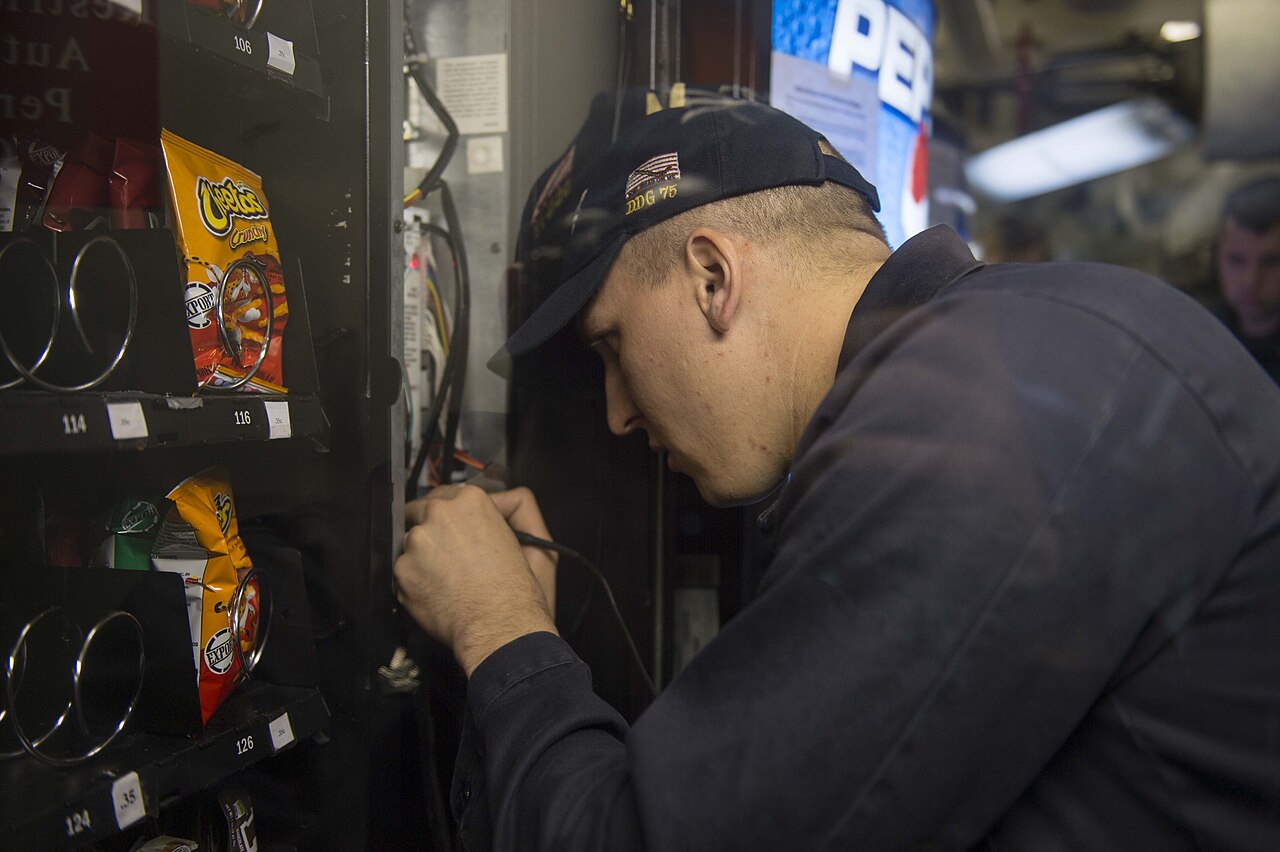
RS485 Lock Control Hex Frames & HMAC-SHA256 Signed MQTT VietQR Activation Payload
So that your Android Kiosk, Mobile App, and Backend developers can integrate with DeviceLab's Smart Locker and Vending controller boards within a single afternoon, our communication protocol uses deterministic CRC16-Modbus error checking alongside cryptographic transaction idempotency (tx_id + hmac_sha256):
// 1. RS485 Command Frame from Android Touch PC / Master Gateway to Slave Lock Board (Slave ID = 0x01)
// Command: Unlock Compartment #05 (Pulse duration: 400ms = 0x04 x 100ms):
// TX Hex: [AA] [01] [A1] [05] [04] [D8 7B]
//          Hdr  ID   Cmd  Box  Time CRC16-Modbus
// RX Status Response after latch release verification (Door #05 confirmed popped OPEN):
// RX Hex: [55] [01] [A1] [05] [01] [00] [E4 29]

// 2. Cryptographically Signed MQTT JSON Command from Cloud Backend upon VietQR Webhook Confirmation:
// Topic: smart-kiosk/vending-hn-042/command/dispense
{
  "cmd": "DISPENSE_OR_UNLOCK",
  "tx_id": "VQR_20261018_994812",
  "timestamp": 1792334400,
  "board_id": 1,
  "slot_number": 5,
  "pulse_ms": 400,
  "require_drop_sensor": true,
  "amount_vnd": 25000,
  "voice_prompt_id": 3,
  "hmac_sha256": "8f4b2e91c0d7a36e5b1290f48c71d2a9e305b6c84f1a2d3e4f5a6b7c8d9e0f1a"
}Classic Field Pitfalls: Power-Supply Brownout During Bulk Unlocking & Touchscreen Freezes from Inductive Back-EMF
When scaling a Smart Locker or Vending network from 1 pilot kiosk to 200 commercial locations, two insidious electrical failure modes routinely plague teams using generic off-the-shelf boards:
🔍 Root-Cause Electrical Analysis & DeviceLab's Production-Hardened Solutions:
- System-Wide Brownout Reset When Courier or Admin Taps "Unlock All Empty Doors": Each 12VDC solenoid lock draws an instantaneous inrush current of
2.0A. If the host software broadcasts a command to open 16 locker doors in the exact same millisecond, the combined current demand spikes to32A (384W), tripping the over-current protection (OCP) on a standard 12V-10A switch-mode power supply and causing both the Android touchscreen and controller board to black out! DeviceLab's Solution: The embedded firmware inside DeviceLab's RS485 Lock Controller implements an automatic Staggered Sequential Firing Queue. When a bulk-unlock command arrives, the board sequences the solenoid pulses350msapart—producing a smooth, reassuring "click... click... click" cascade down the locker bank while keeping peak 12V current strictly below2.5A. - Capacitive Touchscreen Freezing When Solenoid Locks or Refrigeration Compressors De-Energize: When an inductive 12V solenoid coil or 220VAC refrigeration compressor contactor opens, magnetic field collapse generates a reverse-voltage transient (Back-EMF reaching
-150V to -400V) that couples into shared power wiring and locks up the capacitive touch controller IC on the Android display. DeviceLab's Solution: We isolate the actuator power rail from the logic/HMI power rail and place ultra-fast Schottky flyback diodes and TVS clamps directly across every MOSFET output channel on the PCB.
Strategic Comparison: 3 Hardware Approaches for Smart Locker, Vending & Kiosk Chains
| Evaluation Criterion | Buying Off-the-Shelf Boards from Taobao / Alibaba | Using Industrial PLCs to Control Locker Banks / Kiosks | Custom OEM Controller Board R&D & PCBA with DeviceLab |
|---|---|---|---|
| API Protocol Ownership & Payment Cybersecurity | Tied to foreign cloud servers or poorly translated documentation; high risk of vendor lock-in | Open Modbus registers, but lacks native MDB, dynamic VietQR, or hardware solenoid pulse cutoff | 100% ownership of RS485 & MQTT JSON protocols; connects directly to your private cloud in Vietnam |
| Hardware Cost & Supply Continuity Across 50–500 Kiosks | High risk of unannounced board revisions between batches, breaking wire harnesses and firmware | Prohibitively expensive ($500 – $1,000 USD in PLC + I/O bricks for a 48-door locker) | Optimized volume PCBA BOM cost with guaranteed long-term pinout compatibility and domestic warranty |
| Custom Feature Integration (Loadcell Weighing, EV Charging, UV Sterilization) | Impossible to modify hardware schematic or closed MCU firmware | Requires bulky, expensive add-on signal conditioning modules | Integrates custom sensors, audio voice prompts, and your brand logo onto a single purpose-built PCB |
Build a Bulletproof Hardware Foundation for Your Smart Locker, Vending & Kiosk Network
Developing a chain of Smart Parcel Lockers, Automated Vending Machines, EV Battery Swapping Cabinets, Unmanned Laundromats, or 4G VietQR Service Kiosks? Contact DeviceLab's embedded R&D engineering team today for architectural consultation, evaluation boards, and turnkey OEM/ODM mass-production pricing.
Field Engineering Frequently Asked Questions (Technical FAQ & B2B2B Partnership)
❓ What functional blocks make up the hardware architecture of an Automated Vending Machine, Smart Parcel Locker, or Self-Service QR Payment Kiosk?
A commercial-grade unattended terminal (Smart Parcel Locker, Vending Machine, EV Battery Swapping Cabinet, or Self-Service Kiosk) is engineered around a strict 2-tier split hardware architecture: (1) The HMI & Cashless Payment Host Layer—typically an industrial Android/Linux touch panel PC or a headless 4G LTE Cat-1 payment controller that renders dynamic VietQR codes, reads NFC/RFID cards, and communicates with cloud payment webhooks over MQTT TLS; and (2) The Real-Time Actuator & Lock Controller Layer connected via an isolated RS485/UART fieldbus—which directly drives 12V/24V electromagnetic solenoid locks, spiral dispensing motor matrices with stall-current sensing, 38kHz modulated infrared drop-sensor curtains, door micro-switch feedback inputs, refrigeration compressor relays, and anti-tamper vibration/tilt alarms.
❓ Why shouldn't a 32-compartment to 64-compartment Smart Locker wire all solenoid locks directly back to a single central board, and instead use Modular RS485 Slave Lock Controller Boards?
If you wire 48 individual locker compartments directly back to one central controller (where each solenoid lock requires 2 high-current 12VDC/2A coil wires, 2 door-latch feedback switch wires, and 3 infrared parcel-occupancy sensor wires), installers must route a massive harness of over 300 discrete wires down the sheet-metal cabinet columns—making factory assembly prohibitively expensive and field troubleshooting nearly impossible when a wire pinches. Instead, DeviceLab's modular architecture mounts compact 12/16/24-channel RS485 Slave Lock Controller Boards directly inside each locker column, daisy-chained via a single 4-conductor trunk cable (12V/24V Power + RS485 A+/B-). This allows operators to scale seamlessly from a 12-door locker to a 256-door parcel bank without changing the master controller.
❓ How does DeviceLab's lock controller board prevent 12V Solenoid Cabinet Locks from overheating and burning out if the Android HMI freezes?
Electromagnetic solenoid cabinet locks (12VDC / 1.5A–2.5A) are intermittent Pulse-Duty actuators: their low-resistance copper winding (~6Ω) is designed to be energized for only 200ms to 800ms to retract the spring latch. If energized continuously for more than 10 to 30 seconds because a software thread on an Android tablet hangs while holding a GPIO pin high, the solenoid coil overheats past 180°C, melts its enamel insulation, emits smoke, and shorts out the entire locker power supply! To eliminate 100% of coil burnout risk, DeviceLab's RS485 Lock Controller Board incorporates two independent safeguards: (1) A Hardware Monostable Pulse-Width Limiter circuit that physically cuts off the MOSFET gate after 500ms regardless of software state; and (2) A Staggered Sequential Firing Queue (spacing unlocks 350ms apart) whenever an administrator triggers 'Unlock All Doors', preventing power-supply brownout trips.
❓ How does Dynamic VietQR cashless payment activation work on vending machines, commercial massage chairs, unmanned laundromats, and EV charging kiosks?
When a customer selects a product or service tier on the machine, the system generates a dynamic EMVCo VietQR code embedding the exact transaction amount and a unique one-time Order ID on a crisp TFT LCD screen (or uses a unique static VietQR sticker per machine in headless laundromats). The instant the customer scans and confirms the bank transfer on any banking app, the payment gateway (PayOS, VietQR, Casso, SePay, or direct Bank API) fires an HTTPS Webhook to the operator's Backend Server within 1 to 2 seconds. The Backend immediately publishes an HMAC-SHA256 digitally signed MQTT JSON command to the 4G LTE module on the DeviceLab controller board, which verifies the cryptographic signature and transaction nonce before pulsing the MDB/Pulse coin line, energizing the power relay, or rotating the dispense motor.
❓ How does the Optical Drop Sensor on a vending machine controller board verify product delivery so customers are never charged for a jammed item?
In spiral-coil or conveyor-elevator vending machines, a motor may complete a full 360° rotation while a snack bag or beverage bottle remains caught on the coil wire without falling into the delivery chute. DeviceLab's Vending Controller Board drives a multi-beam 38kHz modulated infrared light curtain (Optical Drop Sensor array) across the delivery bin throat: the moment a dispense cycle starts, the MCU samples the IR receiver array at 1,000 Hz with automatic ambient-sunlight compensation. If no falling object breaks the infrared beam within 3.0 seconds after motor rotation stops, the controller automatically jogs the coil an extra quarter-turn; if the item still fails to drop, it flags that slot as 'Out-of-Order' and sends a `DELIVERY_FAILED` MQTT event to the server to trigger an instant refund or voucher code.
❓ What hardware products and R&D services does DeviceLab provide to Smart Locker startups, vending operators, EV battery-swapping networks, and kiosk manufacturers?
DeviceLab serves as the dedicated Make-in-Vietnam OEM/ODM Hardware R&D and PCBA Manufacturing partner behind self-service kiosk and locker networks. We supply field-proven 16/24-channel RS485 Smart Locker Controller Boards and 4G LTE VietQR Payment Activation Boards (supporting MDB, Pulse, RS485, and high-current relay outputs), and we execute full custom PCB + Firmware + Mechanical Enclosure design tailored to your proprietary kiosk architecture. Every board ships with complete, open English/Vietnamese SDK documentation (RS485 Hex Frames & MQTT JSON APIs) so your mobile/web software team can integrate within 48 hours.
Related Technical Articles & Engineering Guides
Deepen your engineering knowledge with practical guides from DeviceLab engineers:



Recommended Industrial IoT Hardware & OEM Solutions
Standardized industrial-grade devices engineered and mass-produced by DeviceLab Vietnam:
Need custom hardware design or embedded device engineering?
You do not need a complete schematic. Describe your functional specifications, target application, and power/size/connectivity constraints.
DeviceLab helps define engineering scope from architecture to functional prototype.