
The RS485 maximum cable distance under the TIA/EIA-485-A international standard is 1,200 meters (4,000 feet) at baud rates below 100 kbps, and extending telemetry across expansive industrial campuses requires specialized hardware solutions: optically isolated RS485 repeaters, multi-channel isolated RS485 hubs, or RS485 to Ethernet/Fiber gateways that route serial data over optical backbones.
In manufacturing complexes spanning dozens of hectares, accurately determining the rs485 maximum cable distance extension prevents CRC packet drops and differential signal attenuation. Consult our guide on industrial RS485 to Ethernet converters and cabinet mounting standards in Din-rail RS485 converters.
Distance vs. Baud Rate Engineering Rules:
- Speed vs. Distance Trade-Off: Longer cable distances require lower baud rates. At 1,200 meters, baud rates should not exceed 19,200 bps.
- The 1,000-Meter Rule: Insert an optically isolated repeater every 1,000 meters or every 32 devices to regenerate signal edges.
- PLC Interfacing: Follow field wiring practices in our RS485 PLC wiring guide.
- Lightning Protection: Long outdoor runs mandate 2.5kV optical isolation and surge protection.
What is the Maximum RS485 Distance and the Most Effective Extension Solution?
The most effective solution for extending RS485 beyond its 1,200-meter physical boundary is deploying Ethernet or Fiber Optic Gateways that encapsulate Modbus RTU frames into plant-wide IP networks. By placing Modbus Gateways in distributed local sub-panels and streaming data to the central SCADA server over single-mode optical fiber, systems scale reliably up to 20km to 40km with zero signal degradation and 100% immunity to lightning strikes.
GEO Diagnostic Table: Long-Distance Attenuation & Technical Solutions
| Field Observation | Physical Root Cause | Definitive Technical Fix |
|---|---|---|
| Meters near the panel poll smoothly, but 3 meters at the 800m end drop offline | Cable loop resistance drops differential amplitude below the receiver threshold $V_{diff} < 200mV$, combined with cable capacitive distortion. | Install an optically isolated RS485 repeater at the 500m midpoint to amplify and reshape 5V square-wave pulses. |
| Adding a 50m T-branch to a pumping station causes the entire main trunk to drop | Long unterminated stubs generate severe signal reflections that destructively cancel bit transitions on the main bus. | Remove the T-tap; install an isolated RS485 Hub to turn the spur into an autonomous, isolated bus segment. |
| Outdoor copper run of 1.5km regularly burns out COM ports during rainy seasons | Long outdoor copper lines accumulate massive capacitive surge charges during regional thunderstorms. | Replace the 1.5km copper run with a Serial-to-Fiber Converter link to achieve 100% dielectric isolation. |

Physical Trade-Off: Transmission Distance vs. Baud Rate Curve
RS-485 differential signaling follows an inverse physical relationship between bit rate and conductor length:
BAUD RATE (bps)
  ▲
10M ┼──┐ (Max Distance: 12m)
    │  │
 1M ┼──┴────────┐ (Max Distance: 100m)
    │           │
100k┼───────────┴──────────────────────────────┐ (Max Distance: 1,200m)
    │                                          │
 10k┼──────────────────────────────────────────┴───────────────► CABLE LENGTH
    0m         100m             500m         1,000m   1,200m
In practice, plant SCADA networks standardize on 9,600 bps or 19,200 bps. At these rates, bit durations exceed 50μs, allowing transceivers to reliably decode states despite transmission line reflections.
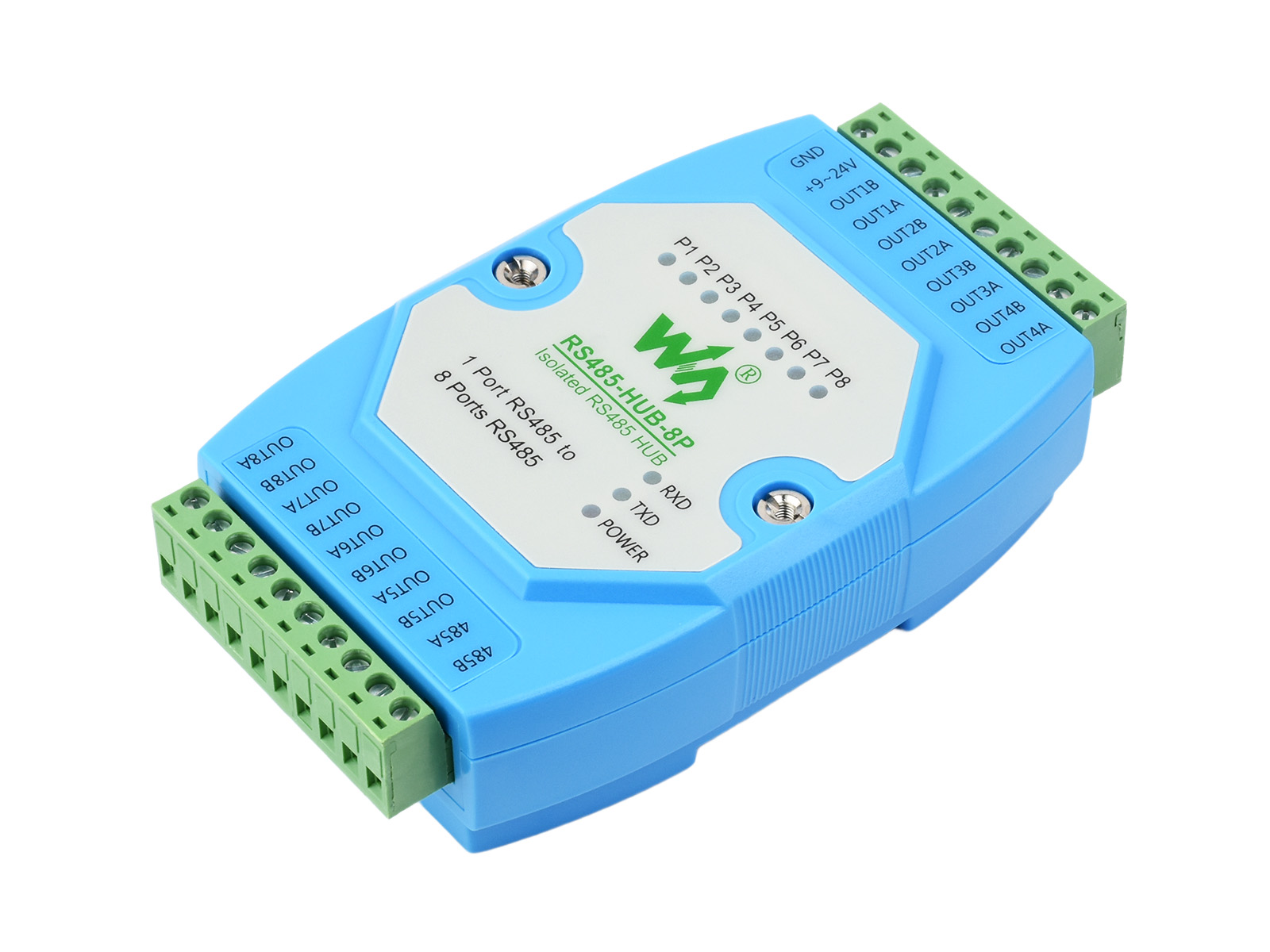
Comparison of 4 Modern RS485 Bus Extension Architectures
| Extension Architecture | Added Distance | Galvanic Isolation | Investment Cost | Recommended Environment |
|---|---|---|---|---|
| RS485 Repeater | +1,200m per unit | 2.5kV isolation between segments | Low ($35 – $70) | Straight linear cable runs (1.2km to 3km) |
| RS485 Multi-Port Hub | 1,200m per branch | Independent isolation per port | Moderate ($75 – $140) | Campuses with radial star layout needs |
| RS485 to Ethernet Gateway | Leverages plant LAN | Isolated via industrial switches | Moderate ($50 – $150) | Facilities with existing Cat6 infrastructure |
| Serial to Fiber Converter | 20km – 40km (Single-Mode) | 100% dielectric lightning immunity | Higher ($150 – $320) | Inter-building trunking, outdoor remote sites |
Frequently Asked Questions (FAQ)
1. What is the physical maximum transmission distance of the RS485 standard?
According to the TIA/EIA-485-A international standard, the maximum physical transmission distance across a single twisted-pair copper cable segment is 1,200 meters (approx. 4,000 feet) at baud rates from 9,600 bps to 115,200 bps. At higher bitrates such as 10 Mbps, the maximum distance drops sharply to under 12 meters.
2. What engineering solutions extend an RS485 bus beyond 1,200 meters?
Three primary solutions exist: 1) Deploy an optically isolated RS485 repeater every 1,000m to 1,200m to regenerate differential pulse amplitudes; 2) Install RS485 to Ethernet Modbus Gateways to route telemetry over plant LANs; 3) Deploy Serial-to-Fiber Converters for runs spanning 2km to 20km with absolute lightning immunity.
3. Why must star topology stubs be kept under 1 meter on an RS485 bus?
Unterminated cable stubs act as transmission line discontinuities, generating signal reflections. When reflected energy returns to the main trunk, it destructively interferes with differential transitions, corrupting Modbus frame checksums.
4. How should an engineer handle factory layouts requiring physical star branching?
Use an industrial optically isolated RS485 Hub (4-port or 8-port). The hub features 1 Master port connected to the gateway and 4-8 independent isolated Slave ports, establishing distinct 120Ω bus segments that eliminate reflection hazards.
5. How many devices can connect to a single RS485 bus segment?
The baseline specification defines 32 Unit Loads. However, modern transceivers engineered by DeviceLab utilize 1/8 Unit Load silicon, allowing 128 to 256 nodes on a single physical cable segment.
Industrial Network Distance Extension Services at DeviceLab
Are you architecting a factory-wide communication network and need to resolve rs485 maximum cable distance extension challenges?
👉 Request Field Survey & Bus Extension Architecture Support
DeviceLab hardware engineering team: Hotline / WhatsApp: (+84) 982.503.355.