
Collecting cycle time and production output from CNC machine tools and mechanical stamping presses is accomplished by mounting rugged inductive proximity sensors (M12/M18 IP69K) to detect top dead center (TDC) of the mechanical press crankshaft, coupled with a 20G shock-resistant mounting bracket, 1.6kHz RC low-pass hardware filter, and 5kHz optical isolation; for CNC milling and turning centers, capturing 24VDC Andon tower relays (Run/Alarm/Stop) and M02/M30 end-of-program signals fed into an Industrial IoT Gateway to calculate cycle times, count actual production, and isolate OEE downtime causes in real time.
Metal fabrication, automotive stamping, and precision machining job shops face fierce margin pressures. However, shop floors commonly struggle with a chronic blind spot: machine operators estimating production figures on end-of-shift paper slips. On mechanical stamping presses, micro-rebounds and vibration rattle standard sensors to pieces, while manual die adjustments register phantom parts. On CNC milling and turning centers, machines cycle their spindles in rapid traverse "air cuts" without touching raw stock, misleading supervisors into assuming high productivity. This guide details the engineering methods for ruggedizing sensor hardware against 20G press shock, decoding CNC operating states, and automating real-time OEE telemetry.
CNC & Press Machinery Telemetry Takeaways:
- Mechanical Press Stamping Pulse: Inductive sensor monitors crankshaft Top Dead Center (TDC) with 20G shock-rated steel bracket.
- False Count Elimination: Hardware RC filter (1.6kHz) and firmware blanking dead-time (1.2s - 2.5s) eliminate double-counting from mechanical bounce.
- CNC Cycle Time Capture: Non-invasive capture of 24VDC Andon relays and M02/M30 program finish signals via high-speed optocouplers.
- Air-Cut vs. Cutting Load: Current transformer (CT) thresholding differentiates rapid traverse (G00) from active metal cutting (G01/G02/G03).
- Non-Volatile Event Logging: Integrated FRAM/Flash ensures zero count loss during plant-wide emergency stops or breaker trips.
Engineering Sensor Hardening for 20G Mechanical Press Vibration
Mechanical stamping presses (from 45-ton C-frame to 500-ton link-motion presses) generate devastating mechanical shock waves each time the die pierces steel plate. Conventional commercial proximity sensors fail within 2-4 weeks due to internal ferrite core cracking, wire fatigue, or thread loosening. The DeviceLab ruggedization standard specifies:
- Sensor Selection: Omron E2B or Autonics PRD series M12/M18 with stainless steel / nickel-plated brass body rated IP67/IP69K, flush-mountable with a 4mm to 8mm sensing distance.
- Mechanical Bracket Isolation: Heavy 6mm steel L-bracket anchored to the press frame using high-tensile Grade 8.8 bolts secured with Loctite 243 threadlocker and Nord-Lock wedge-locking washers.
- Cabling & Conduit: Oil-resistant polyurethane (PUR) robotic high-flex cable routed through metallic flexible conduit to withstand flying metal stampings and hydraulic lubricant immersion.
- Top Dead Center (TDC) Cam Alignment: Mount the sensor to detect a dedicated steel target flag attached to the main crankshaft. Sensing at TDC ensures the pulse triggers precisely as the ram completes its stroke and returns to top rest.

CNC Operating State Decomposition: Isolating Air-Cuts from Real Machining
A chronic challenge in CNC machining facilities is "air-cutting"—operators running dry programs without clamping raw billets, or running feed rates at 10% override to stretch out shifts. DeviceLab implements a dual-layer non-invasive classification architecture:
- Layer 1 — Machine State via Andon Tower (24VDC):
- Green ON, Yellow OFF, Red OFF = Auto Run Mode.
- Green OFF, Yellow ON, Red OFF = Setup / Part Loading / Tool Touch-off.
- Red ON = Spindle Alarm / Emergency Stop.
- Layer 2 — Active Cutting via Spindle Motor Current Transformer (CT):
A split-core CT monitors the spindle inverter output line. During G00 rapid positioning, the motor draws baseline unloaded power ($P < 1.5 ext{kW}$). The instant the cutting tool bites into steel ($G01/G02/G03$), spindle current surges ($P > 3.8 ext{kW}$). The gateway flags "True Machining Time" only when both Green Light is ON AND spindle current exceeds cutting threshold.
Field Problem Solving: 6 Machine Telemetry Issues and Resolutions
| Telemetry Problem Encountered | Field Mechanical / Electrical Root Cause | DeviceLab Gateway Engineering Solution |
|---|---|---|
| Double stroke counted on single press cycle | Ram micro-rebound at bottom dead center shaking the sensor bracket across the sensing threshold twice. | Engage firmware Blanking Window (1,200ms - 2,500ms): ignore all secondary transitions until press completes full revolution. |
| False triggers from flying chips or coolant spray | Metal swarf accumulating on inductive sensor face, creating magnetic bridge. | Switch to Teflon-coated spatter-resistant sensor face; align sensor horizontally so chips fall away naturally. |
| Operator "fiddling" counts by waving wrenches past sensor | Operator deliberately triggering sensor to inflate shift production output. | Cross-validate with main flywheel motor current: reject pulses if main flywheel motor is de-energized or in inching mode. |
| Counts lost during power switchover or breaker trip | Internal volatile RAM counters zeroed out when control cabinet power dropped. | Store cycle totals every 100ms inside Ferroelectric RAM (FRAM) featuring infinite write endurance and instant non-volatile retention. |
| High-frequency noise from CNC spindle VFD corrupting pulses | PWM carrier frequency (8kHz - 16kHz) from spindle drive coupling into signal wiring. | Deploy 5kHz high-speed optocoupler combined with 1.6kHz hardware low-pass RC filter and shielded Cat6 STP conduit. |
| Parts stamped without strip feeding (die dry firing) | Feeder ran out of coil stock but press continued cycling in automated mode. | Integrate strip end-of-stock limit switch or optical part ejection beam into gateway secondary validation input. |
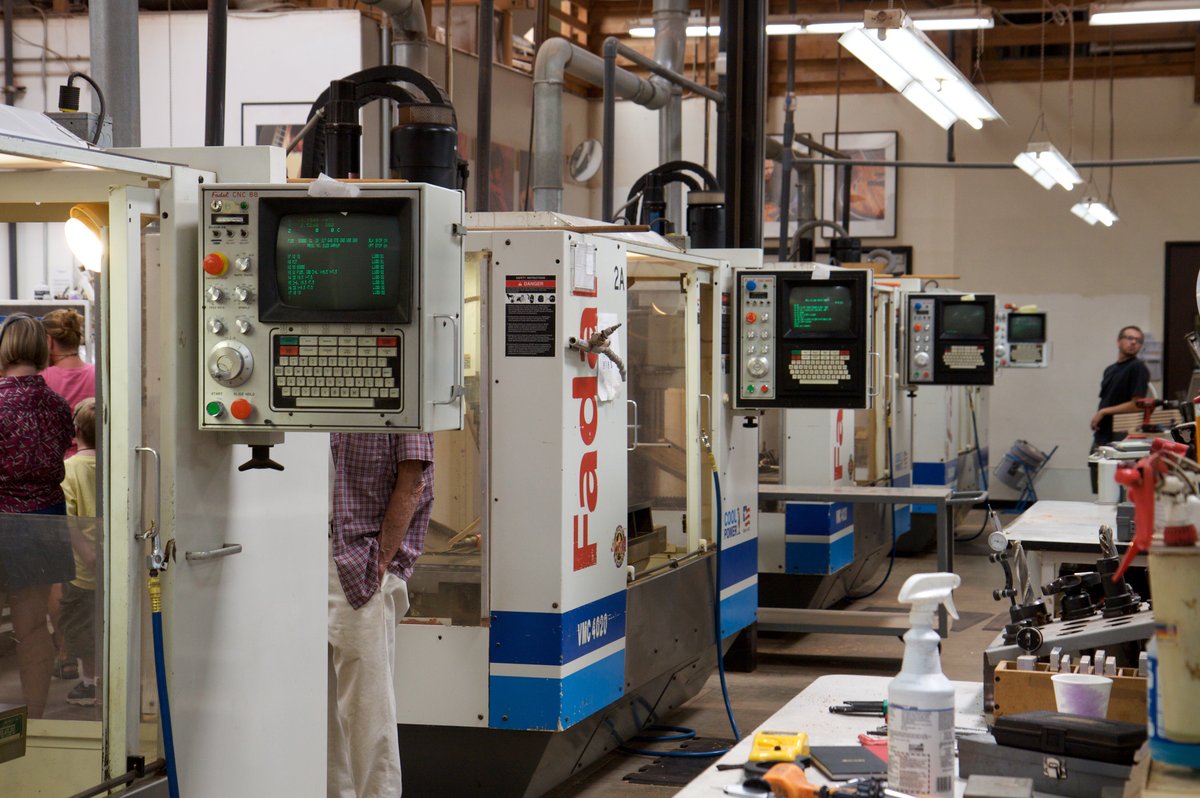
Shop Floor Case Study: 24 CNCs and 12 Presses at Khai Quang (Vinh Phuc)
The Plant: A tier-1 motorcycle precision component supplier in Khai Quang Industrial Park operated 24 CNC milling/turning centers (Fanuc, Brother, Mazak) and 12 mechanical stamping presses (80 to 250 tons, Komatsu and AIDA).
The Challenge: Plant management struggled with erratic daily output. Operators blamed die breakdowns and material hardness, while maintenance claimed machines were idling unnecessarily. Production records were hand-written hours after shifts ended.
DeviceLab Retrofit Deployment:
- Equipped all 12 presses with TDC inductive sensors mounted on 6mm steel brackets, paired with 2.5s blanking dead-time filters.
- Fitted 24 CNCs with non-invasive 24V Andon optocouplers and split-core spindle current transformers to isolate active cutting time.
- Deployed DeviceLab DL-EDGE-485 gateways connected to shop-floor Wi-Fi/Ethernet pushing real-time cycle times, counts, and OEE to a central production board.
Measured Transformation: The system exposed that CNC spindle utilization was actually hovering at just 41.8%, with machines waiting an average of 46 minutes for tool replacement and raw billet staging. With real-time bottleneck alerts, overall shop-floor OEE surged by 22.1%, boosting monthly output by 18,500 finished parts without investing in a single new CNC machine.
Request Machine Telemetry Assessment & PoC Pilot
DeviceLab provides end-to-end hardware retrofits, heavy-duty sensor packages, and cloud/edge MES dashboards for metal stamping and precision machining workshops:
- Hotline / Zalo: 0982.503.355
- Technical Email: hi@devicelab.vn
- R&D Laboratory: DeviceLab Industrial Machine Telemetry Group, Hanoi & HCMC, Vietnam.