
Extracting Run/Stop status and production output from injection molding machines without digital communication ports is accomplished through non-invasive signal acquisition: Utilizing a 2.5kV optically isolated optocoupler circuit to capture mold open limit switch or clamping relay contacts, combined with a split-core current transformer (CT) to verify hydraulic pump load and reading the 24VDC 3-color Andon tower light into an Industrial IoT Gateway to automatically calculate cycle time, count shots, and measure real-time OEE without modifying or compromising the machine's OEM PLC.
Across automotive, consumer electronics, and plastics manufacturing hubs in Vietnam and Southeast Asia, over 60% of active injection molding machines (Haitian, Nissei, JSW, Sumitomo, Toyo, Chen Hsong) were built prior to 2018. While their mechanical toggles and hydraulic systems remain exceptionally robust, their control systems represent legacy generations: lacking factory Ethernet LAN ports, without Euromap 63 or Euromap 77 digitalization protocols, and with OEM retrofit kits commanding thousands of dollars per machine. Plant managers have remained dependent on manual paper logs, resulting in delayed production data, untracked micro-stoppages, and inaccurate overall equipment effectiveness (OEE). This guide outlines the non-invasive retrofitting methodology engineered and validated by DeviceLab across hundreds of operational machines.
Non-Invasive Injection Molding Acquisition Takeaways:
- 100% Non-Invasive Safety: Zero modification to OEM PLC code, zero intrusion on safety interlocks, 100% machine warranty preservation.
- Primary Shot Pulse Signal: Captured from Mold Open limit switches or hydraulic clamping solenoid valves via 2.5kV optocouplers.
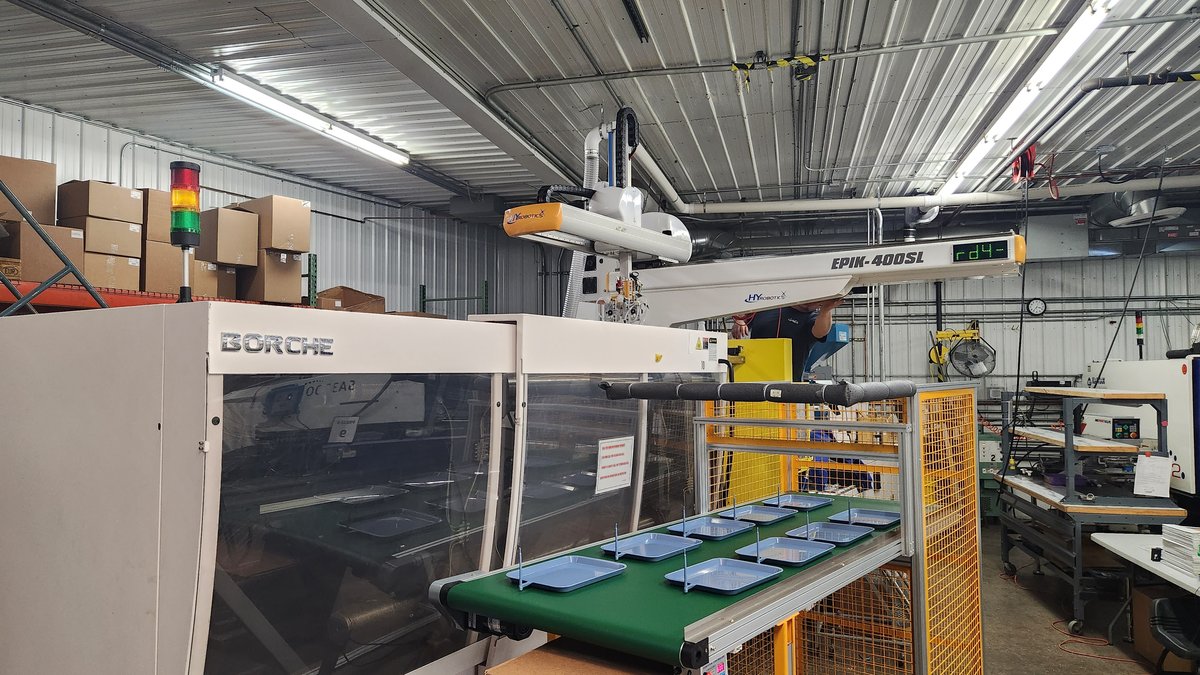
- Operational State Verification: Read directly from the 24VDC 3-color Andon tower light (Green: Auto Run, Amber: Mold Warm-up/Idle, Red: Alarm).
- Hardware-Level Anti-Bounce: Integrated 300ms software debounce and 2.5-second dead-time blanking to eliminate false double-shots.
- Edge-Computed Telemetry: Automatic edge calculation of ISO 22400 OEE, per-shot cycle time, and production counts sent to MES dashboards.
Field Diagnostic Matrix: 6 Injection Molding Data Anomalies and Remedies
| Observed Field Anomaly | Underlying Electrical & Mechanical Cause | DeviceLab Gateway Engineering Solution |
|---|---|---|
| Shot count jumps 2x to 3x higher than actual parts dropped | Mechanical contact bounce from the hydraulic mold limit switch vibrating violently upon opening under 300-ton clamping force. | Engage an edge-level Dead-Time Blanking filter (1,500ms - 3,000ms): gateway ignores all subsequent DI transitions for 3s after initial valid edge. |
| False production counts recorded when technicians manually jog mold open/close | Extracting the mold limit switch in isolation without verifying overall machine operating state. | Multi-condition interlocking logic: Count shots ONLY when Green Andon (Auto Mode) is ON AND hydraulic pump current exceeds idle threshold. |
| Pulse drops or missing counts when neighboring granulators or dryers start | High-voltage inductive switching noise (EMI) from 15kW plastic granulator motors inducing ground noise into signal wiring. | Deploy shielded twisted-pair (STP) cable with shield grounded at panel star-point only; use 2.5kV galvanically isolated digital inputs. |
| Cycle Time on dashboard fluctuates erratically (e.g., 22s then 4s then 40s) | Wi-Fi packet latency jitter or slow SCADA polling cycles (> 2s) distorting server-side timestamp calculations. | Calculate cycle time locally on gateway via 32-bit hardware timer interrupt (1ms precision); transmit computed value rather than raw pulses. |
| Machine stops for maintenance but dashboard continues reporting "Active Run" | Only measuring main breaker power; machine main motor remains energized while operator waits for resin drying. | Combine Andon Yellow lamp sensing with 3-phase split-core CT: differentiate motor idle ($P < 4 ext{kW}$) from active injection ($P > 18 ext{kW}$). |
| Production data gaps occur during plant lunch breaks or shift changes | IT network switch resets or plant Wi-Fi dropouts during shift turnover. | Non-volatile Flash memory (Store-and-Forward) caches up to 60,000 timestamped cycles; auto-syncs with MES upon network reconnection. |
Hardware Circuit Architecture: Optocoupler Isolation & Signal Conditioning
A non-invasive signal acquisition circuit utilizes a high-speed optocoupler (PC817 or TLP281) with 2,500Vrms dielectric isolation, paired with a hardware RC low-pass filter ($R = 10 ext{k}Omega, C = 100 ext{nF}$, time constant $ au = 1 ext{ms}$) and a reverse clamp diode to suppress inductive flyback spikes from hydraulic solenoid valves.
When tapping into a 24VDC mold-open limit switch or hydraulic directional valve relay, the primary hazard is inductive kickback: collapsing magnetic fields across valve coils can generate negative voltage spikes exceeding -150V. Without isolation, these transients will destroy the microcontroller I/O pins within hours. The DeviceLab non-invasive input circuit comprises:
- Optical Barrier: 2.5kV optocoupler separates machine 24VDC control power completely from the Gateway's internal 3.3V logic supply.
- RC Low-Pass Filter: Filters out high-frequency EMI noise spikes (> 1kHz) generated by nearby servo drives and heater contactors.
- Schottky Clamping Diode: Clamps reverse inductive spikes to -0.3V, safeguarding the optocoupler's internal infrared LED.
- Split-Core Current Transformer (CT): Clipped over the main 3-phase pump feeder without disconnecting power cables, delivering 0-5A or 4-20mA signals proportional to instantaneous hydraulic pressure.
Finite State Machine (FSM): 5-State Machine Cycle Decomposition
To deliver true industrial visibility, the gateway firmware executes a deterministic 5-phase Finite State Machine (FSM) sampled at 100Hz:
- STATE 0: IDLE (Power On / Standby): Main power ON, hydraulic pump running at idle ($I < I_{threshold}$), Green Andon OFF, Yellow Andon ON. Shot counter frozen.
- STATE 1: CLAMPING (Mold Closing): Clamping relay energizes, hydraulic pressure rises. FSM initiates cycle timer $T_0$.
- STATE 2: INJECTION & COOLING: Screw motor injects molten plastic, holding pressure applied, cooling countdown active. Green Andon steady ON.
- STATE 3: MOLD OPEN (Part Ejection): Mold open limit switch triggers valid pulse ($T_{pulse} > 300 ext{ms}$). Edge counter increments shot total by +1. Cycle time recorded as $T_{cycle} = T_{now} - T_0$.
- STATE 4: UNPLANNED DOWNTIME / ALARM: Red Andon illuminates or safety gate opens mid-cycle. FSM flags downtime state, logging exact start timestamp.
Real-Time OEE Mathematical Modeling under ISO 22400
The gateway computes Overall Equipment Effectiveness (OEE) locally in accordance with international standard ISO 22400:
$OEE = Availability imes Performance imes Quality$
- Availability (A): $A = rac{ ext{Operating Time}}{ ext{Planned Production Time}} = rac{T_{planned} - T_{downtime}}{T_{planned}}$. Unplanned downtime ($T_{downtime}$) is tracked automatically down to the second whenever the Red Andon is active or machine enters unapproved idle.
- Performance (P): $P = rac{ ext{Ideal Cycle Time} imes ext{Total Shots}}{ ext{Operating Time}}$. Directly reveals operator micro-delays in manual part removal.
- Quality (Q): $Q = rac{ ext{Good Shots}}{ ext{Total Shots}} = rac{ ext{Total Shots} - ext{Defect Shots}}{ ext{Total Shots}}$. Defect shots are captured via an operator tactile reject push-button mounted at the machine station.
Factory Case Study: 32 Haitian & Nissei Machines at Tan Duc (Long An)
Baseline Situation: A major precision plastic components factory in Tan Duc Industrial Park operated 32 hydraulic and all-electric injection molding machines (120 to 450 tons). Operators hand-wrote hourly production on paper clipboards. Actual factory OEE was estimated at 75%, but customer delivery delays were mounting.
DeviceLab Retrofit Implementation:
- Installed 32 DeviceLab DL-EDGE-485 gateways connected to mold-open limit switches via 2.5kV optocouplers and 24V Andon towers.
- Configured 300ms software debounce and 2.5s dead-time blanking; integrated local cycle time calculation.
- Streamed JSON production and OEE telemetry over MQTT to a centralized web-based factory dashboard and TV status display.
Discovered Bottlenecks & Results: Real baseline OEE was revealed to be only 64.2% (not 75%). Over 4.2 hours of daily lost production stemmed from unrecorded resin hopper starvation and sluggish manual mold changeovers. Within 60 days of real-time visibility, the plant optimized mold change procedures, raising factory OEE to 82.6% (+18.4% improvement) and delivering a complete capital payback in just 3.1 months.
Schedule On-Site Injection Molding Telemetry Pilot
DeviceLab provides complete hardware, sensor retrofit kits, and cloud/local dashboard software for plastics manufacturing plants. Contact our automation team for an on-site technical assessment:
- Hotline / Zalo: 0982.503.355
- Technical Email: hi@devicelab.vn
- Engineering Hub: DeviceLab Factory Telemetry Lab, Hanoi & HCMC, Vietnam.