
A technical comparison of Commercial Off-The-Shelf (COTS) gateways (Moxa, USR-IOT, 3Onedata) versus custom project-tailored gateways reveals: COTS units are optimal for small-scale deployments (under 15 points) requiring 1 to 2-day rapid commissioning with standard Modbus protocols; whereas custom project gateways deliver decisive advantages for 30+ points through multi-threaded edge processing, proprietary protocol parsing, non-volatile flash data buffering, and a 35% to 55% reduction in overall hardware cost per node.
When structuring Industrial IoT (IIoT), smart factory telemetry, or building management systems (BMS), project managers and automation leads face a fundamental dilemma: purchase pre-packaged commercial gateways from established brands (Moxa NPort/MGate, Advantech, USR-IOT) or partner with an embedded R&D lab like DeviceLab to develop a tailored gateway hardware and firmware architecture. An uninformed decision can lead either to massive budget overruns on repetitive licenses and redundant features, or project failure caused by generic COTS gateways lacking custom protocol conversion and local data storage. This article delivers a rigorous 15-criteria evaluation, architectural circuit analyses, and a 5-year TCO model to guide your engineering roadmap.
Core Strategic Architecture Takeaways:
- Small Pilot Deployments (< 15 Nodes): Choose COTS gateways for immediate off-the-shelf availability and rapid standard Modbus-to-TCP bridging.
- Scale Rollouts (≥ 30 Nodes): Choose Custom Gateways to save 35%-55% on unit BOM, eliminate recurring software licenses, and tailor exact I/O interfaces.
- Proprietary Legacy Machinery: Custom gateways allow embedding proprietary binary decoders directly into edge firmware, bypassing costly PLC upgrades.
- Critical Network Resilience: Custom designs integrate hardware brownout supercapacitors and non-volatile Flash memory for zero data loss during power dips.
- Total Supply Chain Autonomy: Custom hardware shields integrators from international brand stockouts, sudden end-of-life (EOL) notices, and distributor markups.
15-Criteria Engineering Matrix: COTS Gateways vs. Custom Project Gateways
| Evaluation Dimension | COTS Gateways (Moxa, Advantech) | Budget COTS Gateways (USR, Waveshare) | DeviceLab Custom Project Gateways |
|---|---|---|---|
| Average Unit Cost | High ($120 – $280 / node) | Low ($18 – $35 / node) | Optimized ($45 – $75 / node) |
| Lead Time for 1-5 Units | Immediate (In stock at distributors) | Immediate (Off-the-shelf retail) | 3 - 7 days (Pre-tested demo boards) |
| Lead Time for 100-500 Units | 8 to 16 weeks (Global supply chain risk) | 3 to 6 weeks | 2 to 4 weeks (Direct local SMT lines) |
| Proprietary Protocol Parsing | No (Only standard Modbus/BACnet) | No (Transparent serial pass-through only) | 100% Customized (Embedded C/C++ parser) |
| Local Edge Computing (FSM) | Limited to expensive edge IPC tiers | None | Yes (Real-time OEE, cycle time filtering) |
| Flash Buffering (Power/LAN Loss) | Only on high-end models ($200+) | None (Packets dropped immediately) | Yes (16MB - 64MB SPI NOR/NAND Flash) |
| Hardware Watchdog Timer | Internal MCU Watchdog only | Internal MCU Watchdog or none | Dedicated External TI TPS3823 Watchdog |
| Power Brownout Protection | Standard electrolytic capacitor (~10ms) | Minimal bulk capacitance (< 5ms) | Supercapacitor Hold-Up Circuit (> 350ms) |
| Enclosure & Connector Form Factor | Fixed dimensions, standard Phoenix screw | Fixed plastic/sheet metal | Custom enclosure, M12 or spring clamps |
| FOTA Dual-Partition Rollback | Proprietary closed firmware | Single partition (High bricking risk) | A/B Dual-Partition Fail-Safe FOTA |
| Cloud Platform Integration | Requires third-party broker or edge software | Basic TCP/UDP client only | Direct native MQTT / AWS IoT / ThingsBoard |
| Brand Labeling & White-Label | Impossible (Moxa/Advantech branding) | Generic or brand imprint | Full Laser Engraving / SI Branding |
| IEC 62443 OT Cybersecurity | Compliant on premium flagship models | Non-compliant (Default weak passwords) | Hardened (Encrypted TLS 1.3, Secure Boot) |
| Firmware Source Code Ownership | Zero (Proprietary black-box) | Zero | Full Ownership or Co-development Rights |
| Long-Term Lifecycle Support | Subject to vendor EOL roadmaps | High chip substitution turnover | Guaranteed 7-10 Year Component Life |

Deep Circuit Architecture: 3 Hardware Modules That Set Custom Gateways Apart
1. External Hardware Watchdog Timer (TI TPS3823) vs. Internal MCU Watchdog
Most commercial gateways rely strictly on the internal watchdog timer peripheral of their internal processor. If a severe software memory deadlock, bus lockup, or power rail dip freezes the crystal oscillator or enters an infinite hard fault loop, the internal watchdog can fail to assert a reset. DeviceLab custom gateways incorporate a dedicated external supervisory circuit (Texas Instruments TPS3823). The MCU must pulse a dedicated WDI (Watchdog Input) pin every 1.6 seconds. If the firmware stalls for even 1.6 seconds, the TPS3823 asserts a hard physical power reset to the MCU Reset line, ensuring 100% self-healing reliability in unmanned substations.
2. Supercapacitor Power Brownout Hold-Up Circuit (2.7V 3F)
During sudden plant-wide power dips, line voltage sags from 24VDC down to 6VDC before recovering. Generic gateways reset immediately, corrupting active Flash write operations. DeviceLab integrates an onboard supercapacitor array and buck-boost power supervisor that provides 350 to 500 milliseconds of clean 3.3V power after total input loss. This window is ample for the firmware to execute an emergency interrupt, flush memory buffers to non-volatile Flash, and shut down cleanly.
3. A/B Dual-Partition Fail-Safe FOTA Firmware Updates
Over-the-Air (FOTA) firmware upgrades in remote industrial sites carry the catastrophic risk of bricking devices if network connectivity drops mid-transmission. DeviceLab implements an A/B dual flash partition architecture: incoming firmware writes to the inactive Partition B while Partition A runs normally. The bootloader performs SHA-256 integrity and digital signature checks. Only upon successful verification does the boot flag flip. If Partition B fails to boot cleanly, the system automatically rolls back to Partition A within 3 seconds.
5-Year Mathematical TCO Model: When Does Custom Engineering Break Even?
The total lifecycle cost can be modeled mathematically as:
$TCO_{COTS} = N imes P_{COTS} + N imes C_{lic} + OPEX_{field}$
$TCO_{Custom} = N imes P_{custom} + C_{NRE} + OPEX_{custom}$
Where $N$ is the number of deployed nodes, $P$ is unit hardware cost, $C_{lic}$ is recurring cloud/driver licensing, $C_{NRE}$ is one-time Non-Recurring Engineering for hardware/firmware design, and $OPEX$ is annual field maintenance.
For a project with $N = 50$ monitoring nodes:
- COTS Option (Moxa MGate): $50 imes $190 + 50 imes $0 + $4,500 ext{ (field trips)} = $14,000$.
- DeviceLab Custom Gateway: $50 imes $65 + $2,200 ext{ (one-time NRE)} + $500 = $5,950$.
- Net Project Savings: $8,050 (over 57% total savings!). The financial break-even point occurs at just 24 deployed nodes.
Field Case Study: 120-Machine CNC & Stamping Telemetry at Quang Chau (Bac Giang)
The Challenge: A tier-1 automotive metal parts manufacturer operating 120 CNC machining centers and mechanical presses in Quang Chau Industrial Park needed real-time machine telemetry (Run/Stop, spindle load, cycle count). Generic COTS serial servers priced at $160/unit exceeded their budget ($19,200 hardware alone), lacked local cycle time calculation, and jammed the plant Wi-Fi with unparsed raw serial polling.
DeviceLab Engineering Solution:
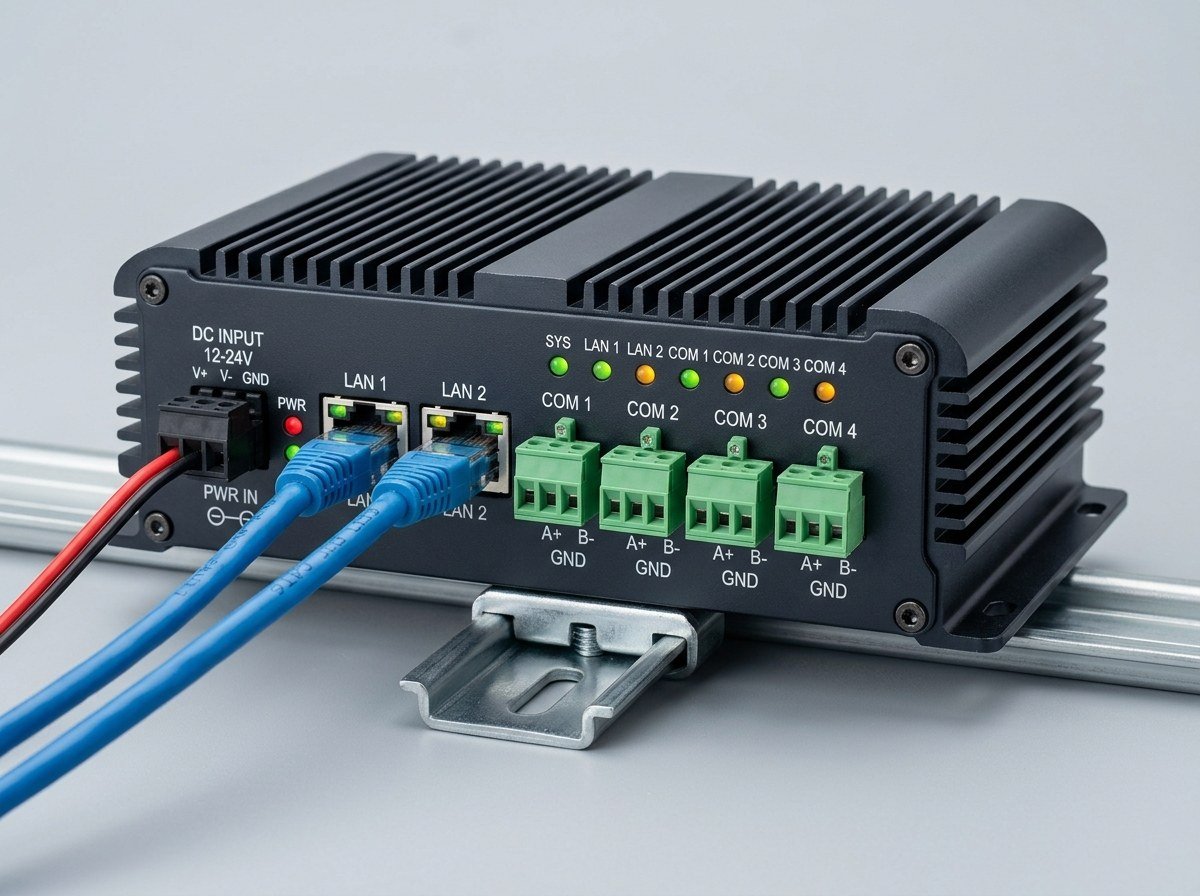
- Engineered a custom DIN-rail Edge Gateway equipped with 2 isolated RS485 ports, 4 isolated 24V digital inputs (DI), and an internal Cortex-M4 MCU.
- Programmed local Finite State Machine (FSM) firmware to compute cycle time and filter mechanical contact bounce right at the machine terminal.
- Packaged telemetry directly into compact JSON payloads transmitted via MQTT to the factory MES server every 5 seconds.
Measured Outcome: Hardware procurement costs dropped by $11,400. Network polling bandwidth was reduced by 85%. Real-time OEE visibility empowered the plant to recover 38 lost machine hours per week, achieving full capital payback in under 75 days.
Consult DeviceLab on Custom Gateway Hardware R&D
Whether you require a pilot batch of 20 customized gateways or volume production of 1,000+ units with private-label branding, DeviceLab delivers turnkey electronic hardware and firmware engineering:
- Hotline / Zalo: 0982.503.355
- Technical Email: hi@devicelab.vn
- Headquarters: DeviceLab Industrial Electronics R&D Lab, Hanoi & HCMC, Vietnam.